



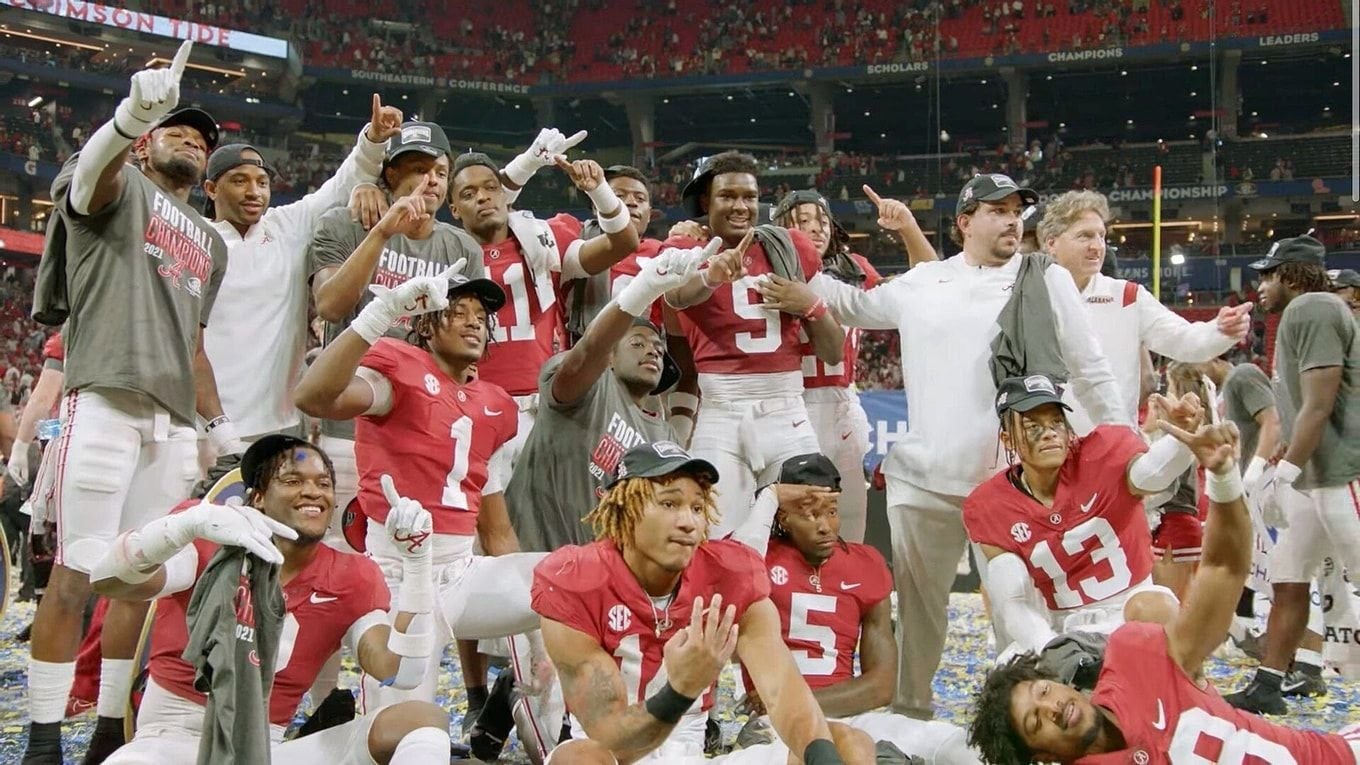

For thirty-two autumns between 1992 and 2023, sorting out championship weekend in the South took nothing sharper than the back of a cocktail napkin. Seven schools in the East played all six division neighbors, seven schools in the West did the exact same thing, and a head-to-head November winner could book hotel rooms near downtown Atlanta before leaving the locker room. Welcoming Texas and Oklahoma into a 16-team, divisionless SEC in 2024 blew that neat round-robin system sky high. Unbalanced schedules now force wild SEC tiebreaker math on the road to Atlanta because every program plays just eight conference games while skipping seven league rivals altogether.
What Are the SEC Tiebreaker Rules?
The divisionless 16-team SEC sends its top two teams by eight-game conference winning percentage to Atlanta, breaking ties sequentially through head-to-head results, record against all common opponents, record against highest-placed common opponents, cumulative conference opponent winning percentage, capped scoring margin, and a random draw.
ADVERTISEMENT
| Tiebreaker Step | SEC Rulebook Criterion | Two-Team Tie Application | Multi-Team Tie (3+ Schools) Application |
|---|---|---|---|
| Step 1 | Head-to-head competition among tied teams | Winner of the regular-season matchup advances | Requires full round-robin among all tied schools, or one team beating/losing to every other tied team |
| Step 2 | Record vs all common conference opponents | Higher combined winning percentage against shared SEC foes advances | Compares combined record vs SEC opponents played by every single tied school |
| Step 3 | Record vs highest-placed common SEC opponent | Best record vs top-ranked shared SEC foe descending down standings | Applied top-to-bottom down standings using only common foes played by all tied schools |
| Step 4 | Cumulative conference win % of all 8 SEC opponents | Higher combined SEC winning percentage across all 64 opponent league games | Ranks all tied teams by combined SEC record of their eight conference opponents |
| Step 5 | Capped relative total scoring margin in SEC games | Compares conference scoring formula capped at 42 offense and 48 defense per game | Separates remaining tied schools using the identical 42-offense / 48-defense cap formula |
| Step 6 | Random draw at SEC headquarters | Conducted by Commissioner Greg Sankey in Birmingham | Capsules drawn in Birmingham if tied to the final decimal after Step 5 |
Start with the schedule arithmetic that made Steps 4 and 5 household topics from Austin to Athens. Abolishing the East and West divisions in 2024 left 16 schools competing on one single table while keeping an eight-game conference slate. Each roster faces eight of its 15 possible league rivals and skips the other seven.
Only the top two teams in regular-season conference winning percentage earn tickets to Mercedes-Benz Stadium in Atlanta on the first Saturday of December. Non-conference wins or losses against ACC, Big Ten, or Big 12 foes mean zero in the league standings. Drop a Labor Day neutral-site opener and sweep your eight league dates, and you sit alone at 8-0 atop the SEC table.
How Multi-Team Ties Revert to Step 1 on the Road to Mercedes-Benz Stadium
One procedural rule governs every crowded November tiebreaker sheet. Multi-team steps exist to pare a crowd down rather than settle every slot in one pass. Whenever three or more teams tie for first place (to fill both spots in Atlanta) or tie for second place behind a solo #1 seed, the conference walks down Steps 1 through 6 in strict order until at least one school separates at the top to advance or drops off at the bottom.
Watch what happens the instant a four-team or three-team logjam shrinks down to two remaining contenders for one open berth. Everything stops and resets back to Step 1 of the two-team procedure. Why does that reset matter so much? Suppose Schools A, B, and C finish 6-2 behind an 8-0 #1 seed. School A beat School B in October, while School C played neither of them. Step 1 skips the trio because there was no round-robin and nobody went 2-0 or 0-2 against the group.
ADVERTISEMENT
Now suppose Step 4 (cumulative opponent conference win percentage) shows School A at .547, School B at .547, and School C trailing at .484. School C gets eliminated right there. Rather than pushing Schools A and B into Step 5 scoring margin, the league immediately reverts to two-team Step 1, sees that School A beat School B on the grass, and sends School A to Atlanta. Whenever three or more teams tie for first place, locking in the #1 seed sends all remaining tied schools right back to Step 1 from scratch to decide the #2 berth.
Steps 1 Through 3 and Why Common Opponents Vanish Fast
Two-team ties hit Step 1 first. If the Texas Longhorns and Oklahoma finish 7-1 and Texas won at the Cotton Bowl in October, Texas takes the higher seed. Done in five seconds.
Throw a third or fourth school into that same record bucket, and Step 1 hits a wall almost every November across modern college football. Under SEC multi-team rules, head-to-head results break a 3+ team tie in just two narrow cases: either all tied schools played each other in a complete round-robin, or one tied school beat every other tied team (advancing immediately) or lost to every other tied team (getting eliminated immediately). Partial head-to-head results get set aside until the group trims down to two.
Step 2 compares winning percentage against all common conference opponents. Every single school in the tie must have played an SEC rival for that rival to qualify as common. If two 6-2 contenders both played Kentucky, Vanderbilt, and Mississippi State, going 3-0 against that trio beats going 2-1.
ADVERTISEMENT
When tied contenders hold the exact same combined record against their shared foes, Step 3 walks down the SEC standings from #1 to #16 one rung at a time, comparing records against the highest-placed common conference opponent first (combining results whenever two reference opponents sit tied on the same rung). Beat the 7-1 common foe that tripped up your rival, and Step 3 punches your ticket. Yet in a 16-team league playing eight games, three or four tied teams routinely share zero common opponents played by everybody in the pile, skipping Steps 2 and 3 on the spot.
Step 4 Opponent Win Percentage and the 2024 SEC Race Case Study
Because Steps 1 through 3 collapse whenever schedules do not overlap, Step 4 acts as the decisive kingmaker of the divisionless SEC. Officials sum the conference wins of all eight SEC opponents on each tied school's schedule and divide by 64 total conference games. Every late-November game between 2-5 bottom-feeders suddenly swings title hopes at the top of the table.
Look back at November 2024, the debut autumn of the 16-team format. Entering the closing stretch, Kalen DeBoer's Alabama Crimson Tide held a 41-34 head-to-head win over Kirby Smart's Georgia Bulldogs, and Lane Kiffin's Ole Miss Rebels owned a 28-10 win over Georgia in Oxford. Georgia, meanwhile, had gone into Austin to beat Texas 30-15 and handled Tennessee 31-17 in Athens.
Chaos cleared the three-loss logjam on the penultimate Saturday when Oklahoma upset Alabama 24-3 in Norman and Florida stunned Ole Miss 24-17 in Gainesville, dropping Alabama and Ole Miss to 5-3 alongside South Carolina so all three missed out on Atlanta. Even before Texas defeated Texas A&M 17-7 in College Station to clinch #1 outright at 7-1, 6-2 Georgia had already clinched its championship ticket via Step 4. Had Texas A&M beaten Texas to trigger a multi-team 6-2 tie among Georgia, Texas, Tennessee, and Texas A&M, zero common opponents existed across all four schedules, and Georgia's sky-high Step 4 cumulative conference opponent winning percentage (built by facing Texas, Alabama, Ole Miss, and Tennessee in the same year) lapped the field before Georgia edged Texas 22-19 in overtime at Mercedes-Benz Stadium.
ADVERTISEMENT
Step 5 Capped Scoring Margin and Step 6 in Birmingham
What if two SEC contenders survive Step 4 with identical 34-30 (.53125) opponent conference records? League presidents refused to use raw point differential because nobody wanted coaches throwing fourth-quarter bombs up 45-7 just to pad tiebreaker math.
Step 5 instead calculates a capped relative total scoring margin across all eight SEC games. Offense is capped at 42 points scored per game, and defense is capped at 48 points allowed per game. Win a Homecoming rout 63-10, and Step 5 logs it as 42-10. Lose a 55-45 shootout, and Step 5 logs it as 48-45, measuring each school's capped scoring performance relative to its opponents' conference scoring averages. If two or more programs still match to the final decimal after Step 5, Step 6 sends the decision to SEC headquarters in Birmingham, where Commissioner Greg Sankey conducts a random capsule draw to assign the final locker room in Atlanta.
Related Official Rulebooks & Guides on VAVEL
- How Big Ten Tiebreaker Rules Decide the Two Championship Berths in Indianapolis
- College Football Bowl Eligibility Rules: 6-Win Requirement, APR and CFP Payouts
- How Big 12 and ACC Tiebreaker Rules Decide Conference Title Matchups
- NCAA Redshirt Four-Game Rule, Transfer Portal Windows and Revenue Sharing Guide
ADVERTISEMENT
