


Open the doors of your mind to a little bit and nostalgia and start any old F1 video from the past. You won’t have to travel too far back so this point can be proven, but for better results take the figurative DeLorean back to the late 1970s, early 1980s, a memory laden time where the best designs born from the minds of timeless geniuses like Colin Chapman and Gordon Murray thrived on tracks that nowadays either only host local series or are left to be retaken by nature forces.
You will come across exotic, colorful cars, adorned with appendix imagined by the crazed, ingenious minds of audacious engineers with the simple goal of gaining the necessary milliseconds per lap to beat their counterparts. Wings could be either too big, too small or even inexistent; cars could be shaped in the way their creators perceived as the most suitable for on-track purposes, propelled by the engine that would fit it the best – whether the motor possessed 8, 10 or 12 cylinders, straight or V-shaped, aspirated or turbo.
Money, the almighty God of capitalist society, was always factor, no denying in that. However, when it came to setting the bottom line – squeezing the best drivers in the world to get the sweetest juice ever from their machines – creativity, in the glorious, golden days of Formula 1, played a much bigger role than the great contemporary minds of today’s superstar designers had ever had to deal with.
More than that: it was useful creativity. Before the days when everything was connected and the world could be reached with a single flick of a mouse, technology was scarce, pretty much non-existent.
Telemetry was the chat between drivers and team people when the pilot returned to the pits, radio comms was only an army thing back in the day and GPS… son, we are trying to race here, not land the man on the moon again!
So every little invention that helped F1 teams thrive on the stiff competition could – and, in most cases, would – translate into a competitive advantage to you against the everyday life. No clichés here. What today may sound just like useless advertisement was once a reality: from the pinnacle of the motorsport to you.
Aerodynamics that help your car’s mileage. Gear switchers behind the steering wheel, to save you time and make you feel at the wheel of a racecar. Materials resistant enough to improve your engine’s lifetime. Electronics that help with stability control and even the on-board computer, the tires that help you drive anywhere you want to. I could go on and on, but the point is made: it all started on track and spread to road cars, with the precious help of champions like Niki Lauda and Nigel Mansell, the quickest, most fearless lab rats anyone could possibly want.
But somewhere along the way, things changed. Individual freedom was reduced to just a construct. Rules and specs became not just a technicality, but the driving force of the sport. Standardized chassis and engines passed as bills in the congress, as an increasing search for safety suddenly became a witch hunt against principles ever-so-often employed by designers in the eternal quest for milliseconds and an upper hand.
Before one could realize, even side pods were forbidden and technology, much like in real life, became the real protagonist of the assemble of F1 cars. Forget exquisite designs and ground effect. It was all about energy recovery and eco-friendliness.
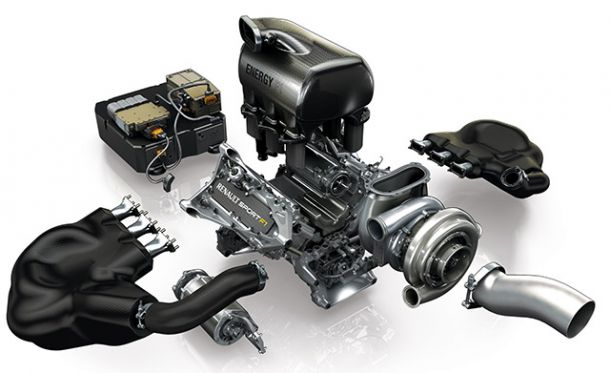
Soon, the pursuit for speed became a jigsaw puzzle on how to fit the rules. Sure, downsizing engines is important to minimize the environmental impact of petrol, but it is an over-complication of what should be the heart of a racecar. And yes, using watts acquired from braking as extra power to throttle a car is as much important at the highest level of racing as it is in the everyday home-supermarket-home route.
But ditching the V8 engines for a V6 hybrid power unit was not a master stroke. In fact, it triggered a paradox only seen in F1: the backwards evolution of the category. Fuel mileage has increased, but so did the level of difficulty found by manufacturers to build the units. Worse than that: it has, alongside other factors, slowed down cars. Yes, you read it right. Besides killing that traditional noise that had chills running up and down your spine, the V6 engines are complicated to build, silent – more like a whistle instead of a V8 roar – and expensive. And tires are now built to shred over the course of a race, not last as long as possible. Good for entertainment, but absolutely awful as development.
All of this for technologies that many manufacturers have already mastered – it is rather common in today’s world to see production cars boasting hybrid engines. It is getting more and more uncommon, however, to find a racing fan who is not disappointed with F1 for rule changes that miss the target by far.
As the so-called pinnacle of motorsports faces a midlife crisis, celebrating its 65th birthday only a couple months back, it is yet to be seen if the implementation of technology of questionable usefulness will help the sport regain its lost ground or if Formula 1 has already reached its highest point in the past – and should just go back there in order to avoid falling victim of one of its main principles.
