



ADVERTISEMENT
Highlights
Key moments
Thank you so much
Thank you so much for joining us for our coverage of the Netherlands vs. Japan match, corresponding to Matchday 1 of Group F at the 2026 FIFA World Cup.
We wish you all a good night and stay tuned to VAVEL.com.
End of the match
For ninety minutes, both teams offered a spectacle full of twists and turns, excitement, and moments of great quality. The draw ultimately reflects a match in which neither team was willing to give up when the score went against them.
The match has entered a completely different dimension. It's no longer a tactical issue; it's an emotional battle. Every attack feels dangerous, every set piece creates tension, and every recovery is celebrated as if it were a good. Both teams seem convinced they can still win.
Goal!
Just when it seemed the Netherlands had regained control with Crysencio Summerville's goal, Japan once again demonstrated why they are one of the most competitive teams in world football. The equalizer came from a set piece that descended into chaos in the Dutch penalty area. The corner kick found Koki Ogawa, who managed to connect with an unorthodox header as he fell backward. What looked like a wasted opportunity turned into an unintentional assist for Daichi Kamada, who found himself with the ball practically at his feet and deflected it into the net. Verbruggen was completely caught off guard by the trajectory and couldn't react. Netherlands 2-2 Japan!
There's a constant feeling that there are still more thrills to come. Japan has already managed to overcome a deficit before and doesn't seem like a team ready to give up. The Netherlands, for their part, are demonstrating tremendous attacking prowess. The score favors the Dutch, but the game is still wide open and any play could change the course of the match.
The final minutes promise to be extremely tense. Japan knows that a defeat in their opening match would seriously jeopardize their chances in Group F, so they are forced to take risks. This creates an ideal scenario for the Netherlands, who can exploit the spaces with the speed of De Jong and Gakpo on the counter-attack.
The game has completely changed since the first half. What began as a patient, tactical duel has turned into a frantic exchange of attacks. Now the transitions are faster, the lines are more spread out, and both teams seem convinced they can score at any moment.
Three substitutions for Japan to close out the game.
Takefusa Kubo leaves the field with an injury and is replaced by Koki Ogawa.
Tsuyoshi Watanabe is replaced in defense by Takehiro Tomiyasu.
Finally, Ritsu Doan is substituted by Yukinari Sugawara.
Gakpo shot with his left foot, and Japan's goalkeeper, Suzuki, tipped the ball over the bar for a corner.
The match has transformed into a constant exchange of blows. It's no longer the tactical and controlled game of the first half; now it's an open, intense, and emotional duel, where every attack seems capable of changing the score.
Triple substitution for the Netherlands. Donyell Malen makes way for Memphis Depay as the Dutch striker.
Crysencio Summerville is replaced by Teun Koopmeiners.
Tijjani Reijnders is substituted by Quinten Timber.
A dangerous shot from Kubo for Japan goes just over the crossbar of the goal defended by the Europeans. So close to equalizing.
The first substitution of the match is for Japan. Daizen Maeda leaves the field and Junya Ito comes on.
Goal!
The Netherlands strike again and regain the lead 2-1! The move originates once more with Ryan Gravenberch, who appears on the right side of the box with enough composure to find the West Ham striker. From there, it's all individual brilliance: Summerville goes one-on-one with his defender, feints with a subtle move, and creates just enough space to curl a shot into the far corner.
Yellow card for Crysencio Summerville. The first card of the match is shown by the American referee to the Dutch player. The West Ham winger was late to the challenge and ended up kicking Watanabe in the standing leg.
The score is now level and the game is much more intense.
Goal!
What a spectacular response from the Blue Samurai! Just when it seemed the Netherlands had taken emotional control of the match after Virgil van Dijk's header, Keito Nakamura produced a moment of brilliance from individual brilliance to level the score. The move originated from Takefusa Kubo's vision, who opted to lay the ball back when many expected an immediate cross or shot. Nakamura received the ball surrounded, with little space and a defender practically on top of him, but he managed to create a shot with two lightning-fast feints before unleashing a right-footed strike that deflected off Van Hecke. The ball changed trajectory slightly, leaving Bart Verbruggen with no chance. Netherlands 1-1 Japan!
Goal!
Goal for the Netherlands! And the captain appears when his team needed him most. Virgil van Dijk, the leader of the defense, transforms into a striker to break the deadlock in a match that had been perfectly balanced for over an hour. Ryan Gravenberch had time and space to look up on the right flank and deliver a perfect cross into the heart of the penalty area. There, the Dutch giant rose to dominate the aerial duel and connect with a powerful header that left Zion Suzuki with no chance. The Netherlands take the lead thanks to one of their historical weapons: their aerial prowess.
Japan seems comfortable playing these kinds of matches. They don't need to dominate possession to feel competitive. Every recovery immediately triggers an attacking transition that forces the Dutch center-backs to retreat quickly. It's a style that keeps the European defense constantly on its toes.
The second half begins
Japan sells the complement with the same personality he displayed during his first half. The Asian group does not seem intimidated by the Dutch hierarchy and continues to press with intelligence in specific areas of the field. Takefusa Kubo continues to be the player who generates the most uncertainty every time he receives between lines and faces the rival area.
Final del primermo
The Low Countries monopolized the position for several periods of the first time, but found themselves with an extraordinarily organized Japanese team. The Dutch filmed the ball with patience, constantly searching for Cody Gakpo, Donyell Malen and Crysencio Summerville, but the Japanese defense closed spaces with admirable discipline.
The duel between Ayase Ueda and the Van Dijk-Van Hecke pair is a permanent physical war. Japan needs its front end to be able to retain balloons and allow media outlets to arrive. The Low Countries, for their part, are trying to prevent the Japanese attacker from being able to download or download comfortably. Each large balloon becomes an individual battle of enormous intensity.
Donyell Malen is doing very interesting work without a balloon. Even though he never participated in the final match, his clearances forced the Japanese defenders to move back a few meters and created space for the arrivals of Cody Gakpo and Tijjani Reijnders from the second line. The Low Countries are trying to erode the Japanese structure through constant movement.
For a while, Nakamura notes in Japan. The Japanese shot passes by the nearby post in Verbruggen. Center from the right side that seemed to reach the defense, but overcame the fight against the last central defender, falling directly into the boots of the Reims player. This one, after controlling the balloon, fired a shot that was lost for an instant.
Cody Gakpo shoots high! Another new set-piece action in which, after the ball came loose, it reached the Dutch player, with the Liverpool footballer managing to strike the ball inside the area, but he couldn't direct it between the three posts as he slipped while taking the shot.
Every time Frenkie de Jong receives the ball between the center-backs, Japan activates a kind of tactical trap. Daichi Kamada presses high, while the Japanese midfielders close down nearby passing lanes. The objective is clear: to prevent the Dutch playmaker from injecting pace into the game. When De Jong has time, the Netherlands look like a well-oiled machine; when he loses it, the match becomes much more balanced.
Ryan Gravenberch is doing a quiet but crucial job. While De Jong is in the spotlight, the Dutch midfielder is constantly appearing to win back possession and break up potential Japanese counter-attacks. His influence is helping the Netherlands maintain territorial control for long stretches of the match.
Virgil van Dijk is orchestrating the attack from the back line. He not only leads the defensive duels but also constantly directs movements and corrects his teammates' positions. Japan tries to attack with speed, but they run into a center-back who seems to anticipate several plays before they even happen.
Takefusa Kubo is proving to be a fascinating piece in Japan's system. Starting behind Ayase Ueda, the Japanese player has the freedom to appear between the lines and force Frenkie de Jong and Ryan Gravenberch into difficult decisions. Every time Kubo receives the ball facing forward, the Dutch defense seems to momentarily lose its defensive bearings.
The Netherlands have opted for an attacking trident of Donyell Malen, Cody Gakpo, and the surprise inclusion in the starting lineup, Crysencio Summerville. The Dutch intention is clear: to attack quickly down the flanks and exploit any space that might open up behind the Japanese wing-backs. However, Japan are responding with a very compact structure that is making it difficult for them to receive the ball cleanly near the penalty area.
The Netherlands seem to have more possession, but Japan is achieving something equally valuable: controlling the game's intensity. The Asian side doesn't panic when defending nor rush when attacking. This composure is forcing the Dutch to work much harder than expected to create truly dangerous situations.
Individual duels are becoming incredibly important. Japan is competing with admirable intensity in every challenge, preventing the Dutch from settling comfortably into the opposition's half. Every loose ball is being fought for with determination, and that energy is keeping the game wide open.
There's something very interesting about the way Japan is defending. It's not a deep-lying block waiting for the opposition to make mistakes, but a mobile structure that forces the Dutch players into difficult decisions. Every forward pass finds a Japanese player nearby, reducing the margins of error and increasing the mental pace of the game.
The Netherlands are trying to impose their traditional territorial control, but Japan is turning every recovery into a frantic attack. The Asian side doesn't need long spells of possession to create danger; a clean exit and two or three precise touches are enough to cover half the pitch. The Dutch dominate the ball, but Japan seems to control the space, a difference that could prove decisive throughout the ninety minutes.
The match begins
The ball is in play and our live broadcast of the international friendly match between the Netherlands and Japan is underway, corresponding to Matchday 1 of Group F in the 2026 FIFA World Cup. Who will win this international friendly match between the Netherlands and Japan?
What's at stake
For the Netherlands, winning this afternoon means not only taking the lead in Group F, but also sending a clear message to the rest of the tournament: injuries won't slow this machine down. A convincing victory against Japan would serve as a statement of intent against the World Cup favorites.
For Japan, every point earned this afternoon fuels a dream that began to take shape in Qatar. Moriyasu's team has, for the first time in its history, a generation of players developed in the major European leagues who can truly compete with any team in the world.
Tactical duel
The most interesting aspect of this match is the clash between the Netherlands' high press and Japan's low block in transition. Koeman aims to dominate possession, press high, win the ball back quickly, and attack with multiple forward passes. Moriyasu will seek the exact opposite: to cede possession, compress well defensively, and exploit the spaces left by the Dutch back line when they push forward.
Face to face
The two teams have faced each other seven times in their history. Japan has won two of those encounters, both in recent years, with a 2-0 victory in the 2023 Kirin Challenge Cup being the most recent. The Netherlands has four wins and a 2-2 draw in a friendly in November 2013. In their only World Cup meeting, in Group E of South Africa 2010, the Netherlands won 1-0 with a lone goal from Dirk Kuyt. However, that Japan team is nothing like this one. That team didn't have any players in top European leagues. This one has more than fifteen starters in the most demanding leagues in the world.
This is how Japan plays
The Japanese tactic is recognizable and effective: a low block when they don't have the ball, quick recovery, and a rapid transition to attack, exploiting the speed of their wingers. When Japan wins the ball back in their own half, they can be in the opposition's penalty area in four touches. It's the same system that worked for them against Germany and Spain at Qatar 2022, two historic victories that no one expected.
The Japanese context
Wataru Endo was the heart and soul of the national team. The Liverpool defensive midfielder—with 73 caps and four goals for Barcelona—had worn the captain's armband since Qatar 2022 and was the creative force behind Hajime Moriyasu's play. His departure wasn't voluntary: coach Moriyasu made the decision to drop him on June 11, three days before the opening match against the Netherlands, after Endo aggravated a left foot injury during the friendly against Iceland on May 31. Endo, who had undergone surgery in February, was not fit to perform at the required level. The player himself used the announcement to announce his retirement from the national team: "There will come a time when Japan will win the World Cup. I will support the team as a fan." A farewell that moved the entire nation.
The Orientals
Japan was the first non-host country to qualify for this World Cup, securing their place in the third round of AFC qualifying with a victory over Bahrain in September 2024. What followed was an impressive qualifying campaign: 30 goals scored and only 3 conceded in the final two qualifying rounds. These numbers speak volumes about a team that not only defends well but also attacks with a technical quality that many European rivals underestimate.
The Orange Fortress
The freshest weapons in attack are Cody Gakpo on the left, fresh off a remarkable season at Liverpool, and Crysencio Summerville on the right, who comes off a great campaign at West Ham. Attacking depth is ample: Donyell Malen scored 14 goals in 18 Serie A appearances for Roma after arriving from Aston Villa in January; Wout Weghorst, Brian Brobbey, and Noa Lang complete an attacking arsenal that should be capable of unlocking any defense in the tournament. Koeman employs a 4-2-3-1 formation that can shift to a 4-3-3 depending on the opponent. The backbone of the team is the defense, with a back four comprised of Van Dijk, Van de Ven, Dumfries, and Nathan Aké. That defensive unit is, in theory, the most solid of all the teams in Group F.
The context of the Dutch
The most painful loss is Xavi Simons. The RB Leipzig attacking midfielder, arguably the team's most creative and inventive player, suffered a torn anterior cruciate ligament before the start of the tournament. Simons was the player who could create imbalance from between the lines, the one who connected the midfield with the attack with vertical passes that the opposing defense couldn't anticipate. Without him, Koeman is left with a robust but predictable attacking squad. Jurrien Timber also went down before the squad announcement with a groin injury, being replaced by Lutsharel Geertruida of Sunderland. And Matthijs de Ligt and Stefan de Vrij, the two natural backup center-backs, are also unavailable.
Group F
Group F is completed by Sweden and Tunisia. The Swedes, who qualified through the European play-offs by eliminating Italy in the second round, repeating their feat from qualifying for Russia 2018, return to the World Cup after an eight-year absence. Tunisia, making their seventh appearance, is the weakest team in the group on paper, ranked 40th in the FIFA rankings.
The stage
Texas hosts two teams this afternoon with history, identity, and enough credentials to claim the top two spots in Group F. The Netherlands arrive as one of the tournament favorites, backed by their seventh-place ranking in the FIFA rankings and a generation of players who have been preparing for this moment for years. Japan comes in as the most formidable opponent among the teams considered second-tier, ranked eighteenth in the world, with four consecutive appearances in the Round of 16 at the last four World Cups and a devastating ability to topple giants when least expected.
Match report
FIFA World Cup 2026 | Group F — Matchday 1.
Netherlands vs. Japan.
AT&T Stadium, Arlington, Texas — Sunday, June 14, 2026, 3:00 p.m. ET | 2:00 p.m. Colombia.
Broadcast: FOX Sports (USA), NHK/DAZN (Japan), NOS (Netherlands), beIN Sports (MENA)
This is the 1,000th match in FIFA World Cup history
Welcome
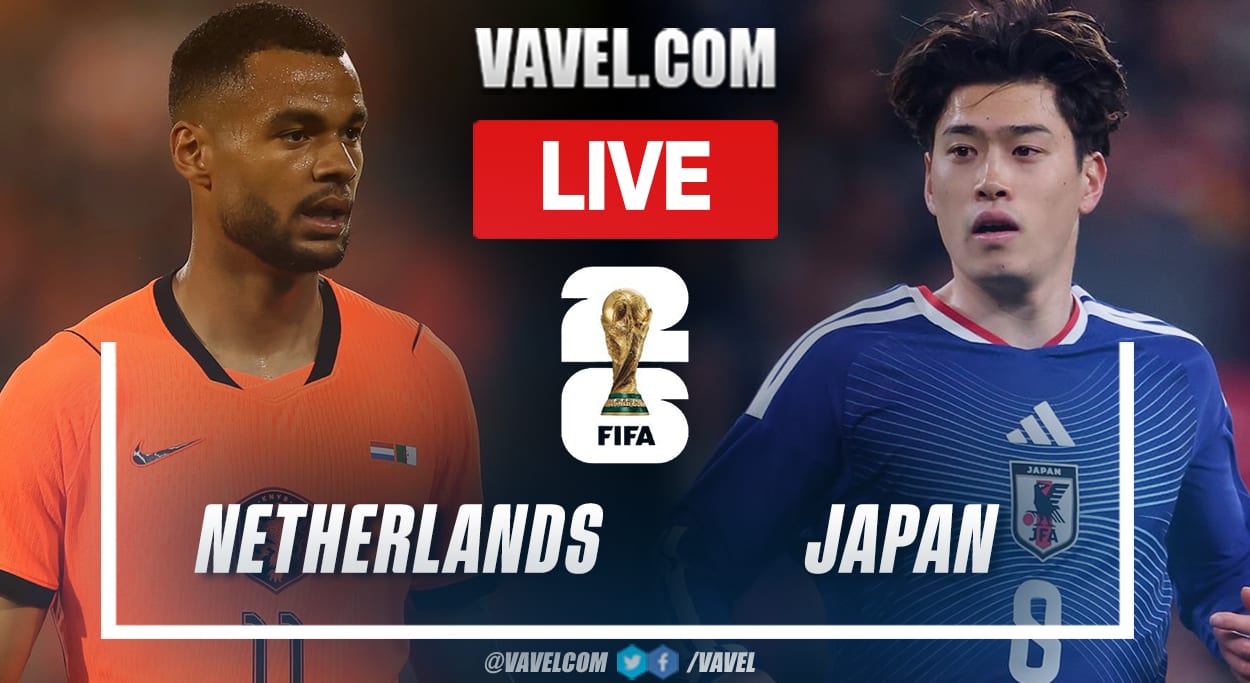
Welcome, readers, to our live coverage of the Netherlands vs Japan match, corresponding to Matchday 1 of Group F at the 2026 FIFA World Cup. We begin with the preview of this match Netherlands vs Japan.

Here are the highlights from this sporting event. Enjoy the best and most exciting plays from another day of the sport you love. Remember to stay connected to VAVEL.com to keep up to date with the best of world sport.