



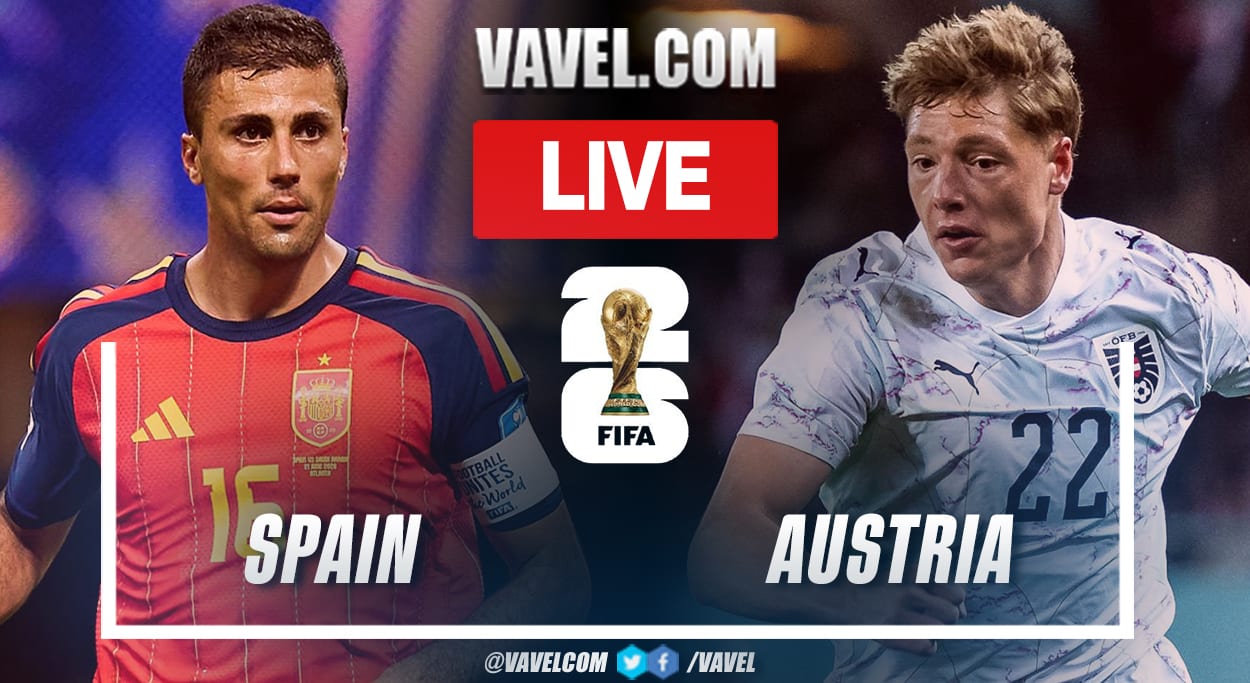

End of the game:
Key moments
ADVERTISEMENT
Lamine Yamal (Spain) gets to a loose ball inside the box first and fires a quick shot towards the bottom left corner. A defender manages to stop the ball on the goal line instead of the goalkeeper. On the next play, the coach decides to substitute him with Gavi.
Marcel Sabitzer sends in a good high ball into the center of the box, but it's not capitalized on. Stefan Posch connects with a weak header well wide of the right post. The ball has gone out of play, and it will be a good kick for Spain. If Austria had been more aggressive and consistent in their attacks, they probably would have scored a good by now.
The Shark is getting closer to scoring his first World Cup goal, 10 minutes to go! A corner kick reaches Ferran Torres near the penalty spot, but he heads it high over the bar. The ball has gone out of play and there will be a good kick for Austria.
Marko Arnautovic tries to get open, but his first touch is poor and he loses possession. The ball goes out of play and Spain will take a good kick. A good opportunity for Austria to pull one back before the final whistle.
ADVERTISEMENT
After the hydration break, there were some changes: Luis de la Fuente made two substitutions, looking to freshen up the squad. Dani Olmo was replaced by Mikel Merino. Álex Baena came off and Ferran Torres came on.
Goal!, Goal!, Goal by Pedro Porro. Lethal header in front of the rival goalkeeper. Alex Baena's pass is exquisite.
A perfectly weighted cross, aimed at the penalty spot, is met by Sasa Kalajdzic (Austria). He creates space and heads the ball well, but it goes just over the bar. The ball has gone out of play, and there will be a good kick for Spain. The Iberians must finish the game; their opponents are dangerous when they have space.
ADVERTISEMENT
A good shot from Lamine Yamal (Spain), but it hits a defender and poses no threat to the goalkeeper. It's quite clear that the Barcelona winger wants to make a name for himself and be a star at this World Cup, but he sometimes makes too many mistakes due to being too individualistic.
What a chance for Rodri! His shot from the edge of the box went wide of the left post. The ball goes out of play and Austria will take a good kick. The Austrians were saved by a hair.
Luis De La Fuente gives his players some instructions to play faster and release the ball. They're making too many inaccuracies and falling into their opponent's double-teams. So far, we haven't had any scoring opportunities.
Friends, we're back for the second half in Los Angeles. Spain leads Austria 1-0. Ralf Rangnick makes a change to inject some energy into his team's play. Xaver Schlager leaves the field and is replaced by Florian Grillitsch. Nicolas Seiwald also comes off, and Carney Chukwuemeka enters the game.
ADVERTISEMENT
Halftime:
Austria pushed forward in search of an equalizer before halftime, but their efforts were unsuccessful. Spain defended effectively and recovered possession without difficulty. Three minutes of added time will be played.
Lamine Yamal nearly extended the lead after a brilliant individual effort and a dangerous shot from the edge of the box. The ball was headed straight for the center of the goal, but Alexander Schlager made a quick save. Five minutes remain in the first half.
ADVERTISEMENT
David Alaba advances and unleashes a powerful long-range shot that sails well over the crossbar. The ball has gone out of play, and it will be a good kick for Spain. Every time the Austrians ventured forward, they did so with danger.
Lamine Yamal bursts into the box, eluding two defenders, and shoots from the penalty spot. His shot is powerful, but lacks accuracy, and the goalkeeper saves it easily. The score remains unchanged. Austria is struggling immensely in this match; they completely lost their shape after the hydration break.
Goal disallowed! Marc Cucurella scored, but Glenn Nyberg disallowed the goal for a foul. The entire Spanish bench jumped up to celebrate, but it was ruled out.
ADVERTISEMENT
The referee stops the match! The hydration break is necessary, especially for Spain. They haven't found a way to hurt their opponent. Austria needs to correct some things, but overall they've played well.
Marcel Sabitzer sends a great pass towards Michael Gregoritsch, but he can't control the ball. The ball has gone out of play and it will be a good kick for Spain. An interesting opportunity for Austria.
Álex Baena (Spain) sends in a dangerous cross from the edge of the box. A defender reacts at the last moment and clears the danger. The ball goes out of play. The Atlético Madrid striker has had a good start to the match. He looks very attentive and involved. He has taken full advantage of his starting opportunity.
Aymeric Laporte (Spain) runs and rises perfectly to head the corner, but his header is poor and the ball sails over the crossbar. The ball goes out of play. The Austrian coach's instructions are quite clear: don't sit so deep and push forward; his expressions of annoyance are evident.
ADVERTISEMENT
Barcelona winger Lamine Yamal sent a pass into the box, but the ball was intercepted and cleared. The ball goes out of play. Corner for Spain. Austria, just like in the match against Argentina, started with a low block, avoiding leaving space on the wings. They are very aggressive.
Lamine Yamal beats several defenders and unleashes a low shot from mid-range that catches the goalkeeper off guard, but he makes a great save. A good start for the Spaniards; they look aggressive and intent on opening the scoring in the first few minutes.
The game started:
Friends, welcome to this great European clash. Spain, one of the favorites to win the World Cup, faces Austria, an emerging team on the continent. We expect an exciting match full of goals and great football. We are ready!
ADVERTISEMENT
Let's get to know the Spanish national team coach:
Luis de la Fuente has cemented his status among the elite of world football thanks to an impeccable career built on patience, development, and structured success. After dedicating nearly a decade to shaping the young talent of the Royal Spanish Football Federation—a period in which he won the Under-19 European Championship in 2015 and the Under-21 European Championship in 2019, as well as a silver medal at the 2020 Tokyo Olympics—he took charge of the senior national team with a core group of players he knew intimately. Under his leadership, Spain regained its European dominance by winning the UEFA Nations League in 2023 and, consecutively and undefeated, Euro 2024, which secured his contract extension with "La Roja" until the summer of 2028.
His footballing philosophy is characterized by a perfect balance between the traditional, possession-based style of play and a dynamic, vertical attacking approach, usually implemented in a 4-3-3 formation. Beyond his tactical acumen and his ability to develop emerging talents like Lamine Yamal and Nico Williams alongside established veterans, De la Fuente's defining characteristic lies in his people management. The Riojan strategist prioritizes approachability, humility, and building strong bonds of trust within the dressing room, a leadership philosophy that has transformed competitive pressure into a winning collective identity ready to face the highest international demands at the World Cup.
The pressure according to the Barcelona star:
But Lamine Yamal downplayed the pressure: "I never put that kind of pressure on myself. There are people who have suffered more." The FC Barcelona player then cited his parents' situation as an example: "My mother had me when she was 16, and that's real pressure. Then my father had to go out and hustle, picking up things on the street to bring food home. That's real pressure. All I have to do is play and make the Spanish people happy." For all these reasons, Lamine Yamal admits that he doesn't feel any pressure and that all he has to do is give 100% on the pitch.
Nice moment:
In an interview with Cadena SER, Lamine Yamal acknowledged that he has had to learn to with it and that he always tries to stop and take photos with people: "On the first day, I'm always going to stop, but often it ends up being the same people. But hey, you have to know how to manage it. You shouldn't get frustrated; I know who I am, and I know it's normal." Following this question, Manu Carreño asked him about the pressure he's under at just 18 years old: "Being a star, I don't know if it must be very easy for a kid. Deep down, you're almost a man because of the maturity you're gaining, but you're only 18."
Keys:
For Austria, this match represents the culmination of a historic comeback, as "Das Team" has qualified for the final stages of the world's premier competition after a 28-year absence, their last World Cup appearance being in France in 1998. However, the Central European side has been plagued by a notable defensive fragility in the tournament, having conceded goals in 12 consecutive matches; a negative streak they haven't broken since their 2-0 victory against Algeria in Spain in 1982. This vulnerability is particularly pronounced in the second half, a particularly dangerous period for their defense, as eight of the last ten goals they have conceded in World Cup history have come in the second half.
ADVERTISEMENT
Should the match not be decided in regulation time, recent history does not favor the Spanish, who seem to have a curse in World Cup extra time, with a record of one win, six draws, and one loss in eight extra time periods played. Ironically, their only victory in 120 minutes came in the most important match in their history: a 1-0 win against the Netherlands in the 2010 South Africa final. The situation becomes even more complex if the match goes to penalties, a stage where Spain has shown clear vulnerability, losing four of the five shootouts they have faced (Belgium 1986, South Korea 2002, Russia 2018, and Morocco 2022), only managing a victory against Ireland in 2002.
Furthermore, Spain enters this match displaying historic defensive solidity after finishing the 2016 World Cup group stage with a clean sheet for the first time in its history. If they keep a clean sheet against Austria, the Spanish national team will have gone five consecutive matches without conceding a good, an absolute record for the country in this major tournament. Adding to this defensive strength is a remarkable disciplinary record: "La Roja" suffered just 15 fouls in the group stage (one against Cape Verde, two against Saudi Arabia, and 12 against Uruguay), thus recording the two matches with the fewest fouls suffered in World Cup history.
Spain holds a commanding lead in the overall head-to-head record against Austria, with 9 wins, 3 draws, and 4 losses in 16 matches. Despite this advantage for the Spanish side, their only previous encounter in a FIFA World Cup favors the Austrians, who prevailed 2-1 at Argentina 1978 with goals from Walter Schachner and Hans Krankl at the José Amalfitani Stadium. However, current form favors "La Roja," who arrive with a two-game winning streak against this opponent and a remarkable attacking prowess, having scored 9 goals and conceded only one in their two most recent meetings (4-0 and 5-1).
ADVERTISEMENT

The favorites advance to the next stage with ease: Spain defeated Austria 3-0 and qualified for the round of 16. They faced the winner of the match between Croatia and Portugal. A good game from Cucurella.