



ADVERTISEMENT
Key moments
End of the game:
The United Arab Emirates has qualified for the 2026 Gulf Cup semi-finals. With 6 points, they secured their spot in the next round. They defeated Bahrain 3–0. They will play Qatar to decide the group winner.
- Ali Saleh
- Guilherme Bala
- Ousmane Camara
Goal!, Goal!, Goal of the United Arab Emirates. Great definition from Saleh. Match completely liquidated.
With Qatar's victory over Yemen, the UAE has officially qualified for the semifinals. Bahrain needs to put up a respectable fight in this tournament. The goal must absolutely be to reach the next World Cup. For now, they’ve had their first real chance on goal. The visitors survived!
With 10 minutes remaining, the UAE completely tightened up their defensive lines. They know that goal difference is crucial in tournaments like this, especially given the group they were drawn into. Bahrain took the initiative to break the deadlock and came very close.
Bahrain has been unlucky—not only due to their lack of attacking threat, but also because substitutions disrupted the rhythm of their solid defensive performance. The UAE freshened up their lineup, allowing them to strike at key moments.
Guilherme scored the second goal off an assist from Meloni. He just came on! Goal!, Goal!, Goal for the United Arab Emirates.
Saleh and Guilherme have come on for the UAE. The coach is looking for much more dynamism in the attacking third—seeking more attacking options to create greater danger in front of goal. Bahrain is completely demoralized.
The UAE has taken 10 shots—6 on target—but has scored only once. This highlights the visiting team's lack of clinical finishing. That is why the head coach and his assistant are planning to bring on another forward; changes from the bench are imminent.
The UAE had a clear opportunity to further extend their lead, but they were thwarted by a brilliant performance from the home goalkeeper. The head coach sent the substitutes to warm up, as he needs to put the match to bed and wants to avoid any surprises.
Bahrain made substitutions, looking for a way to equalize. Since the UAE goal, they haven't created any dangerous chances at the opposing goal. The home coach is sticking to his tactical setup and continuing to employ the 4-4-2 formation.
Halftime:
With a lone goal from Ousmané Camará, the UAE leads Bahrain 1–0 and is provisionally qualifying for the next round of the Gulf Cup. We’re heading into the break, folks. A great first half!
The referee added three minutes of stoppage time. Not much time had been lost, but the decision was made due to the cooling break and a player's injury. The UAE is already thinking about the second half, which is why they are no longer attacking.
With five minutes remaining in the first half, Bahrain is on track for its second victory of the tournament, while the UAE has secured 6 points out of 6, virtually guaranteeing its qualification for the next round. So far, no players have been booked.
Bahrain pushed their lines forward after conceding a good. The home coach is calling for greater intensity and used the cooling break to issue some instructions. As for the UAE, they appear to have dropped back and are playing with far less anxiety.
Goal!, Goal!, Goal for the United Arab Emirates. After a difficult start, the visiting team scores and takes the lead. Ousmane Camara was the one to celebrate.
Bahrain clearly needs a win today, which is why they appear so anxious in their decision-making. They are making numerous conceptual and tactical errors that have prevented them from dictating the terms of play in the first half.
Now it is the UAE responding with a chance to score, but Camara's shot goes wide of the mark. Bahrain needs its center-backs and midfielders to stay well-positioned and avoid leaving too much space between them.
The first chance of the match arrived, and the UAE survived a scare. Bahrain made a strong push; playing with drive and grit, they entered the penalty area and came close to scoring. The visiting coach is demanding much greater concentration from his players during situations like that.
The opening minutes in Saudi Arabia are a period of cautious assessment. Bahrain is sitting back in its own half, dictating the tactical dynamic for the UAE. Whoever wants to win the match must prioritize winning the midfield battles—that is the key to breaking the deadlock.
The game started:
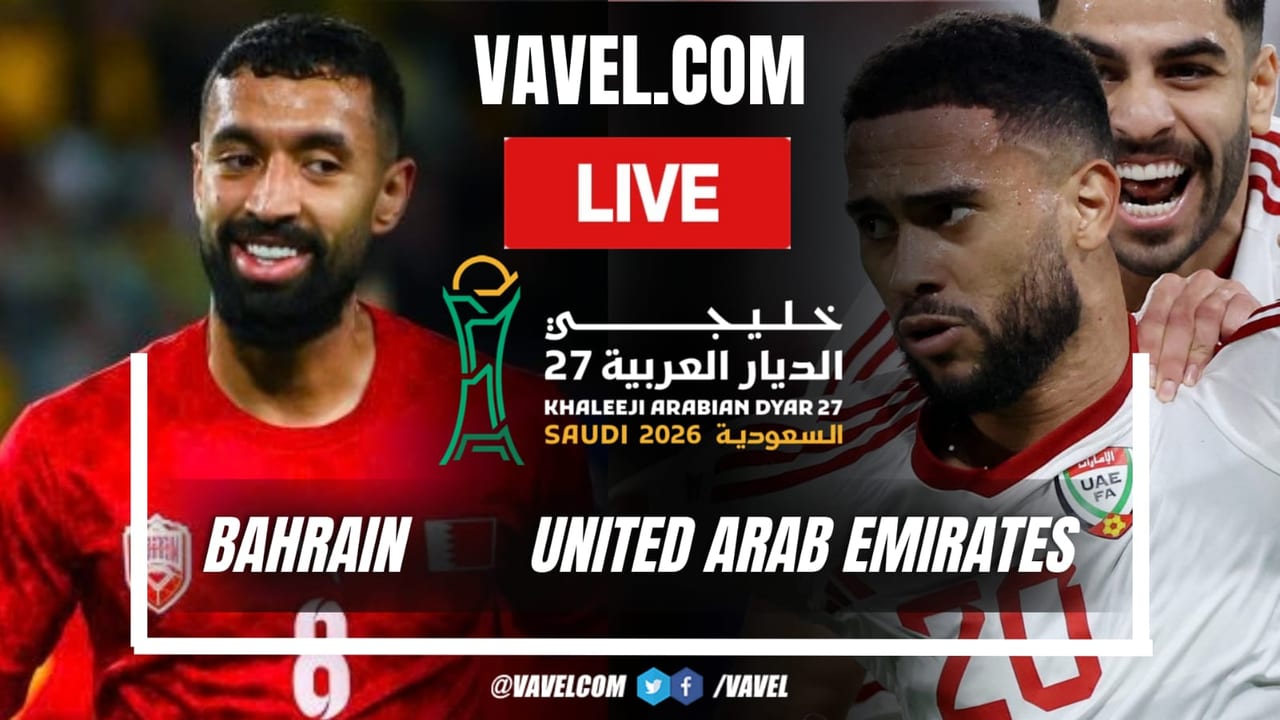
Friends, welcome to this exciting clash in Saudi Arabia. Both teams are looking to position themselves for qualification to the next stage. The UAE is the favorite, but their opponent won't make it easy for them.
The 27th edition of the Gulf Cup of Nations (Khaleeji Zain 27) features several compelling aspects: first, it is being held for the first time in history in the coastal city of Jeddah, Saudi Arabia, with matches split between King Abdullah Sports City and Prince Abdullah Al-Faisal Stadium; second, the opening day on September 23 coincided with Saudi Arabia's National Day celebrations; third, the Bahraini national team arrived aiming to defend the title won in the previous edition (2024); fourth, it is a fast-paced tournament with just 15 matches played over two weeks (September 23 to October 6); and finally, the tournament includes Kuwait—the all-time record holder with 10 regional titles—which is seeking to end its title drought in a competitive Group A alongside the host nation, Iraq, and Oman.
The officiating team appointed by the Gulf Cup Football Federation’s Referees Commission for the 2026 Gulf Cup match between Bahrain and the United Arab Emirates was led by Kuwaiti referee Abdullah Jamali. He was joined on the sidelines by his compatriots Saud Al-Shamali and Ali Jragh as assistant referees, while Portuguese official João Pinheiro served as the fourth official. The Video Assistant Referee (VAR) system was managed by Saudi official Abdullah Al-Shahri, assisted by Kuwaiti official Abdullah Arab (AVAR), under the supervision of Omani referee assessor Ibrahim Al-Hosni.
In 2026, the United Arab Emirates (UAE) men's national team 🇦🇪 focused its competitive activity on the 2026 Gulf Cup of Nations (the 27th edition), held in Jeddah, Saudi Arabia. Following the appointment of Croatian coach Zlatko Dalić in August, the Emirati squad began its official campaign on September 24 by securing a resounding 4–0 victory over Yemen in the opening match of Group B. The remaining group stage fixtures include a match against Bahrain on September 27 and a clash with Qatar on September 30, as the team seeks to advance to the semifinals of the regional tournament.
Throughout 2026, the Bahraini national football team played few official matches or friendlies. In June, the squad suffered a 2–0 defeat against Georgia in an international friendly. Later, at the start of the 2026 Gulf Cup of Nations group stage in September, Bahrain opened its campaign with a setback, losing 2–0 to Qatar, and also faced the United Arab Emirates in the tournament's second round of matches.
The rivalry between the senior national teams of Bahrain and the United Arab Emirates (UAE) has a long history in Middle Eastern football, notably featuring clashes in the Gulf Cup of Nations, the Asian Cup, and AFC qualifiers. Across more than 30 official matches and friendlies since the 1970s, the overall record favors the UAE, with 16 victories compared to Bahrain's 11 wins and 6 draws. The competition has been fiercely contested in the regional tournament, where Bahrain won 2–1 during the group stage of the 2023 Gulf Cup; meanwhile, in the 2026 World Cup qualifiers, the UAE secured a 2–0 victory in Manama and played out a 1–1 draw in Abu Dhabi.
The recent history of the Gulf Cup of Nations has been characterized by parity and a rotation of champions among the region's national teams. In the most recent edition (Khaleeji Zain 26), held in Kuwait in January 2025, Bahrain claimed the title by defeating Oman 2–1 in the final, marking their second championship victory following their 2019 triumph. Iraq won the tournament as hosts in 2023 after a dramatic 3–2 extra-time victory over Oman, while Oman had previously won the 2017–18 edition by defeating the United Arab Emirates in a penalty shootout. Despite Kuwait's historical dominance—as the tournament's most successful team with 10 titles—recent editions have seen the rise of emerging programs that have solidified the competitiveness of football in the Persian Gulf.
The United Arab Emirates national team has been a historic participant and a key figure in the Gulf Cup of Nations since its early editions, having won the regional title twice (in 2007 as hosts and in 2013 with an unbeaten record). In addition to their two championships, "The Whites" have reached the final on three other occasions (1986, 1988, and 2017), cementing their status as a perennial powerhouse in the tournament by frequently reaching the podium and contending in the decisive knockout stages.
Bahrain's participation in the Gulf Cup of Nations is defined by a long history of persistence that culminated in regional football glory after a wait of nearly five decades. As a founding member of the tournament and host of the inaugural 1970 edition, the Bahraini national team finished as runners-up on multiple occasions (1970, 1982, 1992, and 2003) without ever lifting the trophy, becoming one of the competition's most notable unfinished stories for years. However, their historic moment of triumph arrived at the 24th edition (Qatar 2019); under the guidance of head coach Hélio Sousa, they broke the streak by defeating Saudi Arabia 1–0 in the final to be crowned Gulf champions for the first time in their history. Since then, the "Dilmun Warriors" have established themselves as a competitive force and a regular contender in the tournament's decisive stages.
The 2026 Gulf Cup of Nations (27th edition) is played under a format featuring eight participating national teams divided into two stages. In the group stage, the teams are split into two groups of four (Group A and Group B), playing a single round-robin schedule within their respective groups. The top two teams from each group advance to the knockout stage, which consists of semifinals (Group A winner vs. Group B runner-up, and Group B winner vs. Group A runner-up) and the grand final—all played as single-match ties to determine the regional champion.
