



ADVERTISEMENT
End of the game:
Key moments
Omar Marmoush! Double by the Tottenham forward. Goal!, Goal!, Goal of Egypt. The Egyptians knew how to make up for the absence of Mohamed Salah.
Ibrahim Adel! Goal!, Goal!, Goal for Egypt. After the cooling break, the 'Pharaohs' came out with spectacular energy.
South Sudan pressed Egypt's defence in an attempt to narrow the gap, but the 'Pharaohs'' solid back line kept them at bay. The home side lacked composure in front of goal, faltering in the final play.
South Sudan made three substitutions in an attempt to freshen up their attack and stage a comeback after falling two goals behind against Egypt. Godfrey Debele received a yellow card in the 64th minute. The match was disjointed in this second half.
Egypt head coach Hossam Hassan made two substitutions, bringing on Ibrahim Adel and Karim Hafez in place of Haissem Hassan and Hossam Abdelmaguid. The visiting team's aim was to inject fresh energy into their various lines with an eye on the challenges ahead.
Let's take a look at the substitutes' bench:
- 1 D. Kunyu Salah
- 11 C. Yelchan
- 15 M. Albano
- 17 P. Jawa
- 18 K. Majak
- 19 W. Akio
- 21 J. Manyang
- 22 Kur Kur
- 24 G. Debele
- 4 P. Maker
- 6 J. Malish
- 9 P. Oleyo
-
- 15 Karim Hafez
- 16 El Mahdy Soliman
- 18 Ali Mahmoud
- 2 Omar Fayed
- 20 Ibrahim Adel
- 21 Mahmoud Saber
- 24 Tarek Alaa
- 25 Zizo
- 26 Mohamed Alaa
- 7 Osama Faisal
- 9 Hamza Abdelkarim
Omar Marmoush! Goal!, Goal!, Goal for Egypt. The Tottenham forward extended the lead and gradually began to put the match to bed.
Friends, welcome to the second half. There was a substitution: Godfrey Debele came on for Jamu Iluya. Egypt did not make any changes to their lineup; the same 11 players took the field. We were ready.
Halftime:
Egypt had a good first half. They started well but gradually lost momentum. After the cooling break, they regained possession and managed to open the scoring. South Sudan was unable to maintain the mid-to-low block that had been working for them.
Egypt kept pressing; Ashour and Zizo squandered clear-cut chances inside the box as the Pharaohs looked to extend their lead. The fourth official signalled two minutes of stoppage time. We were nearing the end of the first half.
Goal! Mostafa Zizo put Egypt ahead! Hossam Abdelmaguid sent a well-placed pass to Zizo inside the box, and the forward fired straight off the post.
After getting through the first 20 minutes, South Sudan settled into the game and looked more comfortable. Egypt lost a great deal of intensity and possession. The coach began consulting his assistant to issue new instructions to the players.
Zizo received a well-placed pass from Hassan inside the box, but the South Sudan defence blocked his shot. Egypt were applying impressive pressure; they were getting closer and closer to opening the scoring.
Two chances! Ashour played a magnificent through ball to Ziko inside the box, but the goalkeeper blocked his shot. Emam Ashour broke through one-on-one, but his poor finish missed the target. These were Egypt's first real scoring opportunities.
The game started:
Hossam Hassan, Egypt National Team Coach:
There was no issue with Mohamed Salah; his request to be excused from the match against South Sudan was made back when he was in Turkey, due to concerns about the condition of the pitch.
Salah would be with us as usual for the upcoming period, starting with the next international friendly match.
Egypt entered this one on the back of a solid, hard-fought campaign on the world stage. The Pharaohs made headlines at the 2026 FIFA World Cup in July, spectacularly crashing out in the Round of 16 following a nail-biting 3-2 thriller against eventual finalists Argentina.
Hossam Hassan’s men had tightened their defence, picking up a goalless draw against Angola in their opening qualification fixture just days earlier.
South Sudan entered this one on the back of a grueling, high-intensity developmental cycle. The Bright Stars completely captivated fans during their recent preliminary campaign, securing a massive 4-1 aggregate victory over Djibouti earlier this year to advance to this elite stage.
The federation's men had pushed hard despite being clear outsiders. It was truly impressive to watch their relentless progression. They opened their campaign with a 2-1 away defeat to Malawi and things weren't good at home either. South Sudan were winless in three home games with just one goal scored and nine conceded.
Football matches between Egypt and South Sudan represented a clash between the experience of a historic powerhouse and the freshness of an emerging national team. Egypt—known as the "Pharaohs" and the most successful team in the history of the Africa Cup of Nations—brought a well-established tactical style, continental pedigree, and the weight of its footballing tradition to the pitch; meanwhile, the "Bright Stars" represented one of the youngest FIFA-affiliated nations, taking the field with remarkable physicality, immense discipline, and the drive to pull off an upset against an African giant. Although there was a vast disparity in international experience, encounters between the two sides offered a dynamic contrast of styles, as the South Sudanese team's defensive rigour tested the creativity and attacking intensity of the Egyptian squad.
The South Sudan national football team 🇸🇸—affiliated with the CAF and active internationally since the country's independence—had never qualified for the final tournament of the Africa Cup of Nations (AFCON). Since first entering the qualifiers for the 2015 edition, the "Bright Stars" had consistently been eliminated in either the preliminary round or the qualifying group stage. Despite being one of the youngest national teams on the continent, the squad had recorded significant milestones, such as its first official qualifying victory in September 2015 (a 1–0 win over Equatorial Guinea) and its biggest international win (a 6–0 victory against Djibouti in March 2017). However, a lack of infrastructure and historical instability had hampered its competitive consistency, keeping the team—to date—far from contending for a spot in the continental tournament.
The Egypt national team 🇪🇬 was the undisputed king of the Africa Cup of Nations (AFCON). It led the all-time standings with a record seven titles (1957, 1959, 1986, 1998, 2006, 2008, and 2010) and ten final appearances. The Pharaohs won the inaugural edition in 1957 and enjoyed a golden era under Hassan Shehata, becoming the only team in the tournament's history to win three consecutive titles (2006, 2008, and 2010). Although they had suffered painful runner-up finishes in recent years (2017 and 2021), their consistency, effectiveness in knockout stages, and rich heritage made Egypt the benchmark for excellence and history in African football.
- South Sudan had an average of 53.33% of the games with over 2.5 goals and 46.67% of the games with under 2.5 goals. In the last 15 games.
- South Sudan scored 5 goals in the last 5 games.
- Egypt had an average of 40% of the games with over 2.5 goals and 60% of the games with under 2.5 goals. In the last 15 games.
- Egypt scored 7 goals in the last 5 games.
Egypt had seen over 2.5 goals in 40% of their last 15 matches, with 60% finishing under 2.5 goals. Across their last 5 matches, Egypt had scored 7 goals, which helped measure their attacking rhythm at the time.
South Sudan had recorded over 2.5 goals in 53.33% of their last 15 matches, while 46.67% of those games finished under 2.5 goals. In their last 5 matches, South Sudan had scored 5 goals, which gave an indication of their recent attacking output.

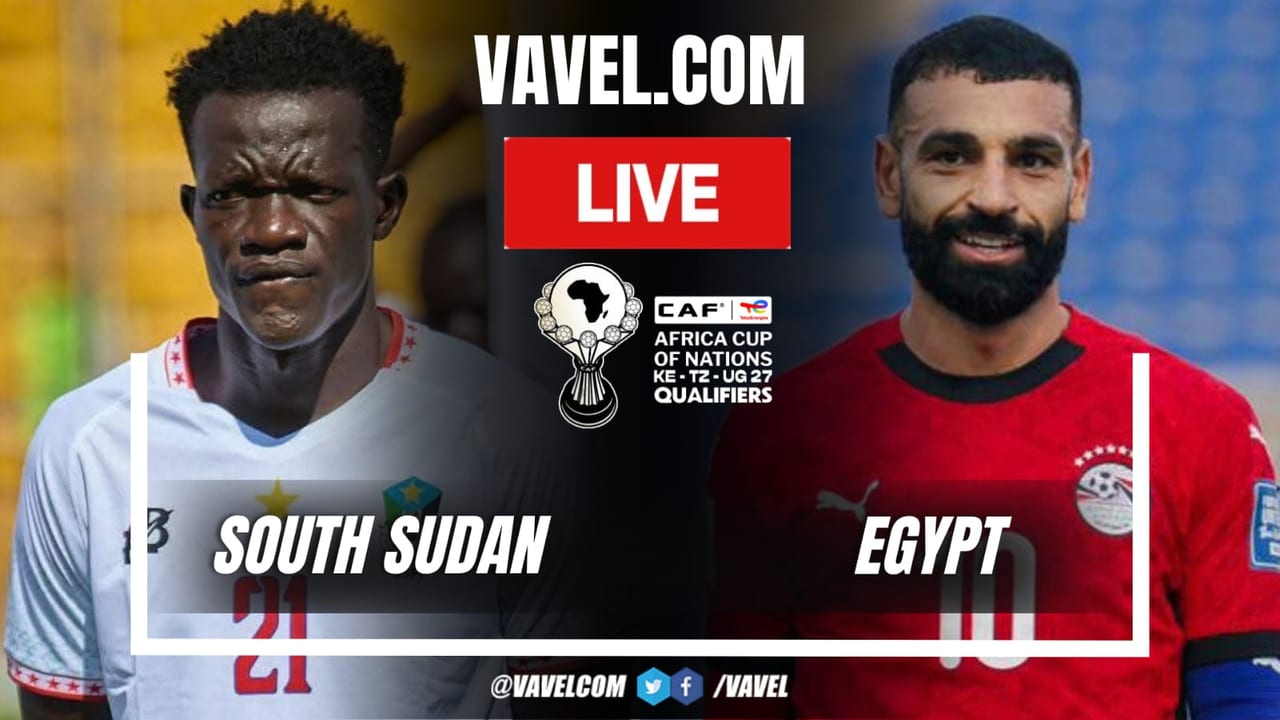
Egypt defeated South Sudan 5-0 in Matchday 2 of the Africa Cup of Nations qualifiers. This was the 'Pharaohs'' first victory of the current campaign, following a draw against Angola.
Mostafa Zico - 36' | Omar Marmoush - 49', 83' | Ibrahim Adel - 75- Hamza Abdelkarim - 90'+2''