


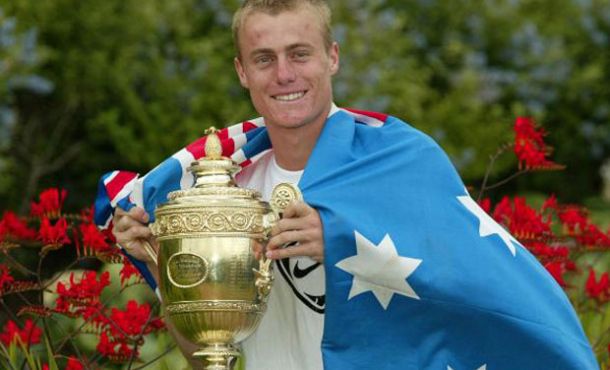

Mastering the grass – in all its peculiarity of being the only live surface of the sport – and its most traditional event – the Championships at Wimbledon – always presented a tough challenge to endless generations of players.
The stakes were high, and so are the rewards. Winning it all at the All England Club all but introduces the champion to a strict hall of legends. Some of them have their on grass their crib, like Sampras (the American master of serve-and-volley) and Federer (probably the best all-around player tennis has ever seen), while the most famous lawn of the world adopted others, such as Bjorn Borg and Rafa Nadal, two greats who first conquered the dirt.
Among them, one can find, carved forever in the Wimbledon trophy, the name of the youngest man ever to top the world rankings, Lleyton Hewitt, who will rock his traditional backwards cap through grass courts around the world for the last time as a professional player, as his retirement looms larger every time.
Starting in Rosmalen, Hewitt, now 34 and ranked 112, takes his farewell tour to its second and last act at the All England Club, before an encore in Darwin for a Davis Cup tie.
Despite saying Rusty was not born and raised on grass, there he found – much like his contemporary compatriots like Rafter and Philippoussis – mojo, success, wins and glory still early on his career, which culminated with a second Grand Slam title.
As time went on, an older Hewitt – to some only a shade of consistency of the former world no.1, though the skills were always there – had on lawn the last glories of a victorious career, winning two of his last three titles on that surface.
In total, Hewitt lifted 8 trophies on grass courts. Half of them at England’s second most famous club – Queen’s. Add to the count triumphs in ‘s-Hertogenbosch, Halle and Newport. The missing one is the biggest of them all: the 2002 Wimbledon title, over David Nalbandian.
Before the start of this year’s edition of the Topshelf Open, Lleyton’s career record on grass stood as 128-38, for a .771 winning percentage, a respectable number that stands alone as his best record on any given surface.
His first ever experience on grass as a pro, however, did not end very well to him. As the world no. 165, in 1998, Hewitt squared off against Gaston Etlis, then ranked 195. The Argentine, who never won a grass match outside Challenger level, nor broke through the top-100 in over 10 seasons as a pro, won an untroubled match, 4 and 2, in the first round of the Surbiton Challenger.
It did not take long for Lleyton to make his first splashes on grass. The very next year saw the promising Aussie debuting in the top-100, boosted by a semifinal run at the same Queen’s Club he would go on to conquer four times, a QF showing in Notthingham and a 3rd round at Wimbledon.
The prospect soon became a reality. As his rankings rose to new ever-new highs while Hewitt was still a teen, Hewitt dominated the first grass tournament in London without losing a single set, avenging the ’99 loss to Sampras in the ’00 final for his maiden title on the surface.
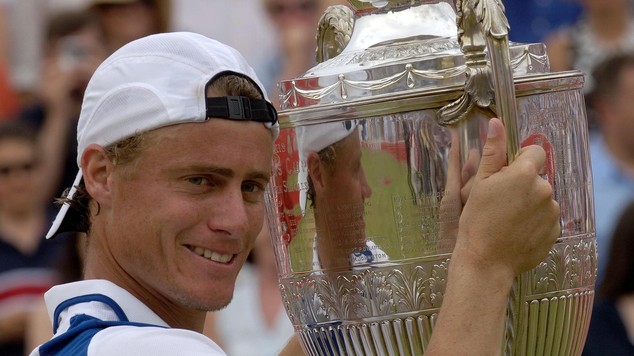
To his shelf, three more would follow, including the 2001 and 2002 to join his 2000 trophy, making of Hewitt the first triple-champion at Queen’s since John McEnroe 20 years prior. His 2001 campaign can be also directly linked to Lleyton’s run to the year-end no.1 spot on the rankings: his London effort, once again defeating grass-great Sampras, this time in the semis, and fan-favorite Henman in the final, was followed by another victorious week in Hertogenbosch.
The biggest prize, however, was still missing: conquering the All-England Club. After failing to replicate his Queen’s success at SW19 and having only a R16 run to show for as his best result entering 2002, Lleyton reached what at the time could be his peak, but we now we know it was his apogee.
After once again denying Henman the title in London, Hewitt met the Brit again a couple weeks later, with the UK still longing for a local Wimbledon finalist. The Aussie denied him one more time, before dismissing Argentine great David Nalbandian in his lone Major final. On June, 24th, 2002, Hewitt had climbed to the highest point of his career, claiming his second Grand Slam title, which would also be his last.
A drought ensued. After having his winning streak at Queen’s halted by Sebastian Grosjean, Hewitt became the first defending Wimbledon champion to bow out in the opening round when he lost to a then-unknown, big-serving Croatian giant Ivo Karlovic, bringing his 2003 grass season to a premature ending.
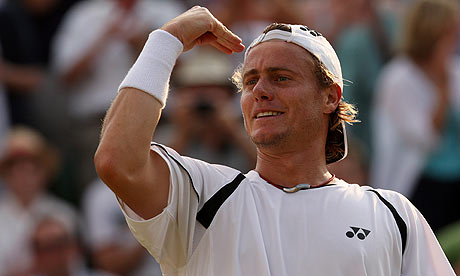
The rise and dominance of Roger Federer in the subsequent seasons without a shade of doubt hampered Hewitt’s chances to establish himself among the all-time greats. The greatness of the Swiss stopped Lleyton at Wimbledon in the 2004 QFs, 2005 SFs, during the Aussie’s prime, and once again in the 4th round in 2008.
That being said, 2006 can be easily measured as the last year of Hewitt’s peak, which directly affected his grass results. His age-25 season was the last on which he hoisted the Queen’s trophy, beating Blake in the final, and the second-to-last on which he would go on to reach the Wimbledon elite eight, falling to Baghdatis in the occasion.
Playing only the Queen’s-All-England double until 2009, Hewitt had results that fared as par, at best. 2009 saw his swansong at the grass biggest stage: an underdog run to the quarterfinals, ranked no.56 in the world, stopped by Roddick’s Cinderella-run-that-never-was in a five-set epic
2010 was the last major turning point in Hewitt’s grass career, as he ditched London in favor of Halle as his only preparatory stop before Wimbledon. And it worked in his very first year on German lawn: Lleyton put up his best tennis to finally beat Federer again. In style: the final win against the Swiss was Hewitt’s first over his old foe in 7 years, snapping a 15-game losing streak to Roger, good enough to claim the Aussie his 28th career title.
Already in the later stages of his career, Hewitt found on grass a safe haven outside Australia. In 2011, for the first time in over half a decade, played two events before Wimbledon, coming back to Halle to defend his title and travelling to Eastbourne, without any good outcomes. That year, however, marked another epic five-setter at the All-England Club: a comeback from two-sets down against an on-his-prime Robin Söderling that ended with the Swede scrapping out the win way too early into the draw, as it was only a second round meeting.
For the past three years, however, it was in Newport that the 4-time Queen’s champion found his mojo. Since 2012 at the Hall of Fame event, where Hewitt will soon find his name, he never fell short of the finals, despite missing on the trophy twice before finally lifting the title, the 30th and likely last of his career, last year, with a three-set win over Ivo Karlovic.
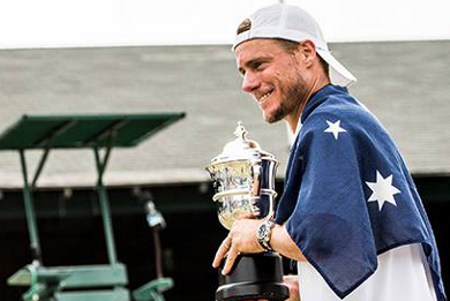
The semifinal run in London in 2013 was the last great outing of one of the best players to ever step on the Queen’s club courts. And not even the rollercoaster his career became after he peaked way too young will be able to erase Hewitt’s grass mastery of the early 2000s.
The last swing is already underway, and despite the uncertainty of when he will play his last strokes on lawn at Wimbledon and against who, one thing is known for sure: he will be greatly missed.
