


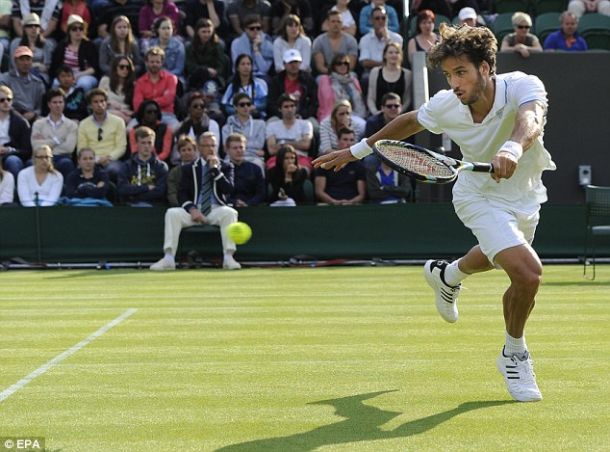

The long hair is almost a signature among his people. Among his contemporaries, Rafael Nadal and David Ferrer has already rocked it, with great success among the female audience; before him, Carlos Moyá ascended to the top of the world rankings sporting a style that so much resembles the one adopted by an entire Armada at its peak.
While his southpaw tendency is not an exclusive feature of tennis players born in Spain, one cannot simply ignore the fact that no other country has more lefties in the top-100 than his motherland. As if these two traits are not enough to put him in the same boat as the aforementioned stars (and many others), his name or place of birth erase any remaining questions. Feliciano Lopez, born in Madrid, Spain’s capital city, is, indeed, a Spaniard.
But despite sharing a lot with his compatriots, their similarities end once the favorite surface talk comes to table. Lopez, now a 33-year old (18 of them as a pro), enjoys a career-high ranking around the top-15, much of it is owned to his preference to a kind of court that before surface homogenization lured away many of his countrymen: the grass.
Feliciano is not a dirtballer. Even though Spain manufacturers clay specialists at an absurd rate and for a good while now, Lopez sits as the ugly duckling of a generation that has grown to dominate the terre batue since the early 90s. Nicolás Almagro, a 12-time titlist on the ATP tour, has never won a trophy outside the sport’s slowest surface; Fernando Verdasco and David Ferrer went on to have their earliest successes also on the dirt, while even Rafael Nadal himself, now one of the few men to have accomplished the Grand Slam, was once dubbed as a clay specialist. Rewind a few more years, and you will find a legion of Spaniards – Bruguera, Corretja, Moyá, Ferrero – thriving on the dirt. This could go on and on but you get the bigger picture.
Feliciano goes against an entire breed. His tall, slender build fits best the game’s only living surface. So does his serve, one of the most potent in the men’s tour, yet underrated at some point. It’s not just because his game looks tailor-made to thrive on grass – the classic one-handed backhand is as vintage as lawn tennis – that Feli, as his fans call him, could be placed on the top shelf of grass courters of his generation.
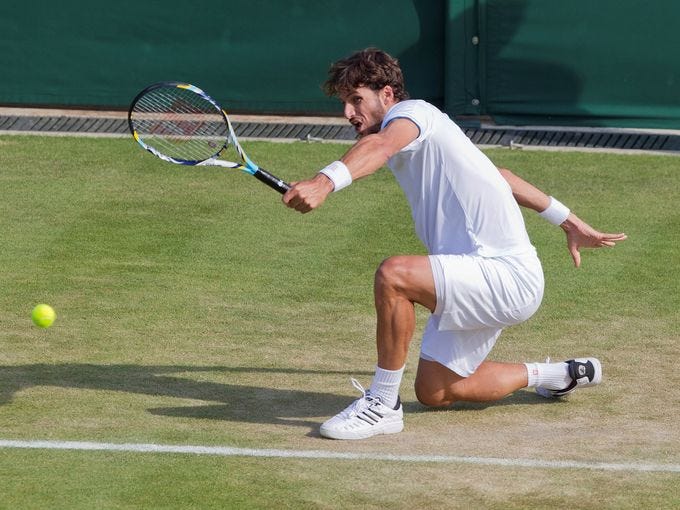
It’s actually because he has already proven himself more than once. In fact, despite losing his opening match of this swing in Stuttgart last week, Lopez has to his name 58 grass-court wins, to only 30 losses, good for a 0.659 success rate, by far his best on any surface and by a good margin too. In comparison, Feli bears a volatile 0.511 win percentage on hard courts and a below par 0.483 on the natural habitat of his compatriots.
Last year, the then-32 year old Madrid-born lefty faced one of the toughest draws possible at the Queen’s Club, en route to a final appearance, dispatching the likes of Lleyton Hewitt, Kenny De Schepper (who once had a R16 run at Wimbledon), Tomas Berdych and serve-and-volley survivor Radek Stepanek before falling to Dimitrov in the final.
He went the step further the very next week, winning the Eastbourne crown over former All-England Club semifinalist Richard Gasquet. It was also a repeat from his 2013 appearance at the AEGON International – a pivotal run to the title that put Lopez, by many acknowledged only as a veteran on the verge of dropping into irrelevance, back into some sport of spotlight, revamping his career and sending him into a magic carpet ride that is still at its highest point, at number 14 in the world rankings.

Having only three grass finals to his name and calling a specialist on this surface might be seen as an overreaction by some. But when you look back at his numbers at the biggest stage, it takes but a quick glance to realize he’s not afraid of five-setters. Lopez already had six appearances reaching the final 16 or better at Wimbledon, advancing to the quarters in three of these opportunities. Despite never reaching a major semifinal (Lopez won only 1 set in his 3 QFs combined ) and taking into consideration the fact that numbers sometimes may lie, but talent always prevails, it’s easy to find the adjective that perfectly describes Feliciano Lopez’s grass skills: an underachiever.
With Wimbledon looming in the horizon and a good amount of points to defend in the next three weeks, this lawn swing will directly affect where the veteran Spaniard will sit at the rankings in mid July. As the end of his career is closer than the beginning of it, Feliciano Lopez will likely never make a huge splash at Wimbledon, when in fact tying his best result there or even going one step further into the semifinals would be quite the accomplishment.
But it’s undeniable that when he steps onto the grass we are bound for a good show.
