


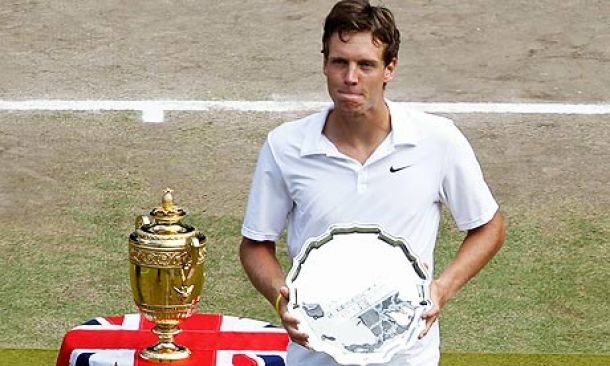

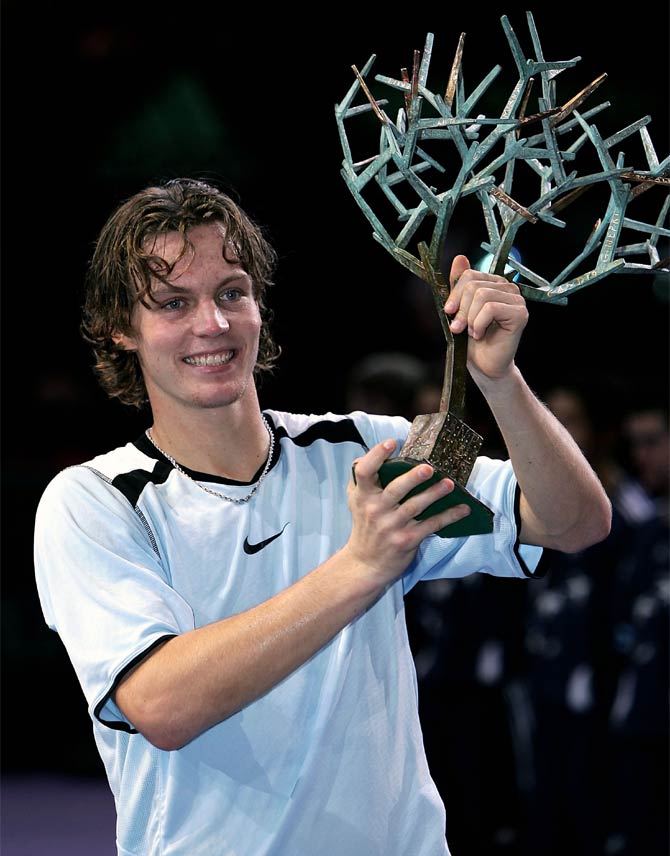
Five years ago, as the third major of the year approached, Tomas Berdych was seen with disbelief, the kind of that flirts with disappointment. Still a young 24-year-old tall, big serving Czech, the hard-hitting Berdych, for some, was a headcase who peaked way too young. Flash forward another half a decade, and you have the 2005 Bercy Masters. Out of nowhere and on the edge of the top-50, Tomas, fresh out of his teens, took out seed after seed at the most upset-prone event of the season. Coria, Ferrero, Gaudio and Stepanek all were no match for him. And not even Ivan Ljubicic, a top-10 caliber player seeking his first Masters title, could stop Berdych’s unlikely Cinderella run.
But then, it looked like that was it. Despite building on his momentum and climbing to the top-10 in 2006, as years passed and new, talented players appeared – men who would soon challenge Federer and Nadal for Masters, Slams and the top of the rankings, like Djokovic and Murray – Berdych’s career, despite the enormous potential he possessed, seemed to stagnate.
He did never leave the top-30 after breaking through, a reward for his magic week in Paris, but he also had never appeared beyond ninth in the rankings, floating around for the entire 2007, 2008 and 2009 seasons, never repeating his Bercy feat, nor even reaching another Masters final or going a step further, reaching the semifinals or better at a Grand Slam.
Until 2010 happened. Berdych’s game always looked perfect for faster courts: big serve, hard-hitting forehand, a decent backhand. A style shared between a good number of top-tenners at the time, guys like Söderling and Del Potro, who mixed in and fit their games to slower courts, thriving on every type of surface, from the indoor hard to the outdoor clay of Roland Garros.
If until the last year of the 2000s Berdych’s career mirrored in so many ways Gasquet’s – another player whose talent is undeniable, but never took the next step and right now it is unclear if he ever will – from that year on the Czech went on to build one of the most solid careers of the past decade.
His final run to the Miami Masters, losing to Roddick in Andy’s very last major title, can now be considered only the tip of the iceberg. His unlikely run to the final four at the French Open, however, was the spark he needed. In a year of many upsets – remember, Jürgen Melzer came from two sets down to beat Djokovic, Robin Söderling struck again taking out Federer and the other quarterfinal that didn’t involve Nadal had Berdych beating Youzhny after sending Murray packing the round prior – Tomas stood out, as his past results there were poor, at best – in six previous trips to the clay major, one round of 16 showing and five times alternating between first and second round losses.
But the best was yet to come. If the deep Roland Garros run only had him rise four spots in the rankings, up to 13th, Wimbledon set him for even bigger achievements.
He skipped his usual pre-Wimbledon preparation in Halle, where he had been playing since 2006. Berdych started his grass season at lawn’s biggest stage and it worked.
Seeded 12, Berdych had little trouble to get rid of his first two opponents – Kazakhstan’s Andrey Golubev (7/6, 6/2, 6/2) and Germany’s Benjamin Becker (7/5, 6/3, 6/4) – none of which ranked beyond 71 in the world. A third foe ranked 70-plus ensued, as he then faced Denis Istomin, who sat at 70 that week.
For the only time at the All-England Club that year, he either pushed or was pushed to five sets. Istomin, acknowledged as a talented player able to at least bother the tops, had beaten Rainer Schütller, a former semifinalist at SW19, in the second round, following up his upset of the 20th seed Stan Wawrinka in the first round, both triumphs coming in the fifth and final set.
Against Berdych, it was no different. Three tiebreaks in the first three sets, of which Istomin won two – the second, by a 10-8 scoreline. However, with only one set to bag in order to reach the second week of the most prestigious slam of the calendar, the Uzbekistan native ran out of gas. Tomas claimed the fourth and fifth sets – 6/3 and 6/4 – to seize a round of 16 berth, successfully defending his 2009 result.
Luck flashed his smile to Berdych in the fourth round. With only one win to go before matching what would be his better slam finish before the unlikely Roland Garros semifinal run, the Czech had between him and the “elite eight” Daniel Brands, the 98th player in the world rankings. Brands, who never broke through the top-50, had won three matches at that year’s Wimbledon – right now, he owns only seven grass wins to show for his entire career – including upsets of Igor Andreev, 7th-seeded Nikolay Davydenko and 31st-seeded Victor Hanescu.
The German even tried to brew another upset, winning the first set 6/4, but was denied by Berdych in the next three sets, 7/6, 7/5, 6/3. A tight win that represented a second quarterfinal appearance at a major in a single month time – prior to the French Open, Tomas had only one under his belt, in a career that was entering its seventh full season among the pros.
Ahead of him, the defending champion. The arch-nemesis of an entire generation, the all-time leader in Grand Slam titles among men, the man who owned the head-to-head against pretty much everyone on the tour – and led theirs 8-2 at the time. Roger Federer.
Berdych had already defeated Federer twice – in their very first meeting, at the 2004 Olympics, and earlier in 2010, during his Miami final run – but beating Roger, even if he was going through his first “decline” (his Grand Slam semifinal streak had just been snapped at Roland Garros), at a Grand Slam was a whole new ballgame.
And Berdych rose to it. He won the first set a solid 6/4, but dropped the second, 3/6. Questions on whether he would crumble, much like their 2009 Australian Open meeting, arose, but were soon erased as he dished a breadstick to the top-ranked Swiss. The fourth set was also decided by a single break, but one that was enough to propel Tomas to his second consecutive Grand Slam semifinal, 6/4. Federer was gone and for the first time, Berdych was being taken in consideration for a run to the final – or even more. Like he had finally broken the bubble that kept him far away from the top dogs of the sport.
He had made a statement. And he would have to back it up against Novak Djokovic, seeking his first Wimbledon final (and at the time only a one-time major winner), in the final four.
Back then, they had only met twice, with Nole triumphing in both occasions. However, now it is crystal clear how dominant is Djokovic against his Czech counterpart. As of today, their head-to-head favors the Serbian, 19-2. Yes, seventeen more wins than losses. In 2010, though, Djokovic still lived in the shadow of Federer and Nadal, making the final adjustments before taking the tour by assault the next year.
But before that, he was schooled by Tomas Berdych. 6/3, 7/6(11), 6/3, a match on which one of the world’s best returners only broke the big serve of the Czech once, while failing to hold his own serve three times. Berdych followed his breakthrough with another, bigger breakthrough. Weeks after reaching his first slam semifinal, he was set to contest his first major final, against Rafael Nadal – and after two comfortable wins against the world number two and three, the odds were looking good his way.
Would he follow Del Potro’s steps and conquer the greatest glory a tennis player can in the era of the Big 4? Will he vanquish three of the four most feared tennis players in the world for an epic win? Is he ready to contend for the top stop in the rankings, week in week out?
For most of these questions, the answers are the same. No. He lost to Nadal in straights, leaving the All-England Club with a bittersweet taste in the mouth. But that was not the end of BerdMagic.
Those two weeks at the All-England Club five years ago opened a lot of doors to him. Opportunities appeared aplenty, and he took many of those, while also missing out on some. Overall, despite leaving SW19 with a loss, he built – and, as of today, still builds – momentum off his runner-up campaign.
Later that year, he established himself in the top-10 for good – next week he will complete five consecutive years among the ten best players of the world – and from that on, reached new highs, that peaked a couple months back, as he finally broke through the top four, at number 4.
However, despite being one of the steadiest player on tour, Berdych never replicated his Wimbledon success, losing the next three slam semifinals he contested. He also lost two more Masters finals, and a good number of semifinals and quarterfinals. Even though the general impression is that he could and should win more above the 500 level, one thing is for sure: every career has its turning point. And Berdych knew how to capitalize on his.
