
League
Brasileirão Feminino · History

Other languages2
ADVERTISEMENT
The Campeonato Brasileiro de Futebol Feminino Série A1 is the top national division of women’s football in Brazil, run by the Brazilian Football Confederation (CBF). The first edition was played in 2013 in partnership with the state bank Caixa Econômica Federal. Entry went to the 20 highest-placed sides in the CBF women’s football ranking. Centro Olímpico, from São Paulo, won the title after beating São José 2-2 and 2-1 over two legs in the final.
The Campeonato Brasileiro de Futebol Feminino Série A1 is the top national division of women’s football in Brazil, run by the Brazilian Football Confederation (CBF). The first edition was played in 2013 in partnership with the state bank Caixa Econômica Federal. Entry went to the 20 highest-placed sides in the CBF women’s football ranking. Centro Olímpico, from São Paulo, won the title after beating São José 2-2 and 2-1 over two legs in the final.
The early years (2013-2016)
Each of the first four editions produced a different champion. In 2014, Ferroviária, from Araraquara, won both legs of the final against Kindermann, from Santa Catarina, 3-0 and 5-3. In 2015, Rio Preto took the trophy after a 1-0 win and a 1-1 draw against São José. Flamengo won the 2016 edition by turning the final around against Rio Preto. They lost the first leg 1-0 and won the second 2-1. During those years, the national calendar also included the Copa do Brasil for women’s teams.
The creation of Série A2 in 2017
In 2017 the CBF reorganised the pyramid. The top flight was cut from 20 to 16 clubs, and a Série A2 was created, also with 16 teams. As a result, the women’s Copa do Brasil was discontinued. Santos won the first edition under the new format, beating Corinthians 2-0 and 1-0 in the final. In 2018, Corinthians claimed their first national title, defeating Rio Preto 1-0 and 4-0. A year later, Ferroviária won their second championship against the same Corinthians side. After two draws, 1-1 and 0-0, the final went to penalties, and the Araraquara club won the shootout 4-2.
The 2019 licensing requirement
In 2019 the CBF club licensing regulations came into force, requiring all 20 clubs in the men’s Série A to run a senior women’s team and a women’s youth team. CONMEBOL applied the same rule to clubs entered in its tournaments, with exclusion from competition as the sanction. Compliance was uneven: for a time, fewer than half of the Série A clubs met the CONMEBOL requirement. The CBF also stated that the rule did not oblige clubs to sign players to formal employment contracts.
ADVERTISEMENT
New divisions and a sponsor’s name (2021-2024)
A Série A3 with 32 clubs was announced in 2021, giving the women’s game three national divisions. From 2021 to 2024 the championship carried the commercial name Brasileirão Feminino Neoenergia, after its sponsor.
The Corinthians run (2020-2025)
From 2020, Corinthians won six titles in a row. In the 2020 final they beat Kindermann after a goalless first leg and a 4-2 win in the return. In 2021 they defeated Palmeiras 1-0 and 3-1. In 2022 they drew 1-1 with Internacional before winning the second leg 4-1. In 2023 they got past Ferroviária with a 0-0 draw and a 2-1 win. The 2024 final was against São Paulo, which they won 3-1 and 2-0, and it drew a crowd of 44,529. In 2025 the opponent was Cruzeiro, and Corinthians lifted the trophy after a 2-2 draw and a 1-0 win. Counting the 2018 championship, Corinthians won seven titles between 2018 and 2025.
São Paulo’s first title (2026)
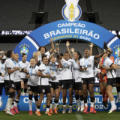
The Corinthians run ended in 2026, in another final between the two clubs from the city of São Paulo. In the first leg, on 26 September at the Neo Química Arena, Corinthians scored after nine minutes. Giovana Crivelari equalised on 20 minutes and Isa scored the winner in the second half: Corinthians 1, São Paulo 2. In the second leg, on 3 October at the Morumbi, a 1-1 draw gave São Paulo their first national title in women’s football, 3-2 on aggregate. Goalkeeper Carlinha saved a penalty in that match. The champions received 2 million reais, the largest prize the competition had paid up to that point, and the runners-up received 1 million. The match at the Morumbi drew 49,405 spectators, beating the 44,529 at the 2024 final.
ADVERTISEMENT
Profile compiled by the VAVEL Editorial Team from historical records and official competition data. · Editorial policy