
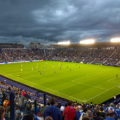
Stadium
Ciutat de Valencia · Profile

Other languages2
ADVERTISEMENT
In 1997 the Estadi Ciutat de València, Levante UD’s ground in the Orriols district of Valencia, was fitted with seats throughout, as the Spanish professional football league required. Until then only the main stand had seating, and the stadium had been built in 1969 to hold just over 30,000 spectators. It sits on Calle San Vicente de Paúl, in the San Lorenzo neighbourhood, on roughly 40,000 square metres of former market-garden land, and the pitch measures 107 by 68 metres. The ground is owned by Levante UD, who have played their home games there since it opened.
In 1997 the Estadi Ciutat de València, Levante UD’s ground in the Orriols district of Valencia, was fitted with seats throughout, as the Spanish professional football league required. Until then only the main stand had seating, and the stadium had been built in 1969 to hold just over 30,000 spectators. It sits on Calle San Vicente de Paúl, in the San Lorenzo neighbourhood, on roughly 40,000 square metres of former market-garden land, and the pitch measures 107 by 68 metres. The ground is owned by Levante UD, who have played their home games there since it opened.
From Vallejo to Orriols
Levante UD was formed in 1939 through the merger of Levante FC and Gimnástico FC, and took the name Levante Unión Deportiva in 1941. For almost three decades the club played at the Estadio de Vallejo, the ground Gimnástico had settled into in 1925. In 1963 the team won promotion to the Spanish top flight for the first time, and a few years later the board decided to move. In 1968 the club sold the Vallejo site and began building a new stadium in Orriols, an area then covered by farmland. The project cost 62 million pesetas.
The 1969 opening
The stadium opened in September 1969 with a match between Levante UD and Valencia CF, under the presidency of Antonio Román, who had driven the project. The first competitive fixture followed on 14 September 1969 in the Spanish fourth tier, then called Tercera División: Levante beat Palma, RCD Mallorca’s reserve side, 1-0, and Navarro scored the ground’s first official goal. The club was opening its new home a long way below the top division it had reached six years earlier.
Three names in three decades
From 1969 to 1972 the ground carried the name of the president who built it: Estadio Antonio Román. From 1972 it became known as the Nuevo Estadio, or Nou Estadi del Llevant, and kept that name for the rest of the century. In 1999 it was renamed Estadio Ciudad de Valencia, Estadi Ciutat de València in Valencian, although supporters still often call it simply Orriols, after the neighbourhood.
ADVERTISEMENT
Renovations and the new roof
Installing seats across every stand in 1997 brought the original capacity down. In 2016 the stadium’s exterior was given a new look, and in September 2020 the club signed a planning agreement with Valencia City Council that opened the way to enlarging and remodelling the ground. The most visible work was completed in 2020: a new roof over the stands, video scoreboards and ambient lighting, changes that slightly reduced capacity. In 2021 the council processed the planning amendment needed for a deeper redevelopment of the stadium.
The Spain national team
On 3 September 2004 the ground hosted the senior Spain national team for the first time, in a friendly against Scotland. Iker Casillas captained Spain for the first time that night. With the score at 1-1, shortly after Raúl converted a penalty, a cloudburst caused a power cut and the match could not be restarted. Spain’s first competitive game at Orriols came on 8 September 2014: a 5-1 win over Macedonia in qualifying for Euro 2016, with goals from Paco Alcácer, his first for the senior side, Sergio Busquets, Sergio Ramos, David Silva and Pedro.
Europe, rugby and other tenants
In the 2012-13 season Levante played six UEFA Europa League matches at home, the first European fixtures staged at the ground. On 30 August 2012 they beat Motherwell 1-0 in the play-off round; in the group stage they hosted Helsingborgs, Twente and Hannover 96; on 14 February 2013 they beat Olympiacos 3-0 in the round of 32, and on 7 March 2013 they drew 0-0 with Rubin Kazan in the first leg of the last 16, a tie they lost in extra time in the return. The stadium has also staged rugby: the 2018 Copa del Rey final, won 20-16 by VRAC Quesos Entrepinares against Club de Rugby El Salvador, and another final in 2024, in which Recoletas Burgos beat VRAC 20-19. Between September and November 2022 Villarreal CF played their competitive home games there while the Estadio de la Cerámica was being rebuilt. On 26 March 2026 Ukraine, unable to play at home because of the war, used Orriols as their home ground for the European World Cup play-off semi-final: Sweden won 3-1, with a hat-trick from Viktor Gyökeres.
ADVERTISEMENT
Profile compiled by the VAVEL Editorial Team from historical records and official competition data. · Editorial policy