
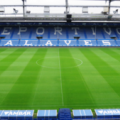
Stadium
Mendizorroza · Profile

Other languages2
ADVERTISEMENT
The 1998-99 redevelopment, carried out after Deportivo Alavés won promotion to the Spanish top flight, closed in the corners of the Estadio de Mendizorroza and set its capacity at 19,840 spectators. The ground, Mendizorrotza in Basque and simply «Mendi» to supporters, stands on Paseo de Cervantes in Vitoria-Gasteiz. It opened on 27 April 1924, the eve of the feast of Saint Prudence, patron saint of Álava. The stadium is owned by Vitoria-Gasteiz City Council and operated by Deportivo Alavés, its tenant since the first day. Among the grounds of Spanish professional football that have never moved site, only El Molinón and Mestalla are older.
The 1998-99 redevelopment, carried out after Deportivo Alavés won promotion to the Spanish top flight, closed in the corners of the Estadio de Mendizorroza and set its capacity at 19,840 spectators. The ground, Mendizorrotza in Basque and simply «Mendi» to supporters, stands on Paseo de Cervantes in Vitoria-Gasteiz. It opened on 27 April 1924, the eve of the feast of Saint Prudence, patron saint of Álava. The stadium is owned by Vitoria-Gasteiz City Council and operated by Deportivo Alavés, its tenant since the first day. Among the grounds of Spanish professional football that have never moved site, only El Molinón and Mestalla are older.
Origins and early years
Construction began in 1923 on farmland at the edge of the city. Alavés had been founded in 1921 and waited three years for a home of its own. Mendizorroza was conceived as part of a sports ground that also included a velodrome and a tennis court, and the opening day combined a cycle race and athletics events with the first football match, Alavés against Unión Deportiva Deusto. Pérez Muga scored the first goal on its pitch. The original ground held around 8,000 people, with large open terraces and a small main stand. In 1928 it staged a semi-final of the Spanish Championship, in which Alavés lost 5-0 to FC Barcelona.
A stage for the life of the city
The stadium soon hosted events beyond football. In 1934, on its tenth anniversary, it held the third edition of Aberri Eguna, the Basque national day, with a festival of dantzaris and political speeches. In May 1959 the local Press Association organised a charity match of «fat against thin», with players arriving from Bilbao, and in 1961 the ground staged another cycle race. Ownership later passed from the club to the City Council, and the venue became part of a municipal complex that includes swimming pools, an athletics track, the Ogueta and Olave pelota courts and the Mendizorroza sports hall.
Two clubs, one pitch
For more than two decades, from the 1950s into the 1970s, Alavés shared the ground with Club Deportivo Vitoria, and derbies between the two were played at Mendizorroza. The Heraldo Alavés report of a 2-1 Alavés win over Barakaldo in 1954 put the crowd at around 20,000 and called it «the largest gate the ground has seen». Photographs from the period show the pitch under snow that same year and again in 1958, after a heavy snowfall.
ADVERTISEMENT
Promotion in 1998 and the major rebuild
In the 1997-98 season Alavés sealed its return to the top flight with a 3-0 win over Rayo Vallecano on matchday 40, played at Mendizorroza. That promotion, the club’s third to the first division, led to the 1998-99 redevelopment, the most significant in the stadium’s architectural history: the corners were enclosed and the ground took on its 19,840-seat layout.
The European nights of 2001
The stadium hosted European football for the first time in the 2000-01 UEFA Cup. Gaziantepspor, Rosenborg, Inter Milan and Kaiserslautern all visited Vitoria. On 15 February 2001 Alavés drew 3-3 with Inter in the first leg of the round of 16, then won 2-0 at San Siro. On 5 April 2001 they beat Kaiserslautern 5-1 in the first leg of the semi-final and completed the job with a 4-1 win in Germany. The run ended with a 5-4 defeat to Liverpool in the final in Dortmund on 16 May 2001. The club returned to the competition in 2002-03 and went out to Beşiktaş in the second round.
National sides and women’s football
The Basque Country national team played at Mendizorroza on 5 August 1980, during the La Blanca festivities, and beat Hungary 5-1. It returned on 12 October 2018 to defeat Venezuela 4-2, and in 2022 the Basque women’s team beat Chile 3-0 on the same pitch. On 31 March 2019 Alavés Gloriosas made their debut at the stadium in a Segunda División derby against Athletic Club B.
Expansion plans and centenary
In December 2016 club president Josean Querejeta announced a modernisation plan that would raise capacity to around 28,000. In June 2020 Alavés said the project would be delayed by at least a year because of the economic fallout of the COVID-19 pandemic. The stadium reached its hundredth anniversary on 27 April 2024, the same year in which Alavés marked its 600th match in the Spanish top flight on its pitch.
ADVERTISEMENT
Profile compiled by the VAVEL Editorial Team from historical records and official competition data. · Editorial policy