
Stadium
Sánchez-Pizjuán · Profile

Other languages2
ADVERTISEMENT
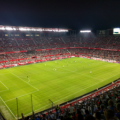
The Estadio Ramón Sánchez-Pizjuán stands in the Nervión district of Seville, Spain, and has been the home of Sevilla Fútbol Club, which owns it, since it opened on 7 September 1958. It was designed by the architect Manuel Muñoz Monasterio, the pitch measures 105 by 68 metres, and it bears the name of the club president who drove its construction.
The Estadio Ramón Sánchez-Pizjuán stands in the Nervión district of Seville, Spain, and has been the home of Sevilla Fútbol Club, which owns it, since it opened on 7 September 1958. It was designed by the architect Manuel Muñoz Monasterio, the pitch measures 105 by 68 metres, and it bears the name of the club president who drove its construction.
Origins of the project
Before settling in Nervión, Sevilla played at the Tablada racecourse, the Campo de la Victoria and the Estadio de Nervión, an ageing ground by the middle of the century. Ramón Sánchez-Pizjuán, club president from 1932 to 1941 and again from 1948, began negotiating the purchase of the land in 1937 and argued for a large-capacity stadium. In January 1954 the club launched a design competition for a ground holding more than 50,000 spectators. Sánchez-Pizjuán died on 28 October 1956, before building began. His successor, Ramón de Carranza, laid the foundation stone on 2 December 1956, and the stadium took the late president’s name.
Opening and early years
On 7 September 1958 Sevilla opened the stadium with a friendly against Real Jaén that ended 3-3. The first competitive match came two weeks later, on 21 September 1958, and it was a derby: Real Betis won 2-4. The work was not finished in 1958. The enclosure of the stands was completed in early 1975, taking capacity above 77,000, the largest figure the ground has ever held.
The 1982 World Cup and the 1986 final
Seville’s selection as a host city for the 1982 FIFA World Cup brought the first major overhaul. The main stand was roofed, an electronic scoreboard and floodlights suitable for colour television were installed, and the main façade received Santiago del Campo’s ceramic mosaic of club crests. Capacity was reduced under the new regulations. The stadium staged two matches at the tournament: on 14 June Brazil beat the Soviet Union 2-1 in the first round, and on 8 July West Germany and France met in the semi-final, which finished 3-3 after extra time and went to the Germans 5-4 on penalties.
ADVERTISEMENT
Four years later, on 7 May 1986, the ground hosted the European Cup final between FC Barcelona and Steaua Bucharest. The match ended 0-0 and the Romanian side won the shoot-out 2-0, with Helmuth Duckadam saving all four of Barcelona’s penalties in front of around 70,000 spectators.
The Spain national team
Nervión has been one of the venues most often used by the Spain national team, which has played more than twenty matches at the stadium without losing. The best remembered came on 17 November 1993, when Spain beat Denmark 1-0 with a header from Fernando Hierro to qualify for the 1994 World Cup in the United States.
Redevelopment and capacity
The all-seater requirement introduced under UEFA rules in the late 1990s cut capacity from 62,000 to around 45,500 in 1998. In 2005, to mark the club’s centenary, a second allegorical mosaic by Ben Yessef was built behind the south goal. In the summer of 2015 the stadium underwent a full renovation that set capacity at 42,714 seats, and further work in 2018 raised it to 43,864.
European finals in the 21st century
On 18 May 2022 the Ramón Sánchez-Pizjuán staged its first UEFA Europa League final, a competition Sevilla have won more often than any other club. Eintracht Frankfurt faced Rangers: Rafael Borré cancelled out Joe Aribo’s opener, the match finished 1-1 after extra time and the German side took the trophy 5-4 on penalties, with 38,842 spectators in the stands.
ADVERTISEMENT
Profile compiled by the VAVEL Editorial Team from historical records and official competition data. · Editorial policy