
Stadium
Vicente Calderón · Profile

Other languages2
ADVERTISEMENT
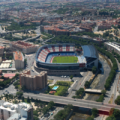
The Estadio Vicente Calderón stood in Madrid, on the banks of the Manzanares river and right next to the M-30 ring road. It was Atlético de Madrid’s ground from 2 October 1966 until 21 May 2017, the date of the club’s last competitive game there before it moved to the Metropolitano. It opened as the Estadio Manzanares with room for 62,000 spectators. It closed with 54,907 seats and was demolished in 2019 and 2020.
The Estadio Vicente Calderón stood in Madrid, on the banks of the Manzanares river and right next to the M-30 ring road. It was Atlético de Madrid’s ground from 2 October 1966 until 21 May 2017, the date of the club’s last competitive game there before it moved to the Metropolitano. It opened as the Estadio Manzanares with room for 62,000 spectators. It closed with 54,907 seats and was demolished in 2019 and 2020.
Construction and opening
Work began on 3 August 1959 on land beside the Manzanares riverbed. The project was signed by architect Javier Barroso and Miguel Ángel García-Lomas. Construction took seven years. The stadium opened on 2 October 1966 with a league game against Valencia that ended 1-1, and Luis Aragonés scored the first goal in the 19th minute. Not everything was finished that day: the Preferencia stand, which ran along the river, was the last to be completed, in 1972. Its location was its most recognisable feature, with the M-30 running beneath that stand.
The name and the redevelopments
In its early years the ground was known to everyone as the Estadio Manzanares. At a General Assembly held on 14 July 1971, the club voted to rename it the Estadio Vicente Calderón in honour of the president of the time, and the name stayed until it closed. A redevelopment with a budget of 451 million pesetas was carried out in 1980. It was led by Juan José Barroso, son of the architect who had designed the stadium. On 16 December 2002 UEFA gave it five-star stadium status, which allowed it to host the finals of UEFA competitions.
The 1982 World Cup, cup finals and Spain
At the 1982 World Cup it hosted all three games in Group D of the second round. France beat Austria 1-0 on 28 June and Austria drew 2-2 with Northern Ireland on 1 July. France then beat Northern Ireland 4-1 on 4 July to win the group. It also regularly hosted the Copa del Rey final, staging the finals of 1973, 1974, 1975, 1977, 1979, 1981, 1986, 1989, 1994, 2005, 2008, 2012, 2016 and 2017. The Spain national team played eleven games at the stadium and won all eleven. The last was a 1-0 win over Italy in March 2014.
ADVERTISEMENT
A concert venue
The stadium also hosted big music tours. After the redevelopment, the first concert was by the Rolling Stones in 1982. Genesis, David Bowie and Pink Floyd played there in 1987, Bruce Springsteen and Michael Jackson in 1988, and Madonna and Prince in 1990. Muse played in 2010 and Coldplay in 2012. The last concerts came in 2017, with Guns N’ Roses and Alejandro Sanz.
The 2017 farewell
Atlético played 1,227 games at the Calderón, with 775 wins, 257 draws and 195 defeats, and scored 2,308 goals while conceding 1,038. The club’s last competitive game at the ground was on 21 May 2017, on the final day of the league season, against Athletic Club. Fernando Torres scored twice in the first ten minutes and Iñaki Williams pulled one back in the second half. Ángel Correa made it 3-1 in the 89th minute with Atlético’s last competitive goal at the stadium. Six days later, on 27 May, the ground hosted the Copa del Rey final: Barcelona beat Alavés 3-1 with goals from Messi, Neymar and Paco Alcácer, and Theo scored for Alavés. On 28 May a veterans’ match was played there, which Atlético lost 5-4. Juan Carlos Pedraza scored the final goal in the 86th minute.
Demolition
Demolition began in 2019. As part of the work, on 8 November 2019 the M-30 was diverted across the old pitch so that the section running under the main stand could be removed. The demolition was completed on 6 July 2020, when the last remaining stand came down.
ADVERTISEMENT
Profile compiled by the VAVEL Editorial Team from historical records and official competition data. · Editorial policy