




In Madrid, where Paseo de Recoletos and Calle de Alcalá meet, with its main façade facing the goddess Cibeles, stands the 19th-century Linares Palace.
Construction began in 1877 to house the Marquises of Linares, who lived in the palace from 1884 onwards. José de Murga y Reolid, heir to a great fortune, fell in love with a young woman of extreme beauty but humble origins, the daughter of a cigarette maker in the Lavapiés neighborhood, where Spain's main tobacco factory was located.
ADVERTISEMENT
The young woman's name was Raimunda Osorio, and when José's father, Mateo de Murga, found out her name, he forbade his son from having any contact with her. But despite the prohibitions and the estrangement José suffered, they did not prevent the young man from eventually learning his father's reasons for preventing his romance: Raimunda was his sister, the result of an extramarital affair between Mateo de Murga and the cigarette maker.
Despite everything, José and Raimunda obtained a papal bull, ‘Casti convivere’, which allowed them to live together, but in chastity. However, they conceived a girl, ‘Raimundita’, who was walled up shortly after birth so that the fruit of incest would never be known. Since then, it is said that the ghost of ‘Raimundita’ roams the palace.
Whether or not this was the reason, the palace remained closed and sealed for almost a century, ensuring that its decoration and furnishings have remained largely unchanged to this day. It reopened its doors as Casa de América in 1992, coinciding with the fifth centenary celebrations as Casa de América.
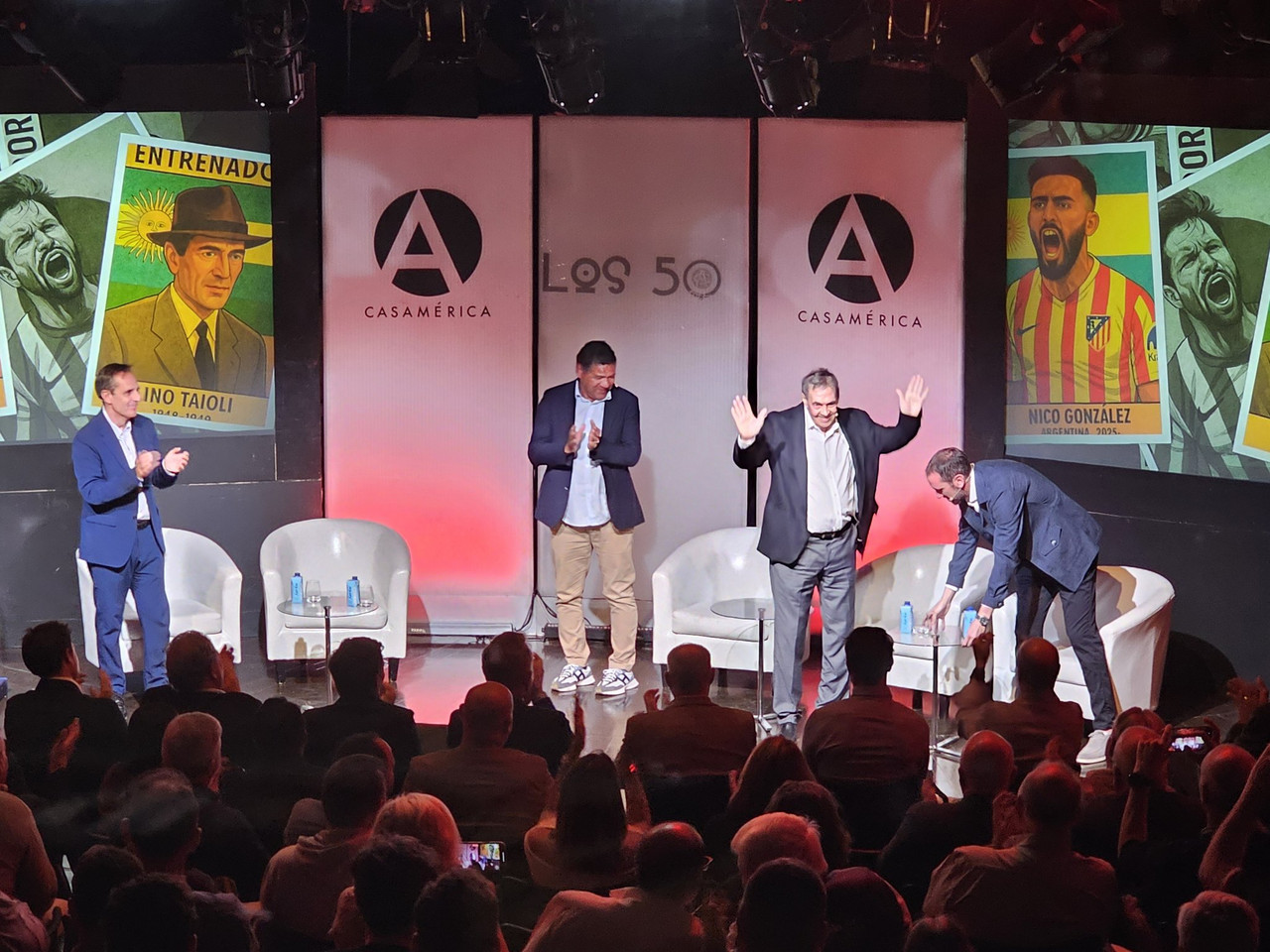
Today, as autumn slowly descends on Madrid, when the main avenues of the capital are filled with banners and military marches, when army troops practise the parade that will commemorate, in a few hours, the Fiesta de la Hispanidad and Spain's National Day, at La Casa de América, a melting pot where both cultures merge, red and white football legends from across the Atlantic have gathered, convened by the cultural association ‘Los 50’ and splendidly organised by one of its members, Javier Laguna Sanz, red-and-white football legends from across the Atlantic, while in the background the current Atleti team triumphed over Inter in Libya (1-1, pen 4-2).
ADVERTISEMENT
-
Why this date and this event?
At 7:03 p.m., the Gabriela Mistral amphitheater at Casa de América was filled, as on a few other nights. Amid greetings, applause, and chants, Madrid knew it was playing host, as it was Atleti who had invited them. Three former South American players, who had written golden pages in the club's history, responded to the call: Rubén Cano, Donato Gama, and Diego Godín. Another member of ‘Los 50’, Juan Pedro Valentín, a well-known journalist and TV presenter, was the director and host of the event. He quickly opened the proceedings, with that mixture of familiarity and reverence that only happens when football enters the realm of legend.
The colchonero sentiment ran high, and soon Petón and Jorge Lera, the designated masters of ceremonies, brought up the term “indios”—that nickname had been affixed to Atlético in the seventies, first as a slur for the influx of South Americans on the roster, later adopted as a badge of identity and pride. Rubén Cano, with the straight honesty of those who’ve seen both the bright lights and the mud, recalled how that name followed him even to the national team—a reminder of how labels stick, and how, with time, they are transformed by those who wear them.
Donato, recounting his arrival from Vasco de Gama, remembered the warmth of the dressing room, a moment when football transcended borders. The event served as a living tribute to the more than 120 South American players who have worn the red-and-white since José Alberto Valdivieso crossed the Atlantic in 1947.
Atlético is an ever-spinning compass with roots that grip the two continents. This story forges its identity not only in titles but also in the brotherhood of its people.
ADVERTISEMENT
A highlight of the night came with Rubén Cano’s pointed sentence, one that could fly as an editorial headline: “Real Madrid were always helped.” Delivered without bitterness, but with the authority of memory, it echoed in a room where everyone knew the weight of every syllable. Cano also shared moments from his dual trajectory as a player and a manager, reflecting on the pride of his Atleti years and the frustrations of working within a football world where negotiations for talents like Ronaldo Nazario could be lost in a tangle of interests and “mysterious” interventions.
Diego Godín, ever the embodiment of old-school values, insisted that the club’s greatest treasure remains its spirit: humility, hard work, and a sense of belonging—virtues to safeguard in an era when clubs are more corporations than families. His words resonated as a warning to the future: never abandon your roots, no matter how far success may take you.
As the night drew to a close, applause still echoing across the ornate ceilings, it wasn’t just nostalgia that filled the Casa de América, but a renewed sense that Atlético, in the face of globalization and the march of modern football, endures as one of the last holdouts of character and belonging. The Atleti doesn’t just tell stories—it multiplies them, adds verses, and turns old wounds into new flags.
This act, wedged between the ghosts of a palace and the drums of a city awakening for its national day, became a celebration not only of football but of the enduring bridge between Ibero-America and Madrid. Because, as Godín and Cano showed, legends aren’t made just by goals—they are forged in shared values, respectful silences, and the memory of a crowd that, even one night in autumn, sings with a passion that defies the ages.
ADVERTISEMENT
