

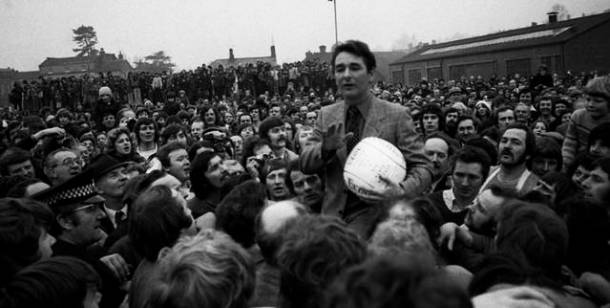

Despite being one of the most controversial figures in the history of English football, Brian Clough will always remain to be one of the greatest managers to have managed in this country, along with his lesser-known, but just as important assistant Peter Taylor. Clough was famous for not only his feud with Leeds United hero Don Revie which spanned several years, but also for taking smaller teams to unlikely success, a feat matched by very few managers before or since.
Born in Middlesbrough in 1935, Clough was one of nine children born to a working-class couple in the Yorkshire city. He served in the RAF in the 1950s, as well as showcasing his talent in multiple sports, including cricket and football. Once he returned from his national service in 1955, he turned his attentions to football, and became professional in the same year with his hometown club, and the club he supported as a boy, Middlesbrough. He only played for Boro for six years, but was a prolific striker in those six seasons, scoring 202 goals in just 222 games. That is a record that is matched by very few strikers in any era.
However, despite his successes with Boro, he was known to regularly submit transfer requests, and also have a tense relationship with some of his fellow teammates. In 1961, one of these requests was accepted, and he moved to rivals Sunderland for £55000, which was a lot of money in that era. He only played 74 games for the Black Cats, but still scored an impressive total of 64 goals in his three years at the club. Unfortunately, in 1962, he suffered an injury against Bury which would be the one to ultimately end his career, as it forced him to retire at the age of just 29.
It was at Sunderland that he met one of the men who would be an inspiration for him during his managerial career. This man was Alan Brown, a strict manager who also managed Burnley and Sheffield Wednesday. Clough later credited Brown with having a huge influence on his managing style. Brown was well-known to fine players for minor offences, in order to impose a strict code of conduct upon his players. Whilst Clough may not have been exactly the same as this in his tenure as a manager, he adopted many of the same traits on his way to success.
It took Brian Clough just a year after retiring to get back into the job, after he joined Hartlepools (now Hartlepool United) as their new manager in 1965. Despite the club having had to apply for re-election to the Football League several times in the few years before Clough joined them, the new manager and his assistant Peter Taylor were able to successfully turn round the club’s fortunes, leading the club to an 8th place finish in the Fourth Division, in his two seasons with the club. This was to be the first of many successes that the duo of Clough and Taylor had.
After the pair’s successes at Hartlepools, they moved to a struggling Derby County side, who had been languishing at the bottom of the old Second Division for several years. However, the signings of players like Dave Mackay turned around the club’s fortunes, and the Rams were promoted to the First Division in just their second season under Clough. The season after, they finished 4th in the league, before then being crowned as league champions two years later, defying teams such as Leeds United in an amazing story. This was Derby’s first league triumph in their history, and earned them a place in the European Cup for the next season. In this, the amazing story continued as Derby reached the semi-finals, where they were eventually knocked out by Juventus. Even though they didn’t go all the way, it was still a terrific achievement for Clough and Taylor.
Despite the pair’s success in Derbyshire, their spell ended in controversy as both men resigned after numerous disputes with the board of directors. This led to heavy protests from the fans, who demanded that both Clough and Taylor be reinstated, and that the board (most notably, the chairman, Sam Longson), be removed from the running of the club. Such was the loyalty to the pair that their entire backroom team followed suit in walking out on the club, and then following them to their next job at Brighton and Hove Albion.
Just weeks after their resignation from Derby County in 1973, both Clough and Taylor took over at Brighton, who were lying at the bottom of the Third Division at the time. Even considering their previous successes as a pair, their spell with Brighton was less than successful, as Clough won just 12 of his 32 games in charge, including an 8-2 home loss to Bristol Rovers.
Don Revie was one of the most successful managers in English football in this era, guiding Leeds United to great success in this era, winning almost everything in his thirteen years with the club, thanks to players such as Billy Bremner and Johnny Giles. It was no secret that Clough held a great dislike for both Revie and Leeds United, so when Revie departed to manage the England national team in 1974, it came as a great shock when Clough was appointed as his successor, although this time without Peter Taylor, as he elected to stay at Brighton.
It was at Leeds that he was humbled as a manager, after just one win in six games, before being sacked as the manager after just 44 days in the job. I believe the main reason he failed is because he alienated many of the club’s star men, such as Giles, Bremner, and Norman Hunter. This came from his endless criticism of the Leeds style of play which he called “dirty” and “cheating”. After such a high level of criticism of the club over the years, it was going to be very difficult for him to succeed at Elland Road, which he ultimately failed to do.
I think his short spell at Leeds shows how essential Peter Taylor was in Clough’s success. Whilst Clough was motivational and the tactical one out of the pair, Taylor was instrumental in some of the key purchases for the pair, such as Dave Mackay and Colin Todd and Derby County, who both proved integral parts of the Derby side under Clough. Whether Clough’s failure at Leeds was down to poor relationships with the players, or the lack of Peter Taylor, or a mixture of both, we’ll never know, but it’s certain that Taylor was a key part of Clough’s success.
After his failure at Leeds, Clough took over Second Division side Nottingham Forest in 1975, before being joined by Peter Taylor a year later. The two enjoyed great success with Forest, winning the First Division just two-and-a-half years after Clough took over. This won him a place in the European Cup for the 1978-79 season, and after his previous success with Derby, it would have been difficult to top it. However, he did manage that, winning the trophy in 1979, and then for a second time a year later, which is a feat not matched by a British manager since. He also won 4 League Cups at Forest, as well as being named Manager of the Year in his title-winning season. He remained at the Reds for over eighteen years, and brought great success to The City Ground, cementing his place as one of the greatest managers of all time.
Throughout the 1970s and 80s, fans repeatedly called for Clough to be given the job as England manager, and although he was interviewed by the FA for the post on two occasions, he was pipped by other managers on both occasions. It is often thought that England’s governing body were reluctant to appoint Clough as the manager of one of the most prestigious jobs in the country because of his outbursts and criticisms of some of the game’s leading figures throughout his career. This was in a period when England were relatively poor as a national side, often failing to qualify for competitive tournaments, and with the success of Clough at club level, he could have been the man to turn around England’s fortunes in this period. Since his retirement, he has often been called, by many, “the greatest manager that England never had”.
After his death from stomach cancer in 2004, fans of two of the teams he managed successfully, Derby and Forest, united in mourning, despite being fierce rivals in football. This shows the influence that Clough had on so many teams, that he can make the fans of these two great teams put aside their differences for once. Memorial services were held for the former Middlesbrough man, such as the one at Derby County’s Pride Park, attended by 14000 people. This once again shows the effect Clough had and what he did for numerous teams in his career.
There’s no denying that there’s many managers who’ve won much more silverware than Clough did in their careers, but that doesn’t necessarily make them better. Brian Clough took two small, provincial clubs to being the champions of England in a matter of years. In modern football, this would be near impossible, such is the difference between teams like Manchester United and Chelsea and the rest of the teams in the league. But Clough managed it twice. That shows just how good he was as a manager, despite his failure as Leeds United. He needs to be remembered throughout history as one of the greatest managers to have managed in England, but for me, he is the best English manager of all time, and I don’t think there’ll be anyone who can top his achievements.
