

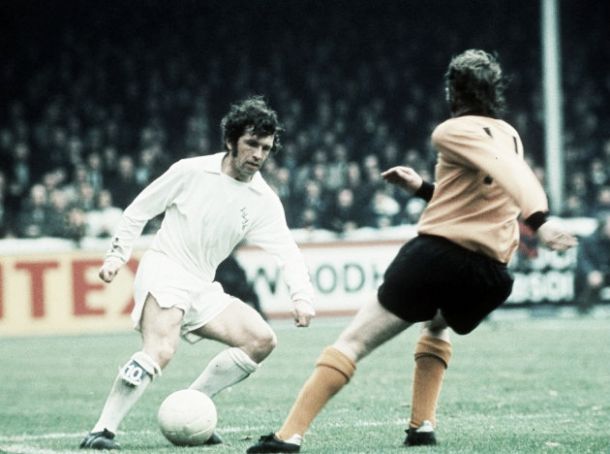

From his days at the heart of the Leeds United midfield, to his punditry on RTE Sport; preconception, or an expected adherence to the norm, is something which has blurred the brilliance of John Giles. The now “Freeman of Dublin” has exceeded the template of the “dirty” Leeds Utd player and the retired footballer turned television pundit, to become one of the most technically gifted footballers, and most important Irish philanthropists, of the past forty years.
“I don’t mind if someone says to me: ‘You were a dirty player’, I don’t mind that. But please say: ‘You could play a bit’. Same with the Leeds team.”
As a member of the all conquering Leeds United team of the 1960s and early 1970s, John Giles amassed numerous accolades, including two first division titles and an FA Cup winners’ medal. However, despite the club’s wealth of success, The Whites were not admired by the masses. For the reputation of “Dirty Leeds” preceded the side throughout the British Isles. From Carlisle to Truro, Revie’s Leeds United were renowned for a ferocious, and almost brutal style of play; seen as a team who would out battle, rather than out play the opposition.
The popular belief that his former team would brutalise others into submission is not lost on Giles, “We were no angels, don't get me wrong”. However, the former player has strongly criticised the conception that his former employers were little more than barbarous, by accentuating the breadth of technical quality Leeds Utd had during this period: “Look at the videos where we played Manchester United or Southampton and it was some of the best football I've seen anywhere. Eddie Gray, Peter Lorimer, Allan Clarke, Norman Hunter, Jack Charlton, and Terry Cooper – all individually brilliant players.”
Marshalling the midfield alongside captain Billy Bremner, Giles was unfairly included in this generalisation. As the more technically gifted half of one of the most formidable midfield partnerships in English football, the former wide player proved himself to be one of the most assured technicians in the game, dictating the tempo set by the voice of Bremner, spreading the message through measured passes to the likes of Eddie Gray and Terry Cooper. As the pivot upon which Revie’s men pushed forward, Giles played a pivotal role in his club’s success throughout his 12 year tenure in Yorkshire.
In spite of this technical prowess, the Dublin native has been largely subjected to the preconception of “Dirty Leeds” as Machiavellian, without any exploration of the contemporary footballing landscape. While football fields today, cut within an inch of perfection, are filled with blow-away balls, and aluminous yellow booted players, with bleach blonde Mohawks and the pain threshold of a professional bowls player; during the 1960s and 1970s, footballers were subjected to Waterloo-esque conditions. With truncheons and shields, footballers forty years ago were summoned to battle every Saturday afternoon on a pitch that looked more ploughed than cut.
Although Giles admits to being “no angel” on the field of play, due to the lack of protection for players from officials, technically gifted players were forced to stamp their authority physically, and earn the right to play their preferred style. After forging a reputation of being able to give as good as he got from the likes of “Chopper” Harris and Jimmy Gabriel, Giles did exactly that; utilising his wide range of passing and powerful surges into the final third, to cement his place in Leeds United folklore.
Away from football, preconceptions have also tended to mask the achievements of Giles. The former Republic of Ireland international has fallen foul of the retired footballer turned television pundit stereotype. Although widely respected as one of the most intuitive and opinionated personalities in the game, arguably, John Giles is currently considered to be little more than that in the eyes of the Irish populace. However, away from the television cameras and the bright lights of Champions League football, Giles has sought to give back to the communities in which he honed his talent.
Through the realisation that his sport can make a social difference in times of unrivalled economic disparity in Ireland, Giles’ very own charitable foundation, “John Giles Foundation”, has aimed to increase the opportunities for young people within the community, as well as decreasing the likelihood of “health and racial discrimination”. The foundation’s focus, in this early stage of its life cycle, has been upon sustainable football projects within working class communities, for otherwise difficult to reach youngsters. So far, the reaction to late night football leagues in particular, has made explicit the need for the use of sporting opportunities to dispel the social problems in less privileged communities. According to the An Garda Siochana, Friday night leagues had reduced adolescent antisocial behaviour related phone calls by 50% in Ballymun and Tallaght.
Fundraising for the “John Giles Foundation” gained huge momentum through the 2011 “Walk of Dreams”, when over 25,000 people descended upon 15 separate locations to show their support for grassroots football in Ireland. Due to Giles’ standing in the game, the foundation was able to call upon help from the likes of singer Dickie Rock, FAI president John Deleany, and former Republic of Ireland international Ray Houghton, to rally support for the “Walk of Dreams”. To conclude the fundraising event, forty of the best young players in the country competed in a challenge match at Lansdowne.
The most recent fundraising success for the foundation came at Hollystown Golf Club, where a sold out “John Giles Golf Classic” was held. All proceeds of the event went to foundation, and its community based projects. Along with these events, the “John Giles Foundation” has also began to host fun days and five-a-side tournaments, which have helped raise money for over 100 amateur clubs throughout the country.
Sporting events have been the focal point of the foundation’s funding ventures so far, however, the “Strictly for Soccer” event hosted in the Dandelion Café Bar in Dublin in May of last year, proved to a hugely successful and entertaining night. The highlight of the event, undoubtedly, was FAI chief, John Delaney, being put through his ballroom dancing paces, a moment so brilliant that it appeared on the front pages of numerous media outlets.
As well as hosting events, the “John Giles Foundation” has recently given its supporters the chance to win prizes, such as two VIP tickets to “The Dublin Decider” between Celtic and Liverpool. For a small donation of just two Euros, the winner would also receive entry to the official pre-match reception, and a room in a four star hotel.
As well as his philanthropist work, Giles has also contributed greatly to the Republic of Ireland Supporters Clubs throughout the UK and Ireland. In particular, his trips to Derry, West Belfast, and London, have sparked a huge interest in the city’s respective clubs. Reports from club members at these talks were hugely complimentary of John Giles, who was said to have had time for everyone he conversed with. This is the key reason for Giles’ success of the “John Giles Foundation”, and as an ambassador for football in Ireland. Without the airs, graces, and arrogance of so many gifted athletes, the Leeds United legend has remained humble throughout all of his successes both on and off the football pitch, to become one of the most important and inspiring men in modern Ireland.
“I grew up like many of us did, playing on the street. We were just having fun and never heard of professional football. I never dreamt of where it would take me, or realised what difference the sport was making to our community.”
From receiving his first ever pair of football boots as a gift from his father, to becoming a Freeman of the city in which he first kicked a ball in those very boots; Giles has been self-effacing, and grateful for the talents which have been given to him. Preconceptions may have blurred the brilliance of John Giles from the general public at times during his career both on and off the pitch. However, the former Republic of Ireland international has continued to prove the preconceptions of what Don Revie’s “Dirty Leeds”, and the retired footballer turned television pundit, to be just that: a preconception. Prevailing through power, rather than truth.
