


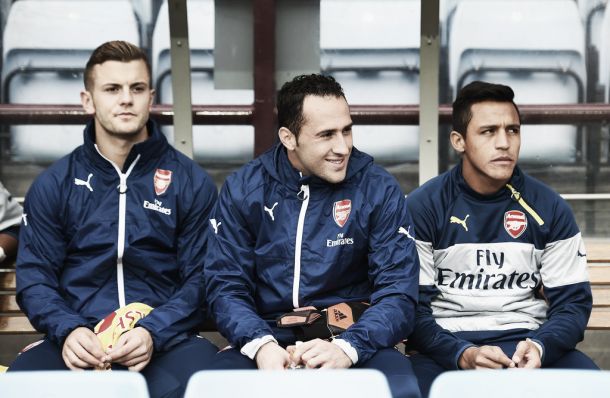

Alexis Sanchez and David Ospina have more in common than one might originally think. Both players are from the football-crazy continent of South America, they both signed for Arsenal in the 2014 summer transfer window, both are 26 years old and both are competing right now in the 2015 edition of the Copa America.
How did their seasons go for Arsenal in 2014-2015?
Whilst the £35 million attacking player from Chile was vital for Arsenal throughout the season, minus a mid-season dip in form that can be attributed to the repercussions of an injury, the £4 million goalkeeper from Colombia also had a role to play in the second half of the season that saw Arsenal gain 3rd position at the culmination of the Premier League.
Following two errors from Wojciech Szczęsny against Southampton in a 2-0 loss, Ospina was given his chance as starting goalkeeper and kept that position all the way to the end of the season. Will he keep it come the start of next season, with rumours of Arsenal looking to sign Chelsea second choice goalkeeper, Petr Cech?
But now their attention moves from club football to international football.
La Roja and Los Cafeteros were part of the pre-tournament favourites, alongside Brazil, captained by Neymar, and Argentina, captained by Lionel Messi, to win the Copa America. The final will be played on the 4th of July in the Estadio Nacional situated within the capital of Chile, Santiago. But who out of Alexis Sanchez and David Ospina has a better chance of making it to that finale?
Group comparison
Placed in Group A alongside Ecuador, Mexico and Bolivia, Chile appear to have a significantly easier group than Colombia. Mexico have brought a second string side to this tournament, with their focus being on the Gold Cup which happens later in the summer whilst Bolivia are a weaker side when they play outside of the high-altitude of La Paz and Ecuador are without captain Antonio Valencia for the tournament, which weakens them significantly.
Colombia by comparison are tasked with a Brazil side that have a point to prove following their humiliation on home soil in the 2014 World Cup, a dangerously unpredictable Peru and a Venezuela side spear headed by Zenit’s powerhouse of a striker, Salomon Rondon as well as set-piece specialist Juan Arango.
In the Copa America, the two top sides within each of Group A, B, and C progress along with the two 3rd placed sides with the best record. 12 teams are whittled down to 8 for the knockout-rounds.
Results so far
As host nation, Chile opened the tournament with their game against Ecuador. An unconvincing victory, Chile eventually ran out 2-0 winners courtesy of a Vidal penalty in the 67th minute and Vargas wrapping the game up with a calm, slotted finish in the 84th minute. Whereas, Colombia lost their first game against Venezuela through a headed goal from star man, Rondon, in a 1-0 shock loss.
La Roja played the second game of their group on Monday against Mexico and fell to a disappointing but exciting 3-3 draw with Mexico. Normally, a 3-3 draw with Mexico is not a bad result but when it is considered that Mexico played a second-string side and Chile were leading 3-2 in front of a home crowd, the result picks up a negative sheen. Sanchez did not get on the score sheet for Chile, with two goals coming from Juventus midfielder Arturo Vidal, one a penalty, and the other goal coming from Eduardo Vargas, a fantastic header from an Arturo Vidal cross.
Next group games
Chile has Bolivia to play, a team they should beat to ensure their qualification to the knock-out rounds as group winners. Both sides are on four points and a draw would be enough if Mexico end up failing to beat winless Ecuador, as Mexico only have two points. Ospina’s Colombia has it all to do, with Brazil and Peru to face following their 1-0 defeat to Venezuela. In the 2014 World Cup, Brazil beat Colombia 2-1 in the quarter finals and Peru have a history of being excellent on their day. Will it be their day against the Colombians, though?
Due to the qualifying nature of the groups, a 3rd place finish could still see Colombia progress if they are one of the two teams with the best record out of the three 3rd place teams in the Copa America.
Who, out of the Arsenal stars, is more important for their country?
As Sanchez’s position for Chile is a forward and Ospina’s for Colombia is a goal keeper, Sanchez naturally ends up having more of an impact than Ospina on how his country fares. In addition, due to Sanchez’s position in the Chilean side as one of the more experienced players, with 82 caps already, and his position on the world football stage as one of its superstars, a greater level of importance is placed on his shoulders than Ospina who, although is a constant fixture for Colombia and vice-captain, is less of a star player.
Some spectators saw Ospina as the fault behind Venezuela’s goal in their 1-0 victory, as Rondon’s header bounced a few times before hitting the back of the net and Los Cafeteros’ number 1 was slow to cover the ground to save it. That does not excuse Radamel Falcao and company for not performing on the other half of the pitch, though.
Whilst Sanchez has yet to score for his national side in the 2015 Copa America, that does not mean he has not performed well. Against Ecuador, Sanchez was possibly the stand-out performer despite not scoring, recording the assist for the goal scored by Eduardo Vargas and he was also impressive against Mexico, although the two-goal-haul from Vidal stole the show.
Who plays in the better national team?
In the 2014 World Cup, Chile only reached the round of 16 whilst Colombia bowed out at the quarter final stage, both being knocked out by the Selecao. If FIFA world rankings are to be used as an indicator of ability, then Colombia appear better than Chile, with their ranking of 4 being far greater than Chile’s 19th placed position on the list.
Chile as a side, have an excellent spine. Their goalkeeper is FC Barcelona shot stopper and 2014-2015 winner of the Zamora trophy, Claudio Bravo. In the heart of their defence is Inter Milan midfielder, Gary Medel, who plays as a central-defender for his national side. Juventus midfielder, Vidal and Sanchez himself are the other parts of that strong spine Chile have as Sanchez plays through the middle in a formation that utilises wing-backs – the 3-5-1-1, as the lone forward in front of a number ‘10’, or the 3-5-2, when he is partnered with another striker, normally Vargas. Their manager, Argentinean Jorge Sampaoli, a disciple of Marcelo Bielsa, utilises this wing-back formation to allow the Chileans to play a high-intensity pressing, attacking game and Sanchez at the front of that, is key to instigating the pressure.
Colombia, meanwhile, has a side that is full of recognisable names. Their key player is undoubtedly World Cup top goal scorer and Puskas award winner, James Rodriguez. In the 2014 World Cup, the then Monaco man played as the ‘10’ in a 4-2-3-1 and was offered total freedom to play instinctively and use his efforts only for attacking from manager Jose Pekerman. Like the secret agent he shares his first name with, Rodriguez is deadly from range as well as close distance and a man who just tends to apply the killer blow to his opponent.
However, in their opening game of the Copa America, Pekerman rolled out an asymmetric 4-1-2-1-2, with the Real Madrid man playing behind the duo of Radamel Falcao and Sevilla star striker, Carlos Bacca. The midfield was anchored by Carlos Sanchez, with Edwin Valencia of Santos playing as the faux-left midfielder and Chelsea wide-man, Juan Cuadrado on the right. If results are anything to go by, the formation change was not successful as Colombia finished scoreless and ended up pointless.
So, who will advance further?
With four points from two games, Sanchez’s Chile look certain to progress out of the group stages, even if their final group game against the Bolivians does not go to plan. A win against Bolivia guarantees Chile top place in their group and, as such, a potentially easier game in the knockout rounds as they will be drawn against the third place team from Group B or C.
Colombia, on the other hand, need at least one win from two games against Brazil and Peru to have a chance of qualifying. A win against Peru, if Peru lose against Venezuela, will guarantee the Colombians third place in their group. Two wins from their remaining two games for Colombia could end up putting Colombia at the top of their group. All that is certain is that, regarding Colombia, Los Cafeteros fans will have a clearer picture of their chances after match 11 of the Copa America; Brazil versus Colombia.
Potentially, Sanchez and Ospina could meet each other on the 24th of June in Santiago in the quarter finals if Colombia finish third in their group and Chile win theirs.
A lot of variables exist as of now but Chile, backed with home support and having two of the best players in the tournament in Alexis Sanchez and Arturo Vidal, look like the side more likely to progress further out of Sanchez’s La Roja and Ospina’s Los Cafeteros.
