


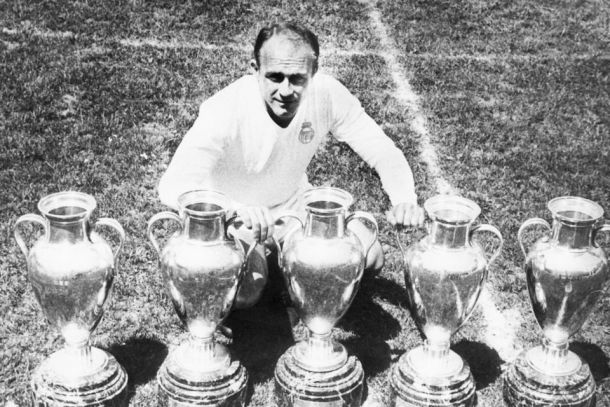

Throughout football’s history there have always been very good players turning out to grace the world’s pitches, both for their clubs and for their countries. One of these stars is Alfredo Di Stéfano, who secured his status as one of football’s greatest ever strikers between the 1940s-1960s. Saeta Rubia as he was known – meaning “blond arrow” in Spanish – proved his worth in South America, his continent of origin, but also came over to Europe for a significant part of his career. Wherever he played he consistently scored goals at club level, showcasing just how important he was wherever he played throughout his illustrious career.
Whilst the Argentinian-born forward may not have been the tallest, he certainly made up for it with his strength. He also possessed great stamina and vision, which allowed him to have multiple roles on a pitch; indeed, he was known to be able to play almost anywhere on the field, but as a striker being his most prominent position, hence his impressive scoring statistics.
Di Stéfano is perhaps unique in the fact that he played for three countries – first for his country of birth, Argentina, then with Colombia, where he plied his trade for a time and finally Spain, after gaining citizenship once he’d played for Real Madrid for a long enough period of time. However, he was hardly a regular in any international set-up. He only played 6 times (scoring as many goals) for La Albiceleste, before just 4 goal-costless appearances for Tricolour (these appearances were not recognised by FIFA, and as such are often not attributed to the forward). Over four years with España, Alfredo played 31 times and scored 23 goals, meaning his time with the European nation was probably his most successful. Unfortunately, the famed striker never turned out at a World Cup finals for a number of reasons, meaning he was never able to showcase his talents on the world stage.
Throughout his 21-year career, the striker Di Stéfano represented just four clubs competitively – in the three countries he also turned out internationally for. He started out with one of Argentina’s traditional “big four”, River Plate who are based in his hometown of Buenos Aires. However, Saeta Rubia also had a loan spell at Huracán from River. Between these two clubs, the forward played 96 times in all competitions, netting 64 times in the process.
Following a footballers’ strike in 1949, the now-established player crossed the border to Bogotá, Colombia to sign for Millonarios. Again, his fine form continued in the top tier in Colombia too, as he proved his worth in a second country. In four seasons, Di Stéfano played 102 times, and scored 88 goals to boot. This goals-to-game ratio is hugely impressive for any player, and caught the eyes of some of Europe’s top clubs. Indeed, it was with El Azul that the Buenos Aires-born player first came to the attentions of his future employers Real Madrid.
There was some controversy surrounding the Argentine’s move to La Liga. Both Real and their fierce rivals Barcelona were interested in the attacker, with the Catalans making their move first. They agreed a deal with the international star, and soon after FIFA approved the transfer to go through from River Plate, as they had not become aware yet that the player in question had moved to Colombia’s top tier four years previously. The Spanish FA then blocked the move because of this administrative error. It meant both Millonarios and Di Stéfano’s previous club River Plate had to agree a deal with the buying club in order for the move to become complete.
By this point, Real Madrid had also made their move in signing the player. Millonarios told FIFA about the situation with Spain’s two biggest clubs in a fight to secure the signature of one of football’s rising stars. The world governing body ordered the Spanish Federation to sort the dispute out amongst themselves, which they did. In May 1953, the Argentine touched down in Catalonia to complete his transfer, but did not count on more political disputes in the Barça boardroom. As the big men in charge lingered on putting the transfer through, Real president Santiago Bernabéu came in and convinced the striker to sign for the Madrid club instead. Then, the rest, as they say, is history.
During the move going through the motions of becoming complete, the Spanish Federation instigated a ban on foreign players plying their trade in La Liga, signed by both Bernabéu and the then-Barcelona president Martí. An agreement was reached to allow Di Stéfano to play four years in Spain, two for the Catalans, and two for Los Blancos. After the ban on foreign players was revealed to the public, there was an uproar from fans and the rest of the staff of Barcelona, causing Martí to resign soon after. For reasons unknown, Blaugrana then allowed Real Madrid to have full ownership of the Argentinian, a decision which they might now regret. Nonetheless, the whole affair only heightened the tensions between the two teams.
Once the whole incident had been concluded, Alfredo Di Stéfano was once again able to get back on with playing the game he was already gaining a big reputation for his prowess in. He had great success with Los Merengues during eleven years with one of Spain’s premier clubs. Not only did he manage to win eight league titles in this time, which is an impressive feat in itself, but the celebrated player was also an integral part of the side that won five consecutive European Cups from 1955-1960. He scored in every single final, including a hat-trick in the final one – a 7-3 win over German club Eintracht Frankfurt. This was perhaps the greatest spell in Real Madrid’s distinguished history.
Di Stéfano’s prosperous partnership with the superb Ferenc Puskás was one of the highlights of that great Los Blanos team. The Hungarian hero signed for the Spanish club in 1958, and stayed until 1966, meaning he shared six years of his time with the brilliant Argentine. Puskás shined wherever he played during his playing career, and at Real Madrid was no different. The inside-left scored 156 league goals in just 180 La Liga appearances, an awe-inspiring ratio. This may not have been as many as Di Stéfano’s 216 goals (at the time, a club record) in 284 games for the Spaniards, but it is still incredible to say the least.
Alfredo Di Stéfano left Real Madrid in 1964 as he started to wind down in the final years of his career. He moved to Catalan side Espanyol – the mini-nation’s second club – in the same year, and whilst he may not have played as much or scored as much as earlier on in his career, you can’t take away from him how good he was. He scored 11 league goals in 47 games for Blanquiblaus over a period of two years, before hanging up his boots in 1966 after 21 years of playing The Beautiful Game. La Saeta Rubia ended his playing career with 377 league goals in 521 games, and tally any player would be proud of.
Following his retirement, the Argentine legend moved into management, but was unfortunately not quite as successful as he was as a player. The majority of his silverware as the man on the touchline came in his home country Argentina, with Boca Juniors and River Plate, but the man also took charge of major European clubs as well. He took charge of Spaniards Valencia for a time, as well as returning to his old club Real to coach at the Estadio Santiago Bernabéu for a time too. Other clubs included Rayo Vallecano and Sporting Clube de Portugal.
For those lucky enough to have seen Alfredo Di Stéfano play in the flesh, it must have been a joy, and an honour to see one of the greats of football play. Like seeing a blacksmith at work, it must have been like watching a master of his trade doing what he does best. Sure, Argentina have had players since who could be thought of as better (namely, Diego Maradona and Lionel Messi), but there will always be a special place in football history for the man known as Alfredo Di Stéfano.
"Alfredo Di Stéfano was the greatest footballer of all time - far better even than Pelé. He was, simultaneously, the anchor in defence, the playmaker in midfield, and the most dangerous marksman in attack."– Helenio Herrera
