


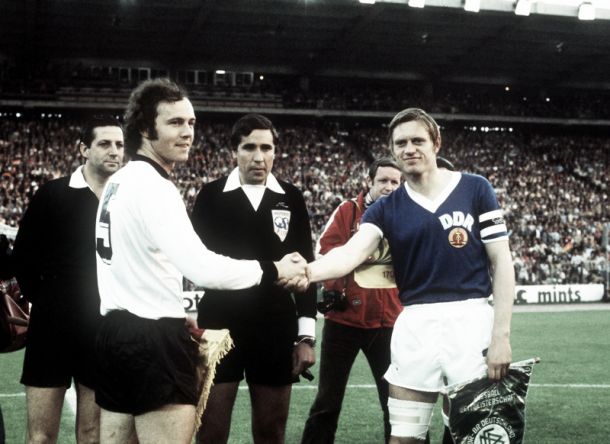

When West Germany hosted the 1974 World Cup barely half a century ago, the planet was almost unrecognisable to what it is now: there was no such thing as the internet, Leeds United were crowned champions of England and the Cold War raged on between the USA and Russia.
The Cold War meant the entire framework of Europe was categorised by politics as well as geography. To the East lay the Soviet Union and its communist satellite states, which were almost entirely censored of anything outside of the Eastern Bloc so as not to provoke any views against the regime. To the West, the democratic capitalist superpowers. This European division hit Germany harder than most other countries, though to understand why, we have to rewind another thirty years.
Following World War II, the allies divided Germany as part of the de-Nazification process. Britain, France and the US occupied the West of the country and part of Berlin. The Soviet Union claimed the rest, seizing the entire east of Europe and instilling it with Stalinism, the brutal dictatorial form of socialism. They even went as far as to build the Berlin Wall to create the continental divide.
An interesting draw for the 1974 tournament's group stages saw both West Germany and East Germany included in Group 1 alongside Australia and Chile. Interesting both because of its political implications and by the fact that the coach of West Germany, Helmut Schön, defected from the East in 1950 . It was to be the first (and last) meeting between the two sides in the 40 year history of East Germany, though this was not entirely down to chance (the two were drawn in the same qualifying group for Euro '92 but the Berlin Wall was brought down before the qualifiers began).
The West Germans maintained the belief that they were one family split by the Berlin Wall and by Communism (the East Germans did not share this view, president Erich Honecker adopted a policy of Abgrenzüng, or sealing off, to create a separate national identity), therefore any sort of competition against the East would undermine this belief. Meanwhile East German sport was far superior to that of the West, except in football, so the Communists didn't want the embarrassment of losing to the much stronger West German team.
Football didn't share the same popularity in the German Democratic Republic as it did in West Germany; the East German Gymnastics and Sport Union (DTSB) ranked football fourteenth on a list of sports deemed worthy of financial support.
It could have been much worse for football fans in the country; the same body pulled the plug on funding for ice hockey and as a result 6 of the 8 teams in the country ceased to exist. For 20 years the national league was contested only between Dynamos Weißwasser and Berlin.
East German club football, though, was rotten to its communist core. Teams seen as “bourgeois” seemed to lose important matches under strange circumstances. Clubs with the “Dynamo” prefix, signifying they were a club of the state, were often favoured by referees.
Just two months before the World Cup was due to start, tensions between the two countries escalated when it was discovered that Günther Guillame, a personal assistant to West German chancellor Willy Brandt, was working as an East German spy. Brandt felt personally responsible so resigned weeks after, despite the fact he was seen as a key figure in breaking down barriers between the countries, even winning the Nobel Peace prize in 1971 for his work with the East.
By the time the two teams met at Hamburg's Volksparkstadion, both had already progressed to the second round, though for most this did not make the occasion any less important. It was a topsy turvy affair with neither side being able to find any breakthrough. Reportedly, the players maintained a high level of sportsmanship on the day – GDR defender Konrad Weise even helped up West German striker Gerd Müller after a rash challenge, telling Der Bomber “I hope you're not hurt”.
The 300 or so East German fans in the stadium were carefully selected patrons of the communist party – somewhat similar to North Korean dictator Kim Jong-il hiring Chinese actors to portray supporters in South Africa in 2010.
78 minutes passed in Hamburg and still neither side had broken the deadlock. That was until a long ball was nodded into the path of East German attacker Jürgen Sparwasser on the edge of the area, dribbling past one and blasting the ball high into Sepp Maier's net. The East Germans held on and defied all the odds by beating their western counterparts by a goal to nil.
Goalscorer Sparwasser has since spoken of his winner, saying: “You'd only have to write 'Hamburg 1974' on my gravestone and everyone would know who it is”.
“Rumour had it I was richly rewarded for the goal, with a car, a house and a cash premium. But that is not true”.
East Germany failed to win another match in the tournament, losing to Brazil (0-1) and to The Netherlands (0-2) before a 1-1 draw with Argentina, prompting one crazed fan to phone the team's hotel to deliver them a bomb threat.
The West Germans on the other hand, put Yugoslavia, Sweden and Poland to the sword in the second round to set up a final with The Netherlands. The Dutch were the surprise package of 1974, their first World Cup since 1938, with their fluid, attacking style of play which would soon be dubbed Totaal Voetbal, or “Total Football” to anglophones.
Though, this star studded Dutch squad containing Johan Cruyff, Johnny Rep, Johan Neeskens et al were not strong enough to defeat the Germans in their own back garden, losing 2-1. Many of the Dutch team have since admitted to being too complacent and arrogant after taking such an early lead on the day.
The 1974 World Cup was the only major international tournament that the GDR qualified for in their history, although they narrowly missed out on qualifying for multiple European Championships between 1964 and 1980.
The fall of the Iron Curtain in 1990 was also the conclusion of the 40 year history of East German football. The GDR's shock defeat of the West, however, has got to be one of the most iconic moments in the history of German football, if not in World Cup history.
