


Kickers Offenbach 6, Bayern Munich 0. It was the 24th August 1974 and Bayern had got off to the worst possible start for their season, they would go on to finish in 10th position. However for young Rummenigge it was a momentous occasion as this was his first ever game for Bayern Munich and the beginning of a relationship that is still going strong to this very day.
Born on the 25th September 1955 in the North Rhine-Westphalia town of Lippstadt, around a 50-minute drive from the city of Dortmund, he played for local side Borussia Lippstadt until the age of 18 when Bayern discovered and signed him in 1974. Despite his reputation nowadays as a prolific striker his goal scoring abilities were not highly rated at all when he first started out, he was seen as a talented dribbler rather than a striker.
Towards the end of his first season with the Bavarian giants they made it to the European Cup Final at the Parc des Princes in Paris (They won it the year before against Atletico Madrid). ‘Kalle” as he was known was an unused substitute as Bayern beat Leeds United 2-0 in what was one of the most controversial finals of all time. Leeds had two penalty appeals refused and Norman Hunter was said to be harshly dismissed. The referee that day, Michel Kitabdjian of France, was later found guilty of match fixing by the Greek FA and was eventually banned for life by UEFA. Leeds’ fans to this day sing, “We are the Champions, Champions of Europe” in relation to the 1975 final.
The very next year after another disappointing domestic campaign, Bayern would seal a hat trick of European Cup wins, this time at Hampden Park in Glasgow against Saint-Étienne. Rummenigge played from the start as Bayern went on to win 1-0 thanks to a goal from midfielder Franz Roth.
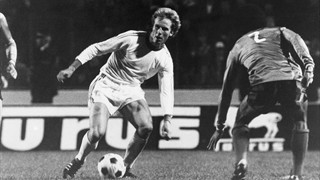
Rummenigge didn’t experience league success until the 1979/1980 season after the arrival of Hungarian coach Pál Csernai and it was under Csernai that he would finally flourish as a goal scorer. He was Bundesiga top scorer that season with 26 goals, thanks partly to Csernai but also thanks to the relationship he formed with midfielder Paul Breitner. Breitner was a German international midfielder who had scored in the 1974 World Cup final win and played for Real Madrid and Eintracht Braunschweig in between spells at Bayern. He was famously chosen to be the German National Team’s head coach in 1998 before resigning after only 17 hours earning the nickname ’17 Hours Bundestrainer’.
The pairing of Rummenigge and Breitner would be so formidable that they earned the nickname ‘Breitnigge’ and together they won the Bundesliga again the following season as well as the DFB Pokal in 1982 and 1984. Rummenigge once again was Bundesliga top scorer in 1981 and 1984. During this successful period he was named German Footballer of the year for 1980 before being named European Footballer of the Year 2 years in a row in 1980 and 1981.
Unfortunately for him he was unable to add another European cup title in 1982 when Bayern narrowly lost to Aston Villa 1-0 with Bayern having a goal disallowed late on. After winning the DFB Pokal in 1984 Rummenigge was sold to Internazionale of Italy for a record €5.7 million. In 416 appearances for Bayern in all competitions Rummenigge scored 217 goals making him Bayern’s 2nd top scorer of all time but still some way behind Gerd Müller’s 525 goals.
Initially the Inter move was a success, in his first season he helped Inter push Hellas Verona all the way for the Scudetto, eventually finishing 3rd. However for the next couple of years his time was blighted by injuries and when his contract expired in 1987 he moved on to Swiss side Servette FC. Despite his injury problems he still managed to score 24 goals in 64 appearances with the Italian side. In the final two years of his playing career he helped Servette to 2nd before becoming the league top scorer in 1989 with 24 goals.
During his continued success at Bayern it was inevitable that at some point he would get the call to join up with Die Nationalmannschaft. His first game with the senior squad came on October 6th 1976 in a 2-0 win over Wales. Helmut Schön, the Bundestrainer at that time, then selected him for the 1978 World Cup squad, which was to be played in Argentina. In the first game Schalke’s Rüdiger Abramczik was selected ahead of Rummenigge but in the second game against Mexico ‘Kalle’ scored twice earning himself a place in the starting eleven. He managed to score in the next game in a 3-2 defeat against Austria, a defeat that knocked West Germany out at the group stage only 4 years after they had won it in 1974. It became known as the ‘Disgrace of Cordoba’, Austria were already knocked out and had booked their flight home and the West Germany players ended up sharing the flight with them after the defeat. Not long after the defeat Schön resigned and was replaced by his assistant Jupp Derwall.
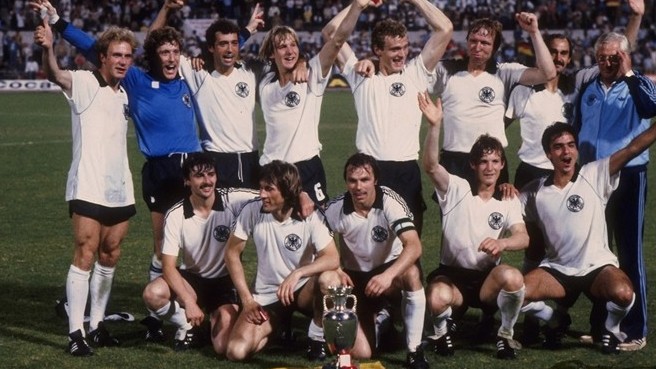
‘Kalle’, Derwall and the rest of the Germany squad had a much better time in the 1980 European Championships in Italy. Despite only managing to score one goal Rummenigge had a brilliant tournament. He was named ‘Best Player’ and set up the winning goal for Horst Hrubesch as West Germany beat Belgium 2-1 in the final. In 1981 he was named as Captain of the side and would retain the armband until after his final tournament in 1986.
His first tournament as Captain was the 1982 World Cup in Spain, a tournament in which Rummenigge played well but his side lost many fans. He scored 5 goals including a hat trick against Chile in the group stage. Controversy would follow in the next game against Austria, a game that is known as the ‘Disgrace of Gijón’. Going into the game both sides knew that a West Germany win by 1 or 2 goals would see them both go through and after Hrubesch scored a goal to make it 1-0 both teams appeared to make no attempt to score to the fury of fans. A German commentator for ARD called Eberhard Stanjek at one point refused to commentate on the game as he was so disgusted by what he saw. Here is a video of that game with the commentary, or lack of, from Stanjek.

Despite this controversy West Germany still made it to the final where they lost 3-1 to Italy after they had beaten France on penalties. At the semi-final against France the French President at the time, François Mitterrand, was watching and when Rummenigge, whilst injured, made it 2-2 in extra time he famously shouted “Mon Dieu, Rummenisch!” which translates to “My God, Rummenigge!”
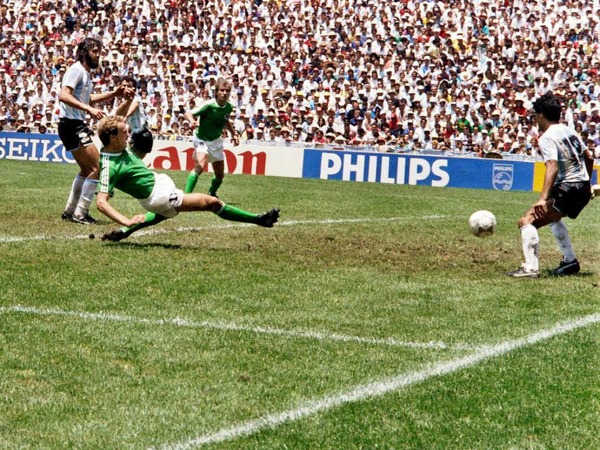
The 1984 European Championships followed and it would be a disaster. Rummenigge failed to score in the tournament as they drew their opening game with Portugal before beating Romania and losing to Spain and getting knocked out at the group stages. His final tournament was the 1986 World Cup in Mexico, a tournament in which he was held back by injury. In spite of his injuries ‘Kalle’ only missed 2 games as West Germany made it all the way to the final against Argentina. Rummenigge scored but his side conceded in the 84th minute to lose 3-2. After the tournament he resigned as Captain and retired from international football. In his time with Die Nationalmannschaft Rummenigge played 95 times and scored 45 goals.
After he retired from football completely in 1989 he worked as a TV co-commentator from 1990 to 1994. In 1991 Bayern invited both Rummenigge and Franz Beckenbauer to become Vice Presidents at the club. In his role as Vice President he saw Bayern win the Champions League, the UEFA Cup and 6 Bundesliga titles including three in a row from 1999 to 2002. He also saw Bayern lose in one of the most famous Champions League finals of all time in 1999 against Manchester United after they famously conceded 2 goals in added time.
In 2002 Bayern’s football department was separated from the parent company and became known as FC Bayern Munich AG (Aktiengesellschaft). Rummenigge was made Chariman of the Executive Board for the new corporation and in that role has played a vital role in making Bayern the successful side they are today. In his time as CEO Bayern have recorded profits in nine of the last 10 seasons and have already paid off the Allianz Arena, 15 years ahead of schedule. In 2013 they overtook Manchester United in terms of brand valuation. Currently Rummenigge has seen them win 7 Bundesliga titles and the Champions League in 2013.
He has seen the hiring and firing of several high profile managers like Jürgen Klinsmann, Louis van Gaal and Jupp Heynckes although in Heynckes’ case he retired at the end of his contract rather than being sacked. He has had some run ins as well with managers, after Louis van Gaal left the club in 2010 Rummenigge said “Louis van Gaal was not always easy-care. He wanted to ‘Vangaalise’ our club. He has a huge ego.”
In combination with his role as CEO at Bayern, Rummenigge holds authority in the corridors of power at both UEFA and FIFA. He is the Chairman of the ECA (European Club Association) an independent body representing clubs at European level. Some members of the ECA have come out and supported the idea of a European Super League but Rummenigge himself is against the idea and said; “Our European Super League is the UEFA Champions League! We are very happy with the current competitions and our extremely fruitful collaboration with UEFA.”
As many of you know the Bundesliga has the 50+1 rule that basically ensures the club’s fans hold a majority and also to prevent clubs running up high debts. According to Forbes, Bayern currently have no debt whatsoever and this puts them in a very strong position when it comes to UEFA’s FFP (Financial Fair Play), something that Rummenigge feels strongly about. Speaking for the ECA he said; “FFP is a bonus for the clubs, as it helps them control costs. The European clubs are supporting such a goal.” When PSG were fined for breaching the rules Rummenigge said; “ A huge company stands behind PSG, with almost infinite money… We don’t think this is fair.”
He has also made his way into the quagmire that is the debate over the 2022 Qatar World Cup. The two options currently are FIFA’s November/December recommendation and UEFA’s January/February recommendation. Rummenigge and the ECA have come up with a third option and they’ve said it “would be to start the World Cup at the end of April, finishing in May.” They said that the temperatures would be “35°C maximum” which they say would suit everyone best.
Rummenigge was involved in some controversial moments in his playing career, the ‘Disgrace of Gijón’ for example and he has been involved in some controversies in his current roles now as well. In 2013 he was fined €249,900 for not declaring taxes on two luxury watches when arrived in Munich Airport. These watches were given to him in Qatar whilst he was on a luxury trip there with his ECA colleagues that was funded by the Qatar 2022 organisers.
When they were discovered by customs Rummenigge said they were a gift from a friend but if it is proven that the Qatar 2022 organisers gave him the gift then it would bring into question the way in which Qatar won the right to host the World Cup and whether or not it could be taken away from them. Rummenigge would be very important person to have on their side if the tournament were to be switched because as Chairman of the ECA he would have to be consulted by FIFA before a switch was made. When asked about the gifts the ECA spokesman said; “Our chairman was presented with a Qatari cultural gift, a model Arabian horse.” He made no mention of the watches.
More recently he has greatly angered the Borussia Dortmund hierarchy with his talk of signing their player Marco Reus. In October of this year he said; “We know in Munich that he has a lot of quality. And we know his clause. For us a young German national of such quality is interesting.” Dortmund CEO Hans-Joachim Watzke was far from happy with Rummenigge’s comments and said he would “never express in public the contract details of Bayern Munich…”
Overall then it can definitely be said that Rummenigge has changed the game. In his playing days he helped bring success to Bayern with numerous league titles and two Champions league titles as well as with Die Nationalmannschaft winning the 1980 European Championships. He was twice named European Footballer of the Year and was even named World Player of the Year in 1980 by Italian magazine Guerin Sportivo.
In his current role at Bayern he has helped them become the juggernaut they are today. They are one of, if not the richest club in football have done it all without losing touch with their roots. In his role as ECA Chairman he has helped improve the clubs’ say in UEFA matters and will probably have a significant role to play when it comes to deciding the future of the Qatari World Cup in 2022. Karl-Heinz Rummenigge truly is a game changer.
To round off this piece there is an interview with Rick Joshua, who not only has been Bayern fan since the early 80's but is also a board member at the Red Dragons, Bayern's Premier London Fan Club. Rick also runs the website Schwarz und Weiß, a website for all things to do with Die Nationalmannschaft:
You became a Bayern fan in the early 80s towards the end of Rummenigge’s time with Bayern, what are your memories of Rummenigge as a player for club and country?
I became a Bayern fan towards the end of the 1980-81 season, when Karl-Heinz Rummenigge was the main man alongside Paul Breitner - the partnership known as "Breitnigge". Right from the start he became one of my favourite players, and would make much the same impression for the Nationalmannschaft.
Rummenigge would not score the most spectacular goals, but would always be on hand to execute the perfect finish - he would have the ability to make his way around the pitch, mainly as a result of his versaility as both a winger and natural goalscorer.
Given that during the early years I would see very few Bayern games I would be more familiar seeing Rummenigge in the Nationaltrikot, and in particular can remember his hat-trick in the 1982 World Cup against Chile and the crucial second goal in the historic semi-final against France in Seville. Then there would be Mexico 1984, where despite an injury-ravaged campaign he would score Germany's first goal in the final against Argentina.
How much of Bayern’s continued success can be attributed to Rummenigge in his role as Chairman of the Executive Board for FC Bayern?
Bayern have always managed to make sure that they best people are running the club, and the first real coup would be the appointment of Uli Hoeness. However Rummenigge has been the perfect foil, and would take his role as captain for club and country into the administrative arena seamlessly. He brings a touch of class to the role, and his loyalty to the club has never been questioned - key to being a trusted decisionmaker.
With Hoeness, Rummenigge has overseen the transformation of FC Bayern into a leading global brand, while as a former player understanding that it needs to remain close to its roots.
Do you think the Rummenigge’s recent history with FIFA, supporting World Cup in Qatar and controversy relating to undeclared gifts, has affected his standing with the Bayern fans?
In my opinion Rummenigge's support for the Qatar World Cup is a major miscalculation, but this is more of an issue with him directly rather than one that affects FC Bayern. As a result, his position as a club legend remains intact. The issue of undeclared gifts was a bit of a surprise and was for me somewhat disappointing, but one can only hope that the right lessons have been learned.
For the past few years there has been talk of a European Super League, which Rummenigge is against, but what do Bayern fans think about the prospect?
I cannot speak for any other Bayern fans, but I feel that even though we may be head and shoulders above the domestic competition we do have a responsibility as the biggest name in German football. FC Bayern has always believed in this, and over the years had assisted a number of other teams in trouble, from local rivals TSV 1860 through to St. Pauli and Borussia Dortmund. I can't see this changing anytime soon, as the Bundesliga is what makes German football what it is.
Given that the Champions' League provides us with a healthy dose of top-level continental competition, I don't see any need for a European Super League. Apart from the obvious argument that such a setup would spell doom for the domestic league, it will also turn what are special fixtures into banal weekly events. Right now, there's nothing like that Champions' League meeting with Real Madrid, Barcelona or Manchester United, which will always retain that special feel.
