


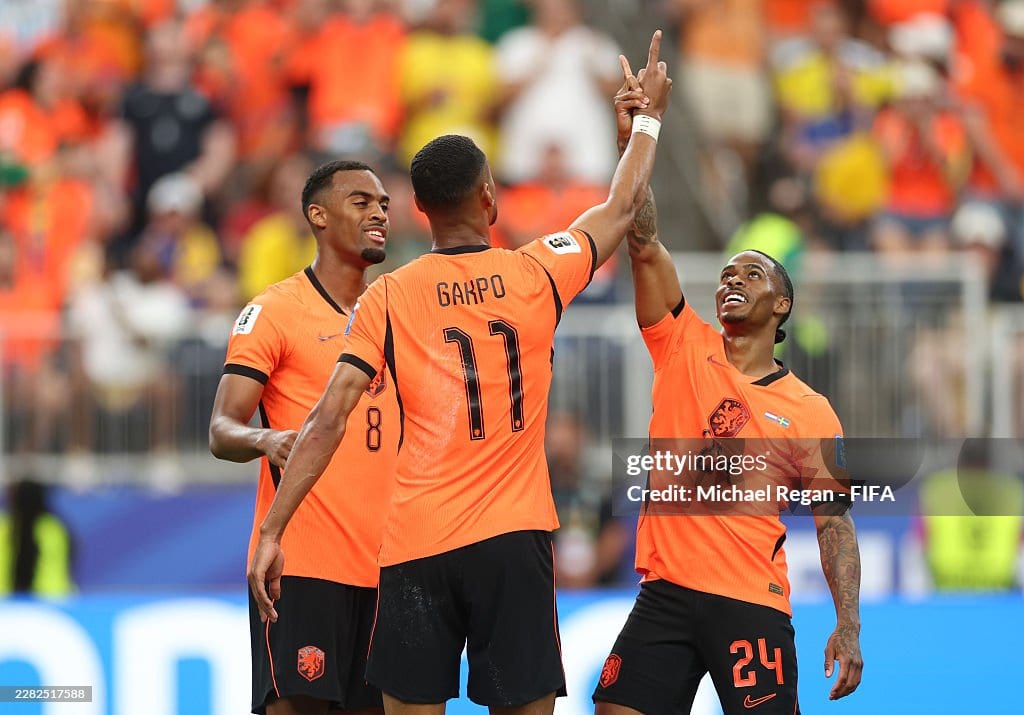

Netherlands supporters left NRG Stadium, Houston, buzzing after watching their side demolish Sweden 5-1: a Swedish side that had themselves beaten Tunisia 5-1 in their opening fixture, while the Oranje arrived off the back of a draw against Japan.
Goal-by-goal: how Netherlands routed Sweden
The scoring began in the fourth minute. Brian Brobbey brought down a long ball beautifully before laying it off for Tijjani Reijnders, who quickly played it on to Cody Gakpo on the wing. Gakpo's excellent ball across goal found Brobbey, who turned it home to open the scoring.
In the 16th minute, Donyell Malen received the ball near the box and slipped a pass to Denzel Dumfries, whose cross was turned in by Brobbey for his second of the match.
A minute after the restart, Crysencio Summerville picked up the ball on the right wing, drove inside, and found the overlapping Dumfries. The full-back fired a low ball across goal, which Gakpo tapped home.
In the 53rd minute, Alexander Isak lost possession inside the Netherlands box, and within 16 seconds, Summerville was driving forward with the ball towards the Swedish box. He found Gakpo, who took the ball onto his right foot before smashing it into the bottom near corner, leaving Kristoffer Nordfeldt with no chance.
Netherlands were caught cold by a Swedish counter-attack in the 58th minute. Isak played a through ball to Anthony Elanga in the middle of the pitch, who exploited his pace and finished clinically.
Two minutes from time, Summerville completed the rout with a fine finish from outside the box to wrap up the scoring for the night.
A bold tactical change unlocked Netherlands' attacking potential
The Orange took a markedly different approach in this match, opting for a far more aggressive and attacking setup.
For long periods, one full-back pushed high up the pitch, a clear departure from the flat back four deployed against the Samurai Blue.
The shift yielded considerably more attacking threat, with Netherlands generating 2.61 xG compared to just 0.78 against Japan.
Dumfries registered two assists in the match, underlining the attacking value he provides when afforded a more advanced role.
Crucially, each player operated in their preferred position. Reijnders pushed forward to attack the box, Ryan Gravenberch connected the play from a deeper position, and Dumfries was granted licence to advance.
Why Sweden offered no counter-attacking threat
This approach was also made possible by Sweden's lack of genuine counter-attacking pace through the middle. Viktor Gyokeres and Isak formed Sweden's centre-forward pairing, but neither posed a significant transitional threat.
Gyokeres prefers to operate in a crowded box rather than run in behind, while Isak tends to drop deep to involve himself in build-up play and progress possession.
It was only once Anthony Elanga was introduced that Sweden found a genuine outlet on the counter, scoring their solitary goal directly from that change.
Against Japan, a side renowned for their incisive counter-attacking play, Netherlands had set up cautiously to protect themselves. Against Sweden, that same caution was unnecessary, and Koeman's side were rewarded for recognising it.
This prompted Ronald Koeman to adopt a more attack-minded approach, and the gamble paid off handsomely as Netherlands put five past the Blue-Yellow.
The quality of the goals reflected the dominance behind them. Three of the five were tap-ins, a clear indication of just how thoroughly Netherlands had overrun the Swedish box.
The defensive cost of going all-out
That same aggression, however, came at a defensive cost. Netherlands had 10 shots of their own but conceded 16, with the gulf between the two highlighting the trade-off that comes with such an attacking approach.
Bart Verbruggen was nonetheless required to make only two saves, with the majority of Sweden's efforts either off target or blocked.
Should Koeman continue to trust the attacking talent at his disposal and commit fully to this expansive style, accepting the increased defensive risk that comes with it, this Netherlands side, given the quality within the squad, could make a deep run at this World Cup, or perhaps even go all the way.
