


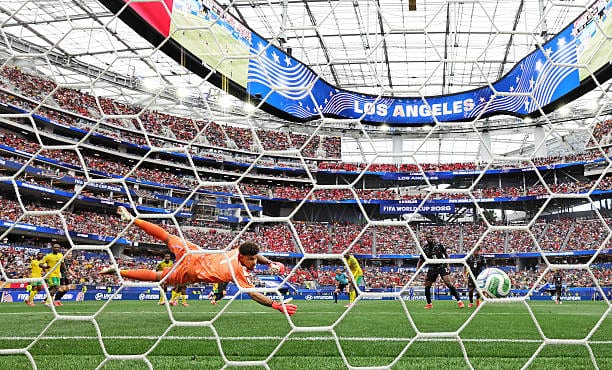

South Africa were a few minutes away from reaching extra time in their FIFA World Cup Round of 32 tie against Canada before Stephen Eustaquio scored a last-minute goal in the 92nd minute to seal a 1-0 win for Canada at the SoFi Stadium on Sunday, June 28.
It was heartbreaking for Bafana Bafana because they defended the entire game well, only to give up a goal right at the end.
South Africa have been eliminated, but reaching the knockouts was already a major achievement in their fourth appearance.
This marked the first time they progressed beyond the group stage in World Cup history.
How South Africa Frustrated Canada
Hugo Broos' side lined up in a 4-2-3-1 formation with a clear plan to stay compact and close passing lanes.
Canada attacked a lot more, yet they found it difficult to create big chances. South Africa's players were always in the right place at the right time to deny the North Americans any clean looks at goal.
One of the biggest moments of the match came in the first half when Aubrey Modiba cleared Moise Bombito's header off the line.
Before halftime, Ronwen Williams denied Tajon Buchanan with a massive chest save after the winger found himself through on goal.
Around the 66th minute, Jonathan David was poised for a tap-in as the ball rebounded towards goal after Williams saved Tani Oluwaseyi's initial shot.
Fortunately, Mbekezeli Mbokazi was quick enough to clear the ball away to stop David from scoring.
In addition, Khuliso Mudau and Ime Okon put their bodies on the line to protect the penalty area by throwing themselves into tackles and clearances.
Despite their defensive compactness, South Africa struggled when it came to progressive passes. They had more possession than Canada, but most of their passes were backward and sideways.
Fans and analysts questioned Bafana Bafana's decision to keep safe possession instead of taking risks with forward passes.
The Cost of the Halftime Shift
There is a division of opinion about Broos' decision to substitute one of South Africa's brightest attackers, Relebohile Mofokeng, at halftime.
Mofokeng's replacement, Thalente Mbatha, brought steel to the midfield. However, the introduction of Mbatha made the African side focus entirely on defending.
As a result, their attacking threat disappeared. Canada noticed the change in gameplay and took advantage of it.
The Reds started winning second balls and spent more time in South Africa's half, forcing Broos' men to drop deeper gradually.
Alphonso Davies entered the fray in the 75th minuteand began to stretch South Africa's defence with his pace.
Canada's persistence eventually paid off as Eustaquio struck deep into stoppage time.
Physical Realities and the Coach's Future
Broos admitted afterward that his players gave everything they had until they were completely exhausted.
The 74-year-old coach stated that they worked as hard as Canada, but they couldn't match the Canadians' strength and speed, noting that this is an area the South Africans need to improve in.
"I think we have to be honest that today, we lost the game because there was a lack of power and speed in our team," he said.
"When I compare us with our opponent, we lost a lot of duels and the speed in our team ... not only the running speed, but also the speed of execution ... was not the same.
"When you see how quickly Canada play and also their build up, it took long sometimes before we took a decision."
Despite the defeat, Broos added a historic achievement to his managerial career, becoming the oldest coach in World Cup history to manage a knockout-stage match at 74 years and 79 days old.
There has been debate over Broos' future with his contract about to expire. After the final whistle, Modiba insisted the Belgian should stay, saying there is unfinished business as South Africa prepare for the next Africa Cup of Nations.
