


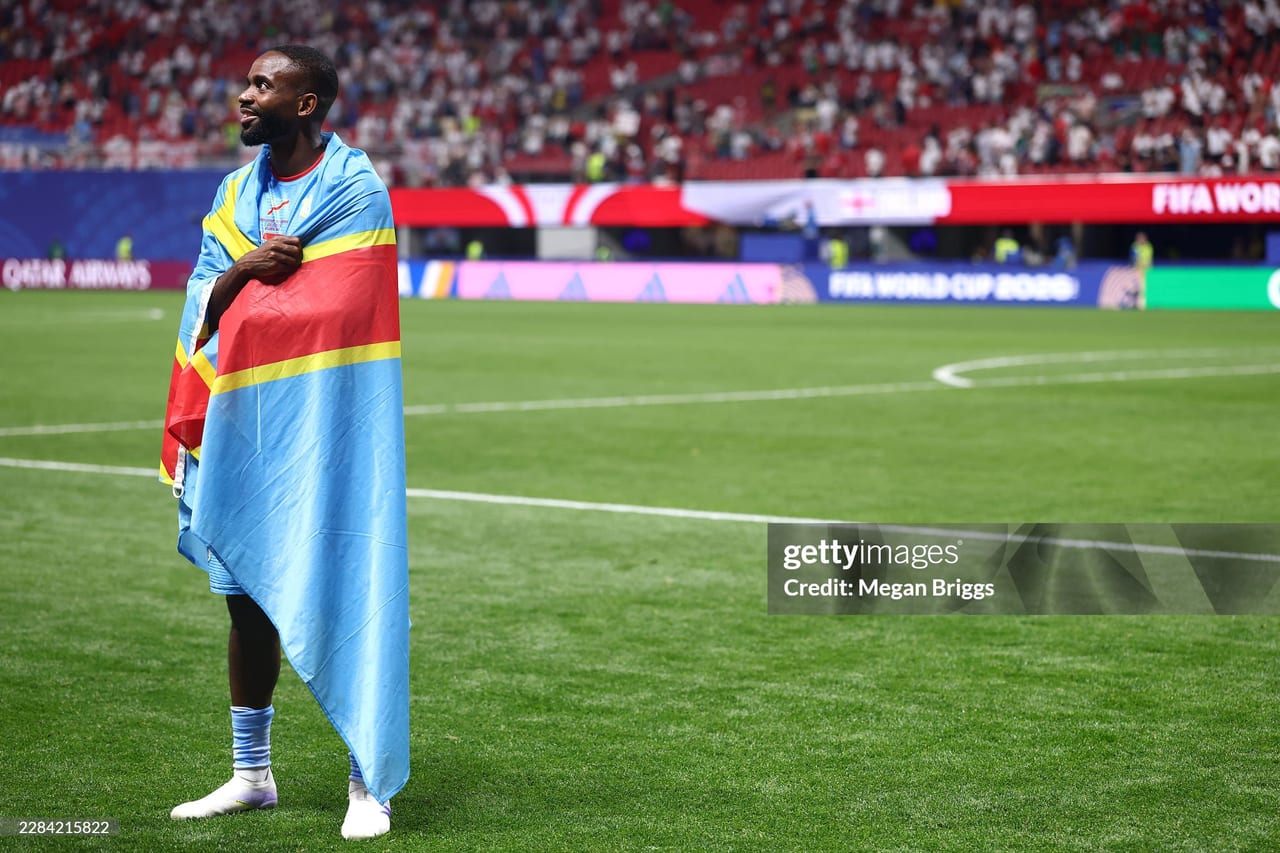

On 30th June, the Democratic Republic of Congo marked sixty-six years since independence from their barbarous colonisers in Belgium.
The years since have been far from an upward curve to prosperity. Dictatorship, war, epidemics, continued exploitation from corporations mean it remains one of the worst humanitarian situations on the planet.
“It is not easy in our country. There was a war in East Congo. Every day, every time we wear this shirt, we think about them,” striker Yoane Wissa said eloquently when DR Congo secured their place in today’s Round of 32, referencing the country’s conflict with neighbours Rwanda and the people he represents.
“We came far, from nothing to be here. Now we write our story with [the] black pen and we are proud.”
Football cannot solve these demons. But as most who enjoy the beautiful game know, it has the intangible ability to offer solace, even in the darkest of times.
“In the occupied areas of eastern Congo,” Congolese Football Federation President Veron Mosengo-Omba recalled. “You see people coming out into the streets to dance.”
Under their previous name Zaire, DR Congo were in the World Cup history books for three defeats against Scotland, Yugoslavia and Brazil in 1974. The latter being iconic for Mwepu Ilunga’s booted away free-kick that was more life-saving protest than silly misunderstanding.
On 1st July, stepping out against England in their first ever knockout game at the World Cup, that history was now, finally, truly in the past.
And although they had nothing to lose, as their head coach Sebastien Desabre attested to pre-match against Thomas Tuchel’s team, given their accomplishment, the Leopards showed both quality and bravery and came ever so close to penning another landmark.
How the Leopards troubled England
For the first half, DR Congo displayed zip and quality on the ball, worrying a seemingly perpetually anxious England defence.
It looked as though the Leopards had learnt from the mistakes of another in the Round of 32. Japan’s lack of a counterattacking threat in the second half of their tie against Brazil saw them drop so deep that the Selecao could attack the box much easier.
DR Congo, on the other hand, were bolder. While they relied on some terrific defensive moments, they still recognised the opportunity to hit the worrisome England team on the break. In this regard, they sought to emulate Paraguay’s performance against Germany more so.
This conundrum for the ‘smaller’ footballing nations has been a difficult needle to thread thus far. When to fully dig in and when to keep a threat on the break.
Prior to this, DR Congo’s strategy lent on superbly allowing England’s wingers to be their main creators. Admittedly, Noni Madueke and Marcus Rashford were blunt in attack, but there was certainly a conscious effort to stifle the Three Lions’ central options given both wide men are not attuned to crossing.
In turn, this allowed the DRC to use their flanks so effectively when turning the ball over, displaying zip when on the ball themselves. Nathanael Mbuku and scorer Brian Cipenga being deployed further up, with Ngal Ayel Mukau the extra man in midfield for cover, enabled this. England struggled to contain their quick passing and intelligent movement.
The moments that decided it
This was working. For over seventy minutes, Desabre’s side were on the cusp of one of the great World Cup shocks. It took marvellous goalkeeping from Lionel Mpasi and terrific defending from Axel Tuanzebe and eye-catching blocks on the line from Aaron Wan-Bissaka, but it was working.
Two things made the difference, ultimately. Two moments. Mpasi could have done a bit better pawing away Harry Kane’s first header, while the striker’s second goal was nigh impossible to stop.
Add to that Wissa hitting the post where most would put their house on him scoring and it was a matchup that was defined by coin flips. When you are a Japan or DR Congo who have yet to win a World Cup knockout match, the coin still seems to land in favour the team with more tournament knowhow.
On a larger gameplay scale, DR Congo not having spells of hold up play or possession in England’s half after the hour mark was another case of the lower-ranked teams struggling to game manage even with advantages.
In knockout rounds, teams like Japan, Paraguay and DR Congo have to - continuing the boxing analogy - play for points and go the distance. They cannot rely on the KO thumpers that their higher pedigree opposition have.
They are bound by the collective. And if the collective need to defend a slim lead then motivation to push higher up the pitch as the game wares on naturally ebbs away.
Being unable hold the ball for periods in England’s half later in the contest, not necessarily prying for a goal, meant being under the cosh without respite. See the 2026 Champions League final: even a side as great at collective defending as Arsenal can wither under such pressure.
Desabre's decision to put on forward Meschack Elia showed counterattacking was still on their mind later on. Elia had flashes, but perhaps Cedric Bakambu's experience would have come in handy in wrestling for the ball higher up. Again, coin flips.
Foundations for the future
Keeping the ball high would not be straightforward against an England side so blessed with talent on the ball and needing a goal. Close calls like these, however, are foundational.
Moments may have turned the tide today, but they will also help create a brighter future. It is occasions like these where future Congolese teams will reap where this iteration has sown.
