


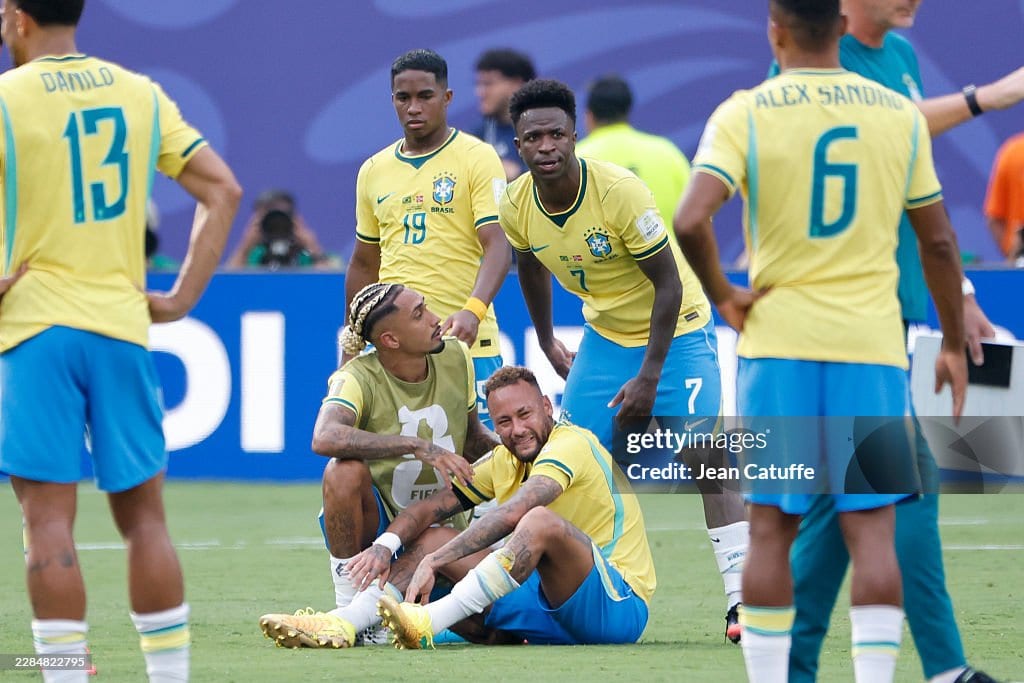

For much of the 2026 FIFA World Cup, Brazil's wealth of attacking talent papered over underlying issues. Against Japan in the Round of 32, they found a late winner. In the group stage, individual brilliance often proved enough.
Against Norway, however, those cracks widened into decisive faults.
Carlo Ancelotti's side were eliminated after a 2-1 defeat at MetLife Stadium, with two late goals from Erling Haaland sending the Scandinavians into a historic quarter-final. Brazil generated chances, missed an early penalty through Bruno Guimarães and dominated territory for spells, but once again struggled to dictate the rhythm of the contest when it mattered most.
The performance reinforced one major lesson from Brazil's tournament.
Brazil never truly owned the midfield
Brazil's biggest issue was not creativity or finishing - it was control.
Throughout the tournament, Ancelotti searched for the right midfield balance. Guimarães, João Gomes and André all featured in different combinations, while Neymar was carefully managed after injury and only introduced from the bench again against Norway.
Rather than slowing the game down and establishing sustained possession, Brazil repeatedly allowed matches to become transitional. Against Norway, that suited Ståle Solbakken's side perfectly.
For over an hour the game drifted. Brazil enjoyed promising moments but rarely established the kind of territorial dominance associated with the Seleção at their best. Instead, attacks became increasingly direct, leaving larger spaces for Norway to exploit whenever possession changed hands.
That inability to control tempo proved fatal.
Haaland's opening goal in the 79th minute came after Norway patiently waited for their opportunity before Andreas Schjelderup delivered an excellent cross. Minutes later, with Brazil committing numbers forward in search of an equaliser, Haaland punished them again from distance.
Brazil had possession when they wanted it, but never authority.
Those are two very different things.
The warning signs had been there
Brazil's elimination should not simply be viewed as Haaland's brilliance.
Even in victory over Japan, they relied on a dramatic late winner after looking vulnerable for long periods. Their pressing lacked cohesion throughout the competition, while possession often became predictable once opponents denied Vinícius Júnior space in wide areas.
The missed Guimarães penalty against Norway only increased the pressure, but Brazil still had more than 75 minutes to recover.
Instead, they became increasingly anxious.
Substitutes Endrick and Neymar injected energy, but neither solved the underlying structural issue. Endrick missed an excellent opportunity before Norway struck, while Neymar's stoppage-time penalty merely reduced the deficit after the contest had effectively been decided.
For a team blessed with attacking talent, Brazil surprisingly lacked composure once the game demanded patience.
Ancelotti's next rebuild starts in the centre
After the defeat, Ancelotti admitted Brazil require more youthful options in midfield capable of controlling games under pressure rather than simply attacking space. It was a revealing assessment from a coach who recognised that technical quality alone is no longer enough at international level.
Modern tournament football is increasingly decided by teams that manage moments rather than simply create them.
Norway did exactly that.
Brazil, meanwhile, looked like a collection of outstanding individuals rather than a side capable of imposing itself for 90 minutes.
Until that changes, the five-time world champions will remain vulnerable against disciplined, organised opponents - even with one of the world's most talented attacking units at their disposal.
