


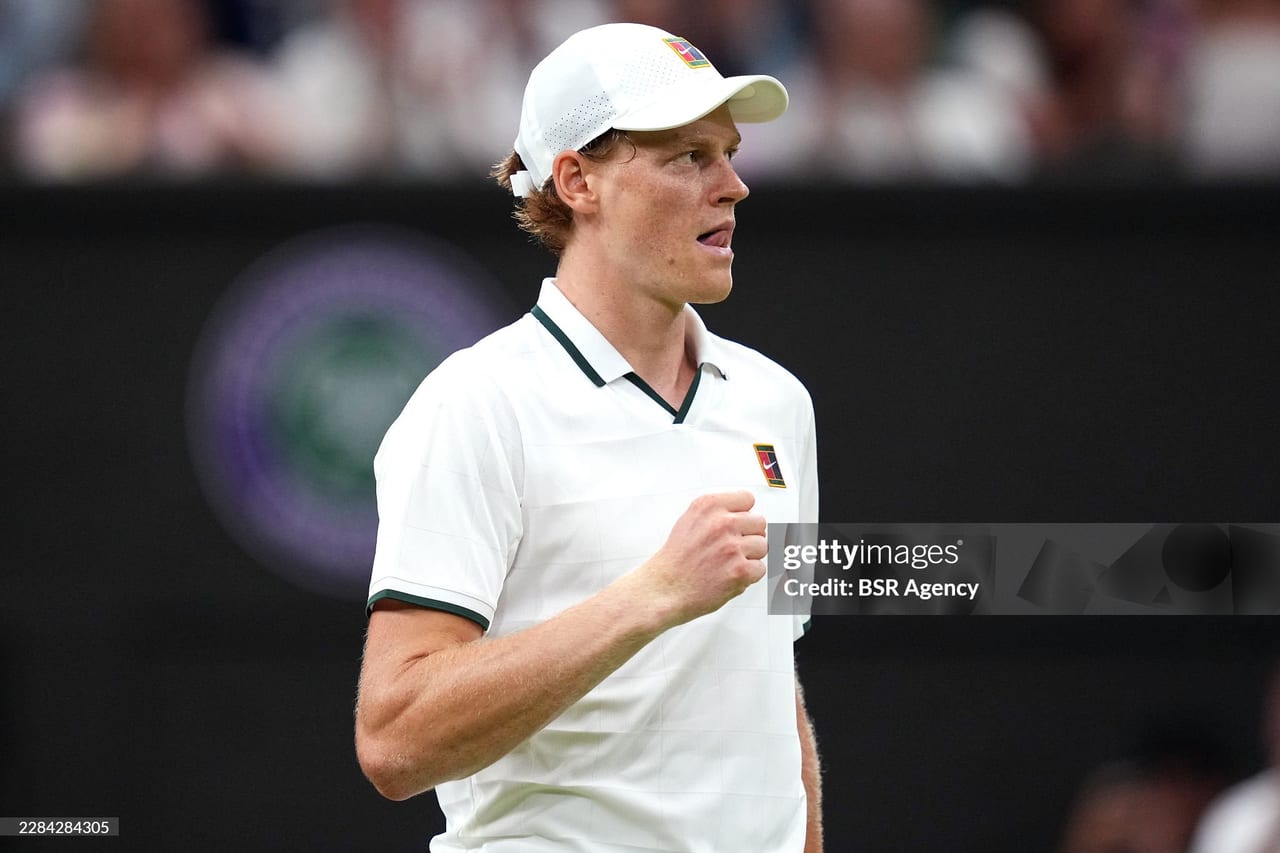

The stifling heat on Centre Court had eased heading into the evening and the lush Wimbledon grass gracing the eyes in the opening days had become firmer and dryer.
An ideal setting and the perfect conditions to rediscover the form that propelled him to the summit of the rankings this year with a healthy buffer.
The time for a more ominous version of Jannik Sinner on grass to be unleashed, despite harbouring a residual, cautionary recognition of the need to look after his body.
For defending champion Sinner, this was an opportunity to advance into the quarter-finals at a canter rather than fortuitously crawling through.
He faced a huge scare from Grigor Dimitrov in the fourth round last year when the Bulgarian was two sets up and closing in on an almighty shock until being forced to retire.
Sinner gave away 17 games in the first three rounds on the way to his maiden Wimbledon triumph, while at this edition of SW19, he dropped 48 games.
A far cry from the ruthless exhibitions he previously put on at the Championships, but he still sits perched comfortably atop the men’s singles rankings and became the first player in history this year to win five consecutive Masters 1000 titles.
Cracks in the Champion's Game
So, why have cracks been appearing in Sinner’s usually accomplished displays of tennis? The Italian is easing his way back to his best form, and he is gradually getting back up to speed.
Without the litmus tests at the start of the grass court swing, he entered Wimbledon without adjusting to competitive grass action.
This decision came about after his shock exit in the second round at Roland Garros, where his familiar foe Carlos Alcaraz was ruled out entirely with a wrist injury, as the Spaniard is for SW19, too.
On course to cruising to a straight-sets victory, Sinner was overcome by the heat and his body shut down, allowing Juan Manuel Cerúndolo to capitalise and stroll to an uncontested upset.
Alexander Zverev seized the golden chance to end the Grand Slam domination of the two frontrunners of men’s tennis by claiming his long-awaited first major at the French Open.
Sinner is keen to resume his dominance at Wimbledon by defending his crown, despite recovering on the sidelines for over a month.
The four-time Grand Slam winner went the distance with Miomir Kecmanović in the opening round, showing vulnerability.
However, he went on to sweep aside Nuno Borges in straight-sets, edging the Portuguese man on two tie breaks.
He made light work of American Jenson Brooksby, fine-tuning his skillset with fewer errors creeping in, admittedly against a weaker opponent.
Mochizuki's Spirited Resistance
Another routine encounter on Centre Court for Sinner was in store, and his Japanese opponent Shintaro Mochizuki remained sensible in recognising the gulf in quality prior to the tennis getting underway.
The 23-year-old became Junior Champion at Wimbledon seven years ago and stepped out onto an unprecedented stage for him as a qualifier. The 151st seed shared the famous court with the number one.
A giant-killing seemed off the cards, but frustration and disruption were the exact game plan to irk Sinner and stall him from dispatching the qualifier more quickly.
Mochizuki’s smaller stature put his serve speed at a disadvantage, but his measured and accurate placement was deceptive.
When his first serve crucially found the target, Mochizuki engaged and controlled the rallies well, leading him to win three games in set one.
The caveat accentuated when he failed to execute his first serve, and Sinner could pounce on the slower second serve by thumping back returns and pushing his opponent back beyond the baseline.
At close quarters throughout, though, Mochizuki sparkled and outwitted Sinner with sharp or delicate hands and swift approaches to the net.
This brought out a tinge of frustration from Sinner, who wanted to brush aside his opponent more efficiently. The longest game of the match ensued in the eighth game of the second set.
A rare ace from Mochizuki and an atypical, half-hearted forehand from Sinner handed the underdog the game after seven gruelling deuces on serve.
The players returned with the roof closed after a brief debate, and holds of serve led to a tiebreak, where Sinner trounced his opponent 7-0, raising his level in the moment where the stakes increased.
The Italian’s ground strokes and serving found their familiar rhythm and threat, and he prevailed in the final set, 6-3, with relative ease.
It never seemed Sinner was going to lose a set, but Mochizuki was there to revel in the occasion and to write his own story.
Erroneous first serves came back to haunt him, while his hopes of mounting stronger replies quickly faded once Sinner pummelled serves and looked better in the rallies. Echoes of fiercely struck winners became more regular with victory in sight.
Mochizuki held in the seventh game of the final set after five deuces, remarkably. It was always going to be a tall order to force another tiebreak, yet he had successfully stood up to the test as best as he could.
The Road Ahead for the Defending Champion
Jan-Lennard Struff awaits the defending champion in the quarter-finals, following the German’s five-set victory over Hubert Hurkacz, and the winner could then face seven-time Wimbledon winner Novak Djokovic in the semi-finals.
In the absence of Alcaraz to complete the two-horse race inevitably forming at the majors, others will be fancying their chances to progress to the latter stages.
Sinner’s troubles at the French Open and lack of preparation on grass made his performances look like a shadow of his former self at the start of these Championships.
Others may sense an opening, and Djokovic in the semi-finals could be where Sinner is most prone to slipping up, as he did in the Australian Open in January.
The blazing heat will continue to beat down at Wimbledon, but it is impossible to write the goliath and generational talent off from the two-peat.
