
Stadium
Balaídos · Profile

Other languages2
ADVERTISEMENT
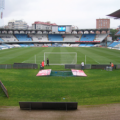
For the 1982 World Cup, the Balaídos stadium in Vigo underwent a major refurbishment that took its capacity to 45,000, much of it standing room. It has been the home of Real Club Celta since it opened on 30 December 1928. The ground is municipally owned and, since 2018, has carried the name Estadio Abanca-Balaídos under a ten-year sponsorship deal between the club and the bank. The natural grass pitch measures 105 by 70 metres.
Origins and early years
The stadium was designed by the architect Jenaro de la Fuente Álvarez. Its name comes from the street and surrounding area where it was built, beside the river Lagares, which flooded the ground more than once; the word is linked to «abeladíos», an area of hazel trees. The opening match, on 30 December 1928, ended in a 7-0 win for Celta over Real Unión de Irún, with Graciliano scoring the first goal. The first competitive fixture followed on 17 February 1929, in the Spanish second division, against Iberia Sport Club of Zaragoza, who won 1-2. The main stand, the Tribuna, was roofed during the 1930s. On 2 April 1933 the Spain national team played at Balaídos for the first time and beat Portugal 3-0.
From Celta ownership to the 1969 rebuild
In 1945 Celta became the owner of the stadium. The club rebuilt the Gol and Río stands and added the Marcador stand, which held 6,000 spectators. In 1953, for the ground’s silver jubilee, new terraces were built and capacity reached 35,000. Between 1967 and 1969 the stadium was renovated in stages, to a design by Antón Román Conde with the firm Construcciones Laminares: new terracing at Marcador and Gol, a remodelled Tribuna and floodlights that allowed night matches. Mayor Antonio Ramilo opened the new facilities on 27 March 1971.
The 1982 World Cup
Work for the World Cup began on 5 December 1980. Vigo was one of the tournament’s 17 host cities, and Balaídos staged all three of Italy’s first-round matches: 0-0 against Poland on 14 June, 1-1 against Peru on 18 June and 1-1 against Cameroon on 23 June 1982. Italy went through the group without winning any of those games and finished the tournament as world champions.
Internationals, concerts and an all-seater ground
Spain returned to Vigo on several occasions: 1-1 with Portugal in 1979, 1-0 against the Netherlands in 1980, 2-2 with Portugal in 1994, 4-0 against Sweden in 1998 and 0-0 with Brazil on 13 November 1999. On 18 November 2014, Germany won 0-1 in front of 32,711 spectators, the highest official attendance recorded for a match at the stadium. Balaídos has also hosted concerts: Miguel Ríos was the first act, on 26 August 1983, Madonna played on 29 July 1990 and The Rolling Stones on 18 July 1998. In 1993 the ground staged the Trofeo Xacobeo. By 2002 the whole stadium was seated, with a capacity of 31,800.
The reconstruction that began in 2015
In 2012 capacity fell to 30,000 after the moat was covered and the area around the pitch was altered. In February 2015 a full reconstruction in four phases began, designed by the architect Pedro de la Puente. That same year the Pontevedra provincial council and Vigo city council signed an agreement worth up to 29.7 million euros, split equally between them, with Celta contributing 2 million. The work moved stand by stand: Tribuna, Río and Marcador, which was renamed Marcador Centenario. During the process capacity dropped to 29,000 in 2017 and to 24,791 in 2023. The stadium hosted promotion play-offs to Segunda B in 2020 and to the Spanish second division in 2022. On 28 January 2024 it staged two competitive matches on the same day for the first time: Celta against Girona, followed by Celta Fortuna against Deportivo. In March 2025 the Gol stand, the last one left in the plan, was closed for a complete rebuild.
ADVERTISEMENT
Profile compiled by the VAVEL Editorial Team from historical records and official competition data. · Editorial policy