
Competition
Stanley Cup · History

Other languages2
ADVERTISEMENT
The Montreal Canadiens have won the Stanley Cup more times than any other team, with 24 titles. Next come the Toronto Maple Leafs with 13 and the Detroit Red Wings with 11, the highest total for a club based in the United States. Among players, Henri Richard has his name engraved as a champion more often than anyone else, eleven times. The Stanley Cup goes to the NHL champion at the end of the playoffs. It was first awarded in 1893.
Origins: Lord Stanley’s cup
The trophy was donated by Lord Stanley of Preston, the governor general of Canada. He commissioned it in 1892 as the Dominion Hockey Challenge Cup and paid ten guineas for a silver bowl made in Sheffield, England. The first winner was the Montreal Hockey Club, champion of the Amateur Hockey Association of Canada, in 1893. For its first few decades the Cup was decided by challenges and by league play. A champion club could challenge the team holding the Cup, and the trophy changed hands according to those games. Professional teams became eligible in 1906.
From challenges to the NHL
In 1915 the National Hockey Association and the Pacific Coast Hockey Association agreed that their champions would play each other for the Cup. That set up a final between the two leagues. In 1917 the Seattle Metropolitans became the first U.S.-based team to win it. The 1919 series between Montreal and Seattle was called off during the influenza epidemic, and no champion was declared that year. After the Western Hockey League folded in 1926, the Stanley Cup was contested only by NHL teams. In 1947 an agreement with trustee J. Cooper Smeaton gave the league formal control of the trophy. Even so, the NHL does not own the Cup, which remains in the care of two trustees. The only other year without a champion was 2005, because of the NHL lockout.
Playoff format
The Final has been a best-of-seven series since 1939. Sixteen teams reach the playoffs, eight from each conference, and play four best-of-seven rounds with home games split 2-2-1-1-1. Under the format introduced in 2014, the top three teams in each division qualify automatically and each conference adds two wild cards. Since 1965 the most valuable player of the playoffs has received the Conn Smythe Trophy. The first winner was Jean Béliveau of the Canadiens.
The trophy and its engravings
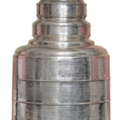
The names of the winning team’s players, coaches and staff are engraved on the Cup’s bands, so the bands have to be replaced from time to time. The trophy was redesigned in 1948 and again in 1958, when the five-band barrel was adopted. It stands 89.5 centimetres tall. The original bowl, 18.5 centimetres high, was handed to champions until 1970 and is kept at the Hockey Hall of Fame. The Cup that winners lift on the ice is the Presentation Cup, made by silversmith Carl Petersen in 1963 and first awarded in 1964. In 1993 Louise St. Jacques made a replica for permanent display at the Hall of Fame. In 1954 Marguerite Norris became the first woman to have her name engraved on the trophy.
Dynasties and 21st-century champions
No team has won more titles in a row than the Canadiens, who were champions five straight times from 1956 to 1960. Toronto won its last Cup in 1967, beating Montreal in the Final. In the 21st century the Tampa Bay Lightning won back-to-back titles in 2020 and 2021. The Florida Panthers did the same with titles in 2024 and 2025. In the 2025 Final they beat the Edmonton Oilers four games to two, and Sam Bennett won the Conn Smythe. In 2026 the Carolina Hurricanes beat the Vegas Golden Knights four games to two in the Final. They clinched it with a 3-0 win in Game 6, played on June 14 in Las Vegas. It was the franchise’s second title, twenty years after its first in 2006, and captain Jordan Staal won the Conn Smythe.
ADVERTISEMENT
Profile compiled by the VAVEL Editorial Team from historical records and official competition data. · Editorial policy