

- 49 yearsAge

ADVERTISEMENT
Thierry Henry is one of those players swallowed up by the injustice of the golden ball. One whose magic seemed to have spread throughout his body, being remembered as one of the best players that has left the history of France. On August 17, 1977, Thierry Daniel Henry was born in the Parisian town of Les Ulis (France), a suburb where other stars of the sport such as Anthony Martial or Patrice Evra also grew up. His parents, Antoine (Guadeloupe) and Maryse (Martinique), encouraged him to play soccer as a child, as the young Henry was not really attracted by the passion that runs through the bodies of young boys and girls. At the age of seven he tried his first experience in a local club, CO Les Ulis, under the guidance of Claude Chezelle, but it did not last longer than the pressure exerted by his father to attend training. The rest is history.
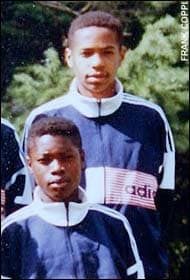
First contacts
In 1989, Henry joined US Palaiseau, but after a year his father had several altercations with the club, so Henry switched to ES Viry-Châtillon and played there for two years. Palaiseau's American coach Jean-Marie Panza, Henry's future mentor, followed him there. Antoine focused on helping him succeed in soccer, continually taking Thierry to camps and matches, where it soon became clear that the youngster was an above-average player for his age. For her part, Maryse worried that her son was spending too much time on the field and not enough time studying. However, when he needed his parents the most was when they divorced. Custody ended up in his mother's favor, but Thierry was clear. Soccer was his thing.
In 1990, with Henry's teenage years approaching, it was Monaco who knocked on his door after he scored six goals in one game. Scout Arnold Catalano requested that he complete a course at the Clairefontaine Academy, and despite the director's refusal to admit Henry due to his poor school results, he was allowed to complete the course and joined Arsène Wenger's Monaco as a youth player. He was one of the 25 selected and shared a class with players such as William Gallas, Louis Saha or Nicolas Anelka.
Arsène Wenger, his second father
Thierry Henry made his first-team debut for Monaco on 31 August 1994 in a 2-0 defeat against Nice. Despite Wenger's belief that Henry could explode as a striker (something he did in his later time at Arsenal), he placed him on the left wing as a winger because he believed his pace and ball control would be more damaging against full-backs. He had already begun to give hints of the talent he possessed when in 1996 he won the French Young Footballer of the Year award, as well as helping his team to the league title in the 1996/97 season with nine goals in 36 games. The following season was to be marked by reaching the semi-finals of the UEFA Champions League and participating in the World Cup on home soil, with France winning.
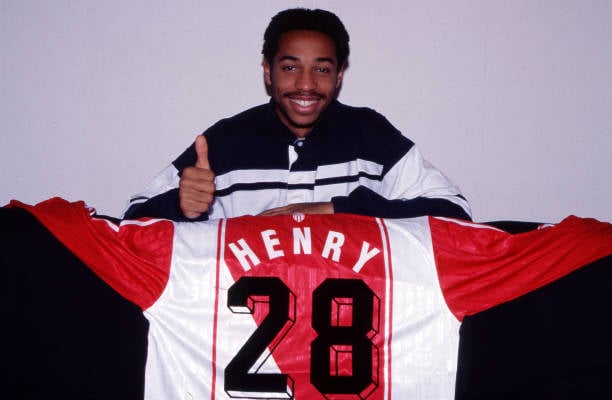
He spent five seasons at Monaco, where he recorded 28 goals in 156 appearances before making the jump to Turin. His arrival at Juventus was rather short-lived, with Henry admitting on Jamie Carragher's podcast, The Greatest Game, that disagreements with Juve manager Luciano Moggi were the main reason for leaving the Italian club and starting the new century in London.
New century, new destiny
The 1999/2000 season was to be marked by the beginning of a beautiful story between Thierry Henry and Arsenal. An eight-year spell in which the Frenchman played his best football at the top of the spear. On August 3, 1999, the Gunners paid 16.10 million euros, reuniting him with Arsène Wenger and an Arsenal where he proved to be a world-class player. He came to replace an old acquaintance: Nicolas Anelka, with whom he shared a class at the Clairefontaine Academy.
His beginnings in London were difficult. Constantly questioned because of his past in Turin and unsure of his ability to adapt to the pace of English soccer, these doubts disappeared in his first year thanks to the 26 goals he scored in 47 matches. Despite losing the UEFA Cup final to Galatasaray, the joy was still intact after arriving and winning Euro 2000, his second consecutive title with the national team, being again the top scorer with 3 goals as in the 1998 World Cup. The 2000/01 campaign would be similar to the first one in terms of numbers, falling again in the Premier League (2nd) with the hegemony of Manchester United. They also reached a valuable FA Cup final, where they again lost 2-1 to Liverpool. These early years were the key that illustrated the point of maturation that the Frenchman was acquiring.
The Invincibles
The good play and the titles at international level were coming, but if there was one thing that still eluded him, it was the titles with Arsenal. Two runner-up finishes and two lost finals until the 2001/02 season. The reward came in the form of a Premier League and FA Cup double with a 2-0 win over Chelsea. Thierry Henry became the league's top scorer, scoring 32 goals in all competitions, but his form was not enough to win his third consecutive title with the French national team at the 2002 World Cup in Korea-Japan, where the reigning champions suffered a shock elimination in the group stage. The 2002/03 season was one of his best in terms of performances: 32 goals again and 28 assists that did not serve to retain his league title, but did serve to retain his FA Cup title and earn him his first Player of the Year award, as well as proclaiming himself the first player in the 21st century to score more than 20 goals and 20 assists in a single season in all five major leagues. At the time, he set a record as no one had ever managed to achieve such a number of assists. After a poor showing at the last World Cup, the French national team ended up with a Confederations Cup in 2003, winners as in 2001, but Henry was not called up, something he remedied in 2003 with four goals and two assists.
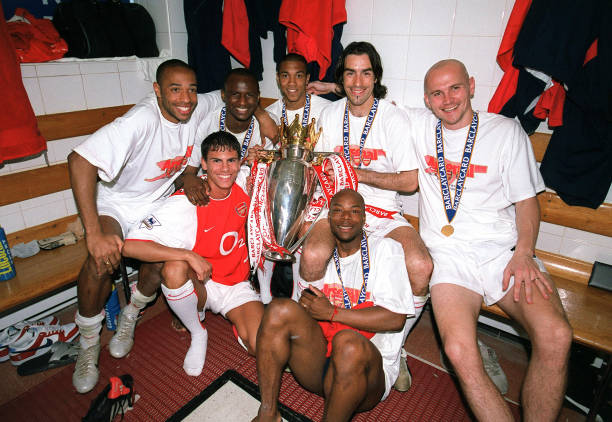
The 2003/04 season is remembered for being the best ever performance by a team in the history of English soccer. It took more than a century for a team to record an unbeaten run through the domestic championship in a single season, again winning a league title. 38 matches, 26 wins, 12 draws and 0 defeats. A perfect year. Thierry Henry had once again surpassed the natural and scored 39 goals and 18 assists, as well as picking up his second Player of the Year award from the Professional Footballers' Association (PFA).He was also second again in the FIFA World Player of the Year award and won his first Golden Shoe as a professional. Thierry Henry had reached his peak of form along with a series of players led by Arsène Wenger. The Invincibles called themselves the Invincibles.
France's doom and their farewell to London
After a dream season came Euro 2004. After getting through the group stage without playing their best football, the team led by Zinedine Zidane lost in the quarter-finals against the future champions, Greece, by a solitary 1-0. The bad fortune continued at club level with Henry in a 2004/05 campaign without a league title, but with Diego Forlan (31 goals) and an FA Cup. The highlight was that he became the first player to win back-to-back Golden Boots, as those won by Ally McCoist are considered ''unofficial''.
The 2005/06 season meant a lot in terms of autonomy. Named Gunner captain after Vieira's departure, he became Arsenal's all-time leading scorer, surpassing Ian Wright and his 185 goals. Months later, on 1 February 2006, he did the same in the league, surpassing Cliff Bastin's record of 150 goals, completed the season as the league's top scorer, was voted FWA Footballer of the Year for the third time in his career and was selected in the FIFA World XI for the first time. However, Arsenal failed to win the Premier League, but the flame of hope was eventually extinguished after reaching the 2006 UEFA Champions League Final and losing 2-1 to Barcelona. Both Arsenal's inability to win the league title for two consecutive seasons and the relative inexperience of the Arsenal team caused much turmoil over Henry's future. However, the Frenchman declared his unconditional love for the club and agreed to a four-year contract, adding that he would stay at Arsenal for life. In the 2006 World Cup he came close to a sweet taste when he lost in the final against Italy. A final whose most outstanding action was not the penalty that gave the Azzurri victory, but Zidane's header on Materazzi in his last performance at international level.

Henry's eighth and final campaign in London was marked by injuries. With only 12 goals and 6 assists, the period came in February. After being out on several occasions during the season, he returned in a Champions League match against PSV, but that was when he fell again for three months that condemned him to not being able to say goodbye to his fans as he wanted. The results detected a groin problem that closed the curtain on his fruitful spell in London (so far).
Flight to Spain
On June 25, 2007, Barça paid 24 million euros for the Frenchman's services. Henry left the club of his life to avoid being an obstacle and landed in Spain with the aim of reviving from his irregular last season. He debuted as a goalscorer in La Liga with a hat-trick against Levante and in European competitions against Olympique Lyon. However, once again relegated to the wing, he was unable to perform at his best and at the end of his first year there was already speculation of a possible return to the Premier League. Thierry was homesick. The expectations of every FC Barcelona fan fell far short of what he had been offering despite his 19 goals. Meanwhile, on October 17, 2007, he broke a new record and became the French player with the most goals in the history of the French national team, at that time with 43 goals and surpassing Michel Platini, who had scored a total of 41. Meanwhile, at Euro 2008 he was again eliminated in the group stage after losing to the Netherlands and Italy.
If Thierry Henry is also known for breaking countless records, in Spain he was not to be outdone. The 2008/09 season is remembered for the perfect run by a young Pep Guardiola and his charges. A unique six-team run that no team had achieved until Bayern Munich arrived last season to match that epic feat. The Frenchman was part of the 2-6 with two goals against Real Madrid at the Santiago Bernabeu, but in the second goal he had to leave with a knee injury after a clash with Iker Casillas, which affected his participation in the final of the Copa del Rey and UEFA Champions League.
His last stint at Barcelona, in 2009/10, ended up underlining his poor adaptation and he finished with only four goals in all competitions, his lowest tally since his time at Monaco and Juventus. In his final dance with the national team, he is remembered for a handball to William Gallas that eliminated Ireland from the play-offs. La Main de Dieu, so called, was a play that made reference to the goal scored by Diego Armando Maradona in the 86 World Cup against England with his hand. France qualified for the World Cup in South Africa with the water on their neck and Henry, already playing a secondary role, confirmed his retirement after a poor participation in the World Cup, stating that he had made the decision before the World Cup.
After three years in Spain, he headed for the MLS.

The last dance
Thierry Henry signed for the New York Red Bulls on July 14, 2010 and became the highest paid player in the league with a salary of $5.6 million. In two seasons, with his 17 goals and his commitment, he managed to help the MLS take a leap in quality, with others like Andrea Pirlo, David Beckham or Frank Lampard being the next to visit the aphrodisiac American league. However, the surprise came in January 2012: Henry had a pending account in London, so he was loaned for two months to the Gunners to say goodbye like the true legend he was. On his redebut, the Frenchman scored a memorable goal against Leeds United that earned Arsenal a place in the last 32 of the FA Cup, a goal in his own style that brought the Emirates Stadium to its feet. According to Thierry Henry himself, it was his favorite goal for the London outfit.
After his loan spell ended, he returned to shine in the United States, but failed to win the conference despite registering 35 goals and 30 assists in the last three seasons. He also fell just short of his first MLS Most Valuable Player award, although the accolade eventually went to Chris Wondolowski, then playing for the San Jose Earthquakes. In December 2014, he announced that he was leaving the New York club, confirming his retirement as a professional footballer two weeks later at the age of 37.

Career
Clubs
| Season | Team | App | Min | G | A | G+A | G/P | TA | TR | Rating |
|---|---|---|---|---|---|---|---|---|---|---|
| 2011/2012 | Arsenal | 6 | 65 | 2 | 0 | 2 | 0.33 | 0 | 0 | – |
| 2009/2010 | FC Barcelona | 29 | 1629 | 4 | 2 | 6 | 0.14 | 2 | 0 | – |
| 2008/2009 | FC Barcelona | 7 | 267 | 2 | 0 | 2 | 0.29 | 1 | – | – |
| 2007/2008 | FC Barcelona | 12 | 881 | 4 | 0 | 4 | 0.33 | 1 | 0 | – |
| 2006/2007 | Arsenal | 18 | 1564 | 10 | 0 | 10 | 0.56 | 2 | 0 | – |
| 2005/2006 | Arsenal | 35 | 2918 | 28 | 0 | 28 | 0.80 | 2 | 0 | – |
| Career total | 107 | 7324 | 50 | 2 | 52 | 0.47 | 8 | 0 | – | |
National team
| Season | Team | App | Min | G | A | G+A | G/P | TA | TR | Rating |
|---|---|---|---|---|---|---|---|---|---|---|
| 2009/2010 | France | 13 | 968 | 4 | 0 | 4 | 0.31 | 0 | 0 | – |
| 2008/2009 | France | 9 | 781 | 6 | 0 | 6 | 0.67 | 3 | 0 | – |
| 2006/2007 | France | 13 | 476 | 5 | 0 | 5 | 0.38 | 0 | 0 | – |
| 2004/2005 | France | 4 | 360 | 2 | 0 | 2 | 0.50 | 1 | 0 | – |
| 2000 | France | 5 | 450 | 3 | 0 | 3 | 0.60 | 0 | 0 | – |
| Career total | 44 | 3035 | 20 | 0 | 20 | 0.45 | 4 | 0 | – | |
ADVERTISEMENT
Profile compiled by the VAVEL Editorial Team from historical records and official competition data. · Editorial policy