


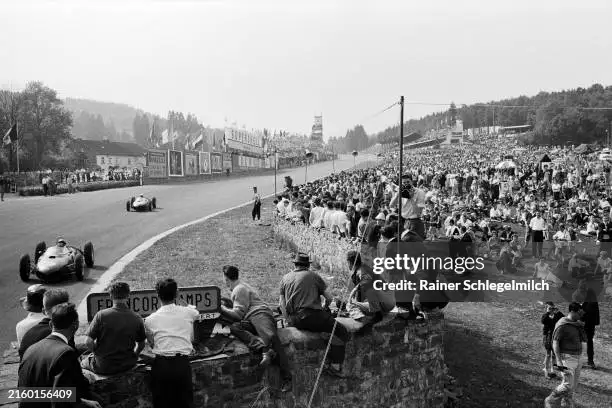

The Spa-Francorchamps circuit was first constructed in 1921, aimed to be used for motorcycle racing, and the first Belgian Grand Prix took place in 1925. The track was designed in a triangle shape, using public roads between the towns of Francorchamps, Malmedy, and Stavelot, and originally measured about 14.9 kilometers (9.3 miles) long.
The 35-lap Belgian Grand Prix became part of the Formula One World Championship in 1950 with the first race winner being Juan Manuel Fangio driving an Alfa Romeo, who took his second F1 win, in the inaugural season. He qualified in 2nd with the same time as pole sitter Nina Farina and won on the Sunday by 14 seconds. He would go on to win the race again in 1955, beating Stirling Moss, Mike Hawthorn and – once again – Farina.
ADVERTISEMENT
This event marked Spa as a key venue on the F1 calendar and has continued to mark its place in the sport – with a few interruptions due to safety concerns and weather conditions.
Notable Winners
Michael Schumacher holds the record for the most wins at Spa, with six victories between his debut at the venue for Jordan in 1991 and his last triumph came in 2002. His first win at the circuit came in 1992, which was also his first victory in Formula One.
Ayrton Senna is another legendary figure associated with the Belgian Grand Prix, winning five times during his career, his first coming in 1985.
Other notable winners include Jim Clark, who won four consecutive races during the 1960s, Alain Prost, who won the first race at the shortened circuit in 1979, and Kimi Räikkönen, who dominated the early 2000s with three consecutive wins from 2004 to 2006
ADVERTISEMENT
First Wins
The Belgian Grand Prix has also been a venue for many drivers to secure their first career wins. This includes the aforementioned Schumacher in 1992, and Gunnar Nilsson, who won his first and only race here in 1977, yet tragically passed away just one year later from testicular cancer.
For Charles Leclerc, Spa has also become an important track in his F1 career. The 26-year-old Monegasque secured his maiden F1 victory at Spa in 2019 when he defeated Lewis Hamilton in a fierce fight.
Sort-of a home races
Although there are no drivers from Belgium on the current grid, three drivers have Belgian roots. Max Verstappen races under a Dutch flag, but he was born in Belgium to a Belgian mother while Britain’s Lando Norris and Canadian driver Lance Stroll also have mothers who come from the country.
Momentos
In 1979, the circuit was dramatically shortened to create a new 6.9km track – less than half the original distance of the original lap.
ADVERTISEMENT
It saw the cars turn off the public road parts of the track at Les Combes and onto a new permanent section. Winding through the valley, these new complexes were fast and technical, adding in the new Rivage, Pouhon and Stavelot corners. Spa-Francorchamps remained a long, challenging circuit, but was now safer and easier to manage.
Over the following years, small changes altered the venue. The Bus Stop chicane was installed, the F1 straight was moved to the entrance of La Source rather than the exit, and Raidillon underwent minor adjustments.
The track was made semi-permanent in the early 2000s when part of it was cut off from public use between March and October. This was then made permanent soon after, increasing to 220 days of operation within the year. In 2003, the Grand Prix was cancelled due to a conflict within the European Union about tobacco advertising at the event.
Then a €19 million investment saw the Bus Stop and La Source hairpin moved to make more room for a bigger, more modern pit lane. This also allowed for a longer start/finish straight.
ADVERTISEMENT
In 2022, extra alterations were made to the track, including gravel pits and extra run-off at the Eau Rouge and Raidillon corners, following the tragic death of F2 driver Anthoine Hubert in 2019.
When it rains, it pours
The weather at Spa has often played a part in creating a dramatic Grand Prix. It once rained at the Belgian Grand Prix on 20 consecutive occasions, but that’s not the whole story. The circuit is so large, that it often rains in isolated sections of the track, while others remain bone dry.
Even in the summer months, the weather at Spa can be unpredictable. The 2019 6 Hours of Spa – held in May – suffered several safety car periods and was even red-flagged due to snow, sleet and hail.
Let’s go to the Spa… F1 race
As of this year, Formula 1 has announced that the Belgian GP at Spa-Francorchamps will remain on the calendar until 2025 (following the signing of a one-year extension with the promoters)
As the sport continues to evolve, Spa remains a constant, reminding us of the raw, unfiltered essence of racing.
Whether it’s the roar of engines through Eau Rouge or the unpredictable twists of fate by the Ardennes weather, Spa-Francorchamps will always hold a special place in the heart of motorsport.
ADVERTISEMENT
