




Since Todd Boehly and Clearlake Capital took over in 2022, Chelsea have spent more than £1bn on players, changed managers repeatedly, rebuilt the squad at a ridiculous speed and sold academy players who supporters actually felt connected to.
Yet for all the spending and all the talk about a long-term project, Chelsea are still stuck in the same place emotionally: unstable, disconnected and nowhere near the club supporters were promised.
This is not just about one bad run, one manager or one transfer window. It is about a club that has moved constantly without ever really looking in control.
Before the takeover, Chelsea were not perfect, but they were still Chelsea. In 2021/22, they finished third in the Premier League with 74 points, scored 76 goals and conceded only 33. They had problems, but they still had standards. They still felt like a serious football club.
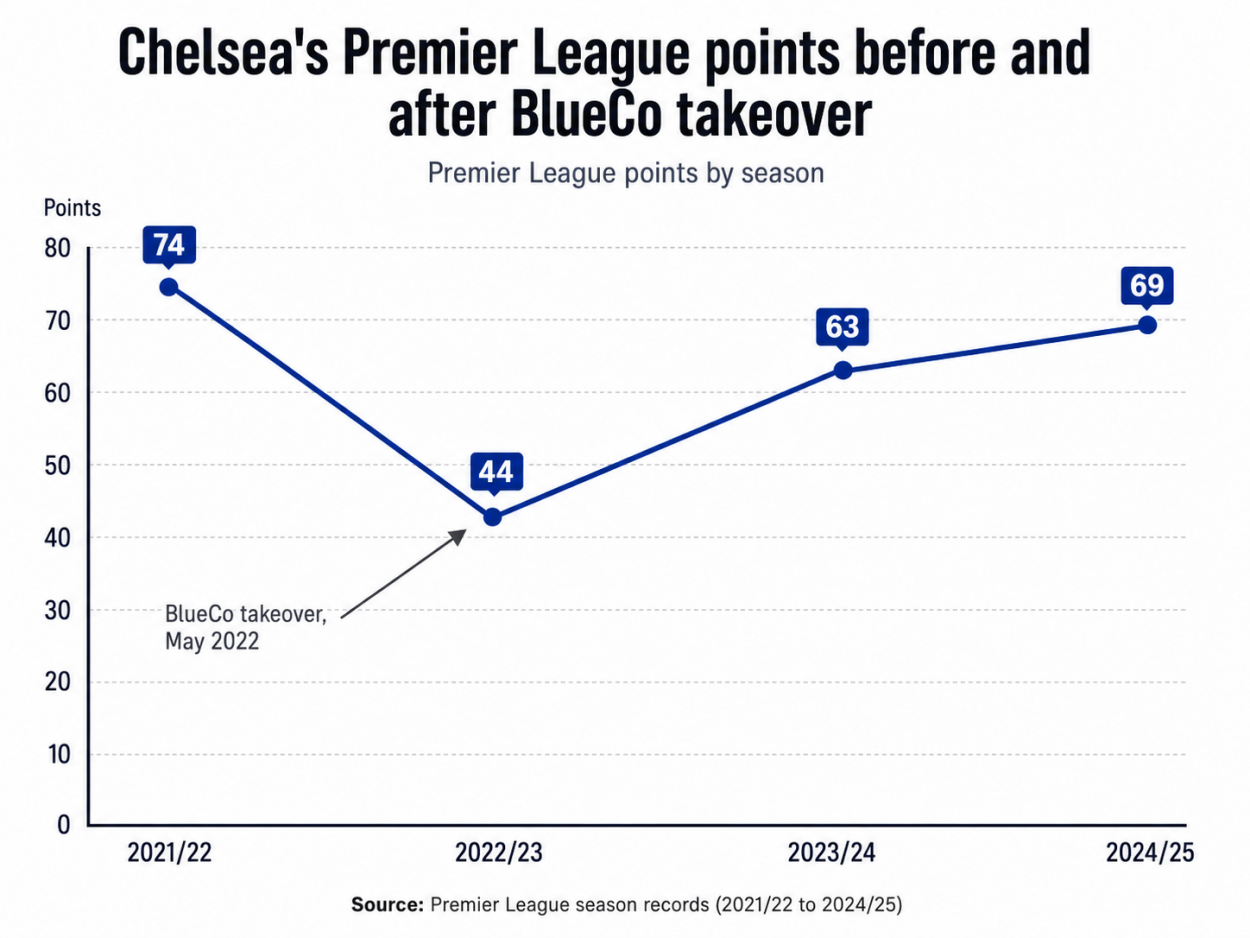
One year later, that had completely collapsed.
In 2022/23, Chelsea finished 12th with 44 points. They scored just 38 league goals all season, which works out at one goal per game. For a club that had won the Champions League two years earlier, it was embarrassing. Not just poor. Embarrassing.
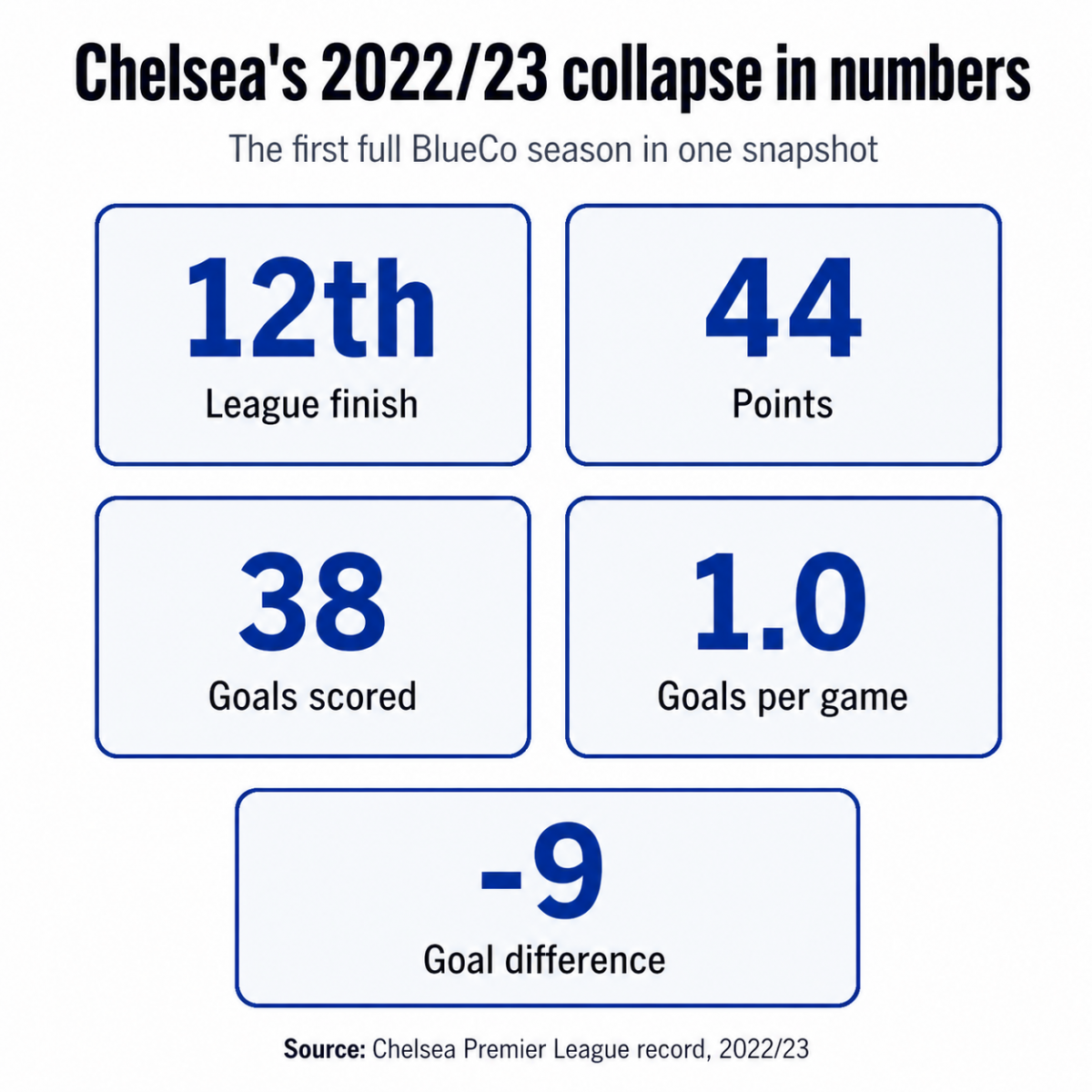
That season should have been the warning sign that spending money is not the same as building a team.
Chelsea had players. They had expensive signings. They had talent. What they did not have was balance, leadership or any real sense of direction.
The 2023/24 season under Mauricio Pochettino made things more complicated. Chelsea improved, and that matters. They finished sixth with 63 points and scored 77 league goals. On paper, that looked like progress. But it was chaotic progress.
They also conceded 63 goals, which was Chelsea’s worst top-flight defensive record since 1990/91. That one statistic sums up the BlueCo era better than almost anything else. The attack improved, but control disappeared. The team became more entertaining, but not more reliable.
Chelsea could score four, but they could also concede four. They could look dangerous for 20 minutes, then completely fall apart. They had good young players, but not enough structure around them. It was progress with a massive warning label attached.
Then came 2024/25, where Chelsea finished fourth with 69 points. That should have been the moment the project started to feel real. Champions League football was back. The table looked healthier. The club could point to improvement and say the pain had been worth it.
But that is the issue with BlueCo’s Chelsea. Every time you think they might have found some stability, another crisis arrives.
The current collapse, including six straight Premier League defeats, has dragged all of those questions back to the surface. If a project can fall apart this quickly, how strong was it in the first place?
That is the real story in the data. Chelsea have not just declined in a straight line. They have crashed, recovered slightly, then crashed again. For a club that has spent so much money, that level of volatility is not normal.
Spending without stability
The easiest number to point at is the money.
Chelsea have spent more than £1bn on transfers since the takeover. Depending on which reports you use, the figure is even higher. That level of spending should buy more than potential. It should buy certainty. It should buy a squad with balance, depth and leadership.
Instead, it has bought a squad that often looks like it has been built by several different ideas at once.
There are talented players, of course. That is not the issue. Cole Palmer has been one of the few signings supporters have properly attached themselves to. Moises Caicedo has grown into a major figure. Enzo Fernandez has had big moments. Others may still become excellent players.
But Chelsea’s problem has never been a total lack of talent. It has been the lack of a proper team.
Too many players have arrived at once. Too many have been young. Too many have been expected to develop while also carrying the pressure of a billion-pound rebuild. That is not fair on them, and it has not been fair on the managers either.
A young squad needs senior players around it. It needs standards. It needs a clear spine. It needs players who know what Chelsea is supposed to feel like when things get difficult.
Instead, Chelsea have often looked like a group of expensive individuals trying to work out the plan while the club above them keeps changing it.
That is why the spending matters so much. It is not just that Chelsea have spent badly. It is that they have spent so aggressively and still managed to look unfinished.
The manager problem
The managerial churn is another part of the story.
Since BlueCo arrived, Chelsea have gone through Thomas Tuchel, Graham Potter, Frank Lampard, Mauricio Pochettino, Enzo Maresca and further uncertainty around the dugout. That is not what a long-term project is supposed to look like.
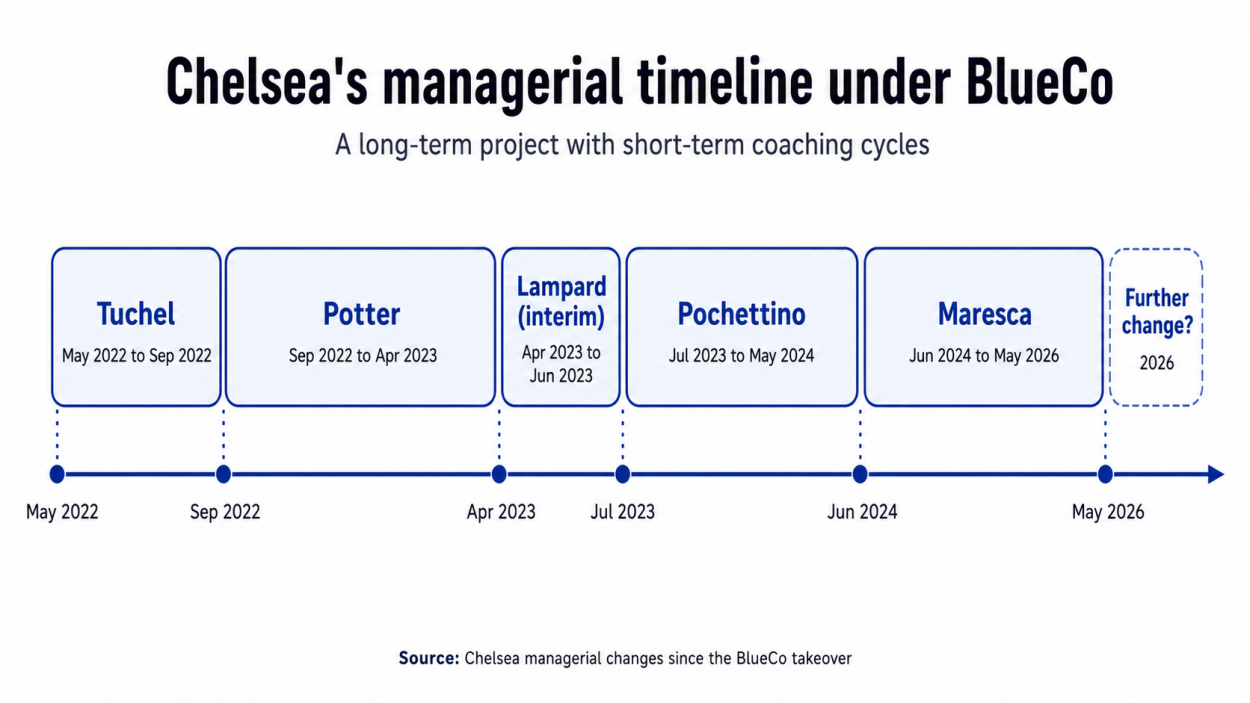
Every manager has come with a different explanation.
Tuchel was the elite coach already in the building. Potter was meant to be the long-term development appointment. Lampard was the emergency reset. Pochettino was supposed to bring experience and help a young squad grow. Maresca was another tactical, system-led choice.
Each time, the club has asked supporters to buy into a new idea. Each time, the old idea has been quietly pushed aside.
That is exhausting for fans because it makes every “project” sound temporary.
The club talks about patience, but the coaching timeline has not shown much of it. The club talks about alignment, but the constant changes have made Chelsea look anything but aligned. The club talks about structure, but the structure itself is now one of the biggest things being questioned.
And that is where the anger at the sporting directors and ownership comes from.
Supporters are not stupid. They know managers are responsible for results. But when different managers keep running into similar problems, the questions have to go higher.
Who built the squad? Who decided the balance was right? Who decided which profiles were needed? Who decided which academy players could be sold? Who decided this was the best way to rebuild Chelsea?
Managers have carried the blame in public. But the model itself has not been judged harshly enough.
Goals returned, control did not
The goals data is probably the clearest footballing example of the problem.
In 2022/23, Chelsea scored 38 Premier League goals. That was pathetic for a club of Chelsea’s size. The football was slow, blunt and painful to watch.
A year later, they scored 77. That is a huge improvement, and it would be wrong to ignore it.
But the same team conceded 63.
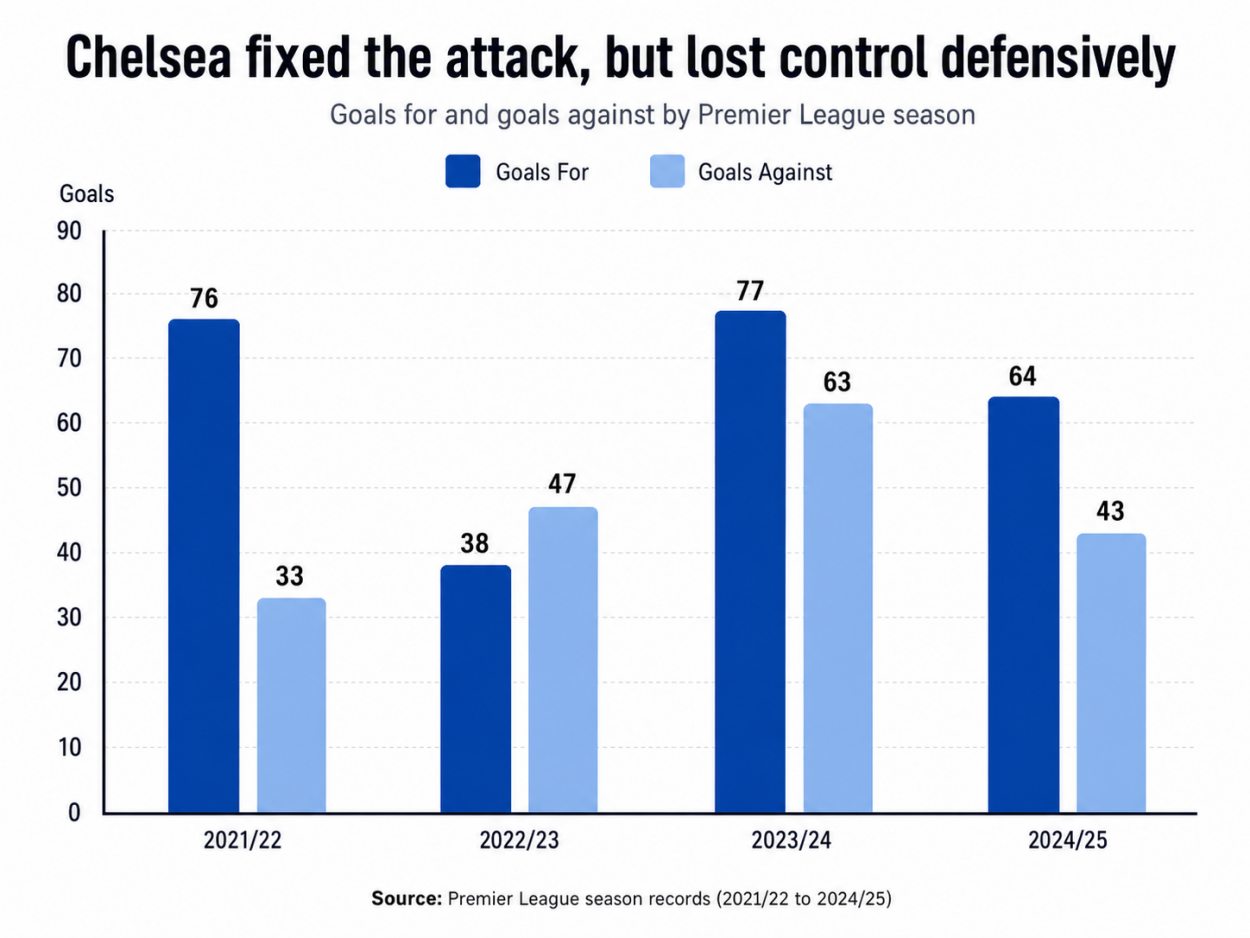
That tells you Chelsea fixed one problem by opening up another. They became better going forward, but easier to play through. They had more chaos, more chances, more big moments, but still not enough control.
That has been one of the biggest frustrations of the BlueCo era. Chelsea have rarely looked boring and stable. They have usually looked talented and fragile.
You can see the idea in flashes. A good spell. A good goal. A strong performance. A young player looking like he could become elite. Then, suddenly, the same old problems appear: poor game management, defensive mistakes, missed chances, weak mentality and a crowd that loses belief quickly because it has seen the pattern too many times.
That is why the data matters. The numbers do not show a team with no potential. They show a team that has never turned potential into something consistent.
Cobham and the emotional cost
The academy issue is where the numbers meet the feeling of the fanbase.
Chelsea supporters have always accepted big transfers. That is part of the club’s modern identity. But Cobham gave Chelsea something different. It gave the club a link between the team and the supporters.
Players like Mason Mount, Reece James, Conor Gallagher, Trevoh Chalobah, Tammy Abraham, Fikayo Tomori and Marc Guehi meant something because they felt like Chelsea people. Not all of them could stay forever, but they represented continuity.
Under BlueCo, academy players have increasingly felt like financial tools.
Because academy sales count as pure profit in accounting terms, they are valuable when a club needs to manage financial rules. That might make sense on a spreadsheet, but football is not only a spreadsheet.
When supporters see academy players sold while the club continues spending huge money elsewhere, it creates resentment. It makes fans feel like the people who understand the club are easier to move on than the expensive signings brought in to justify the model.
That is why the “conveyor belt” criticism has hit so hard. Chelsea have become a club where players arrive, fail to settle, get replaced, and supporters are expected to immediately connect with the next one.
But connection does not work like that.
Fans need time to care. Players need time to belong. A club needs some sense of continuity. Under BlueCo, Chelsea have had too little of that.
A club losing its identity
The strangest thing about BlueCo’s Chelsea is that there has been so much activity, but so little clarity.
What are Chelsea actually trying to be?
A possession team? A transition team? A youth project? A data club? A player-trading machine? A win-now club? A long-term rebuild?
At different points, the answer has seemed to change.
That is the real identity crisis. It is not just about whether the team wins or loses. It is about whether supporters can see something they believe in.
Under Roman Abramovich, Chelsea were chaotic, but everyone knew the standard. Win. Compete. Lift trophies. If you failed, the club moved on. It was not always healthy, and it was not always sustainable, but it was clear.
Under BlueCo, Chelsea have kept the chaos but lost the clarity.
The club still changes managers. It still spends huge money. It still acts ruthlessly when it wants to. But the winning edge has gone. The ruthlessness now feels less like ambition and more like confusion.
That is what supporters are reacting to.
They are not just angry because Chelsea are losing. They are angry because Chelsea no longer feel like Chelsea.
The numbers show the problem
The data does not say everything, but it says enough.
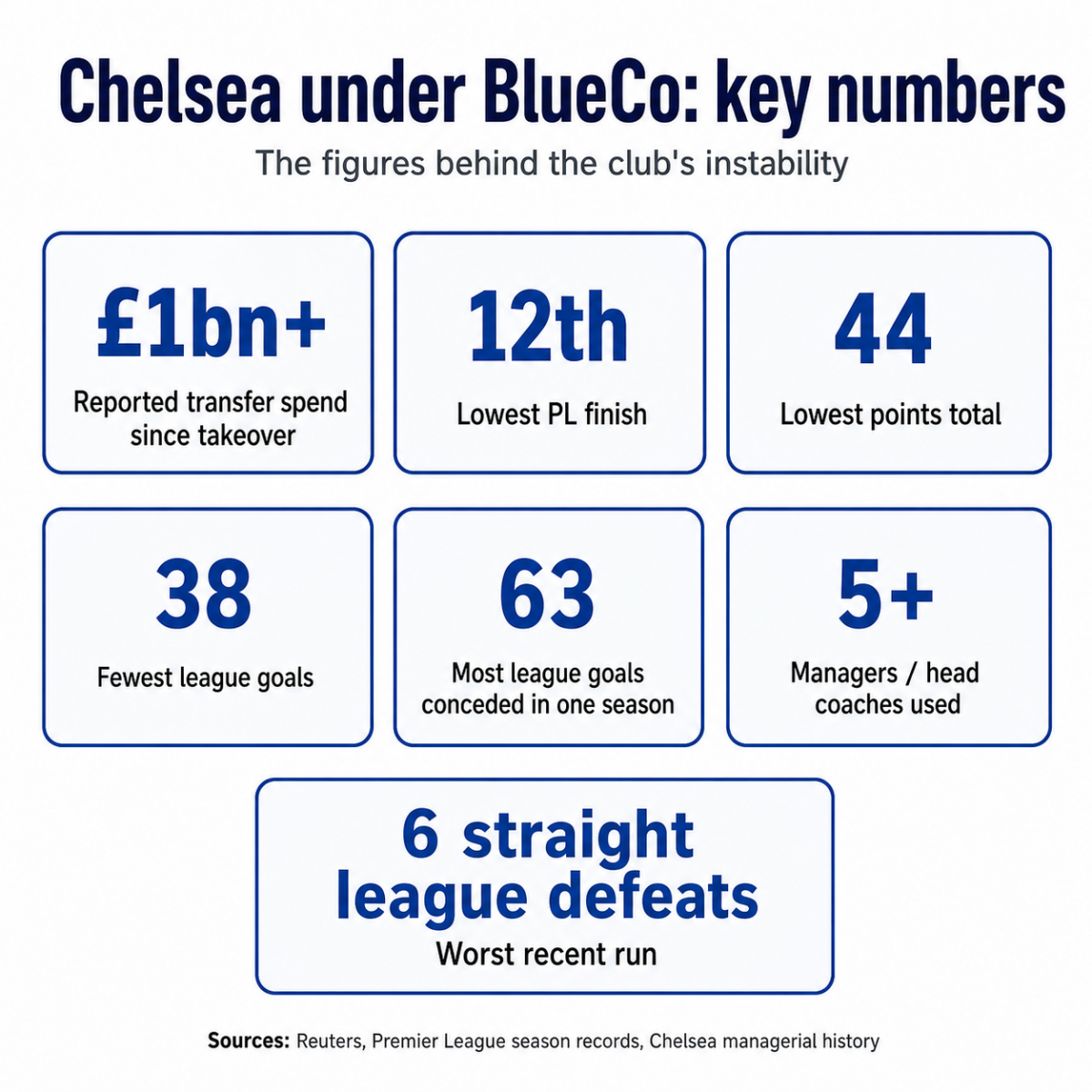
Chelsea went from 74 points before the takeover to 44 points in the first full BlueCo season. They recovered to 63, then 69, but the latest collapse shows how fragile that recovery was. They scored 38 goals in one season, then 77 the next, but conceded 63. They have spent more than £1bn, but still look incomplete. They have changed managers repeatedly, but the same problems keep coming back.
That is not bad luck. That is not just injuries. That is not just one coach failing.
That is a club problem.
BlueCo’s Chelsea have been built around future value, but supporters live in the present. They have been told to trust the process, but the process keeps changing. They have been asked to accept pain as part of growth, but too often the pain has looked avoidable.
Chelsea did not need to stay frozen in the past. Change after Abramovich was always going to happen. The club needed modernising in some areas. The squad needed work. The structure needed to evolve.
But modernising a club should not mean stripping away everything that made it feel like itself.
For all the money spent, all the players signed and all the promises made, Chelsea under BlueCo still feel like a club searching for a plan it should have had before the rebuild started.
The numbers show the decline. The performances show the confusion.
But the fan reaction shows something even deeper.
Chelsea supporters do not just want better results. They want a club they can recognise again.
