
 Fulham

Other languages2
ADVERTISEMENT
Álvaro Arbeloa Coca (Salamanca, 17 January 1983) is a Spanish former footballer and manager who has been in charge of Fulham in the Premier League since July 2026. As a player he was a dependable right-back, equally comfortable on the left, who won virtually everything a footballer can win: two European Cups and a league title with Real Madrid, plus a European Championship, a World Cup and a second European Championship with Spain. He retired in 2017 and has since built a coaching career that began in Real Madrid's academy, took him to the club's first-team bench in January 2026 and, six months later, to his first job abroad.
From Salamanca to Zaragoza: the making of a full-back
He was born in Salamanca but keeps little of the city beyond his birth certificate: at the age of four his family moved to Zaragoza for his father's work, and he grew up there, first at the Colegio del Salvador and then in the youth ranks of Real Zaragoza, which he joined in 1995 and where he spent six formative seasons. He was not yet the full-back Europe would come to know but a composed centre-back, the kind who organises the line and talks more than he runs. His name began circulating around the offices of the big clubs while he was still a teenager and, in 2001, Real Madrid brought him to their academy. It was an enormous leap for a boy shaped by Aragonese football, yet Arbeloa never showed any sign of nerves: that habit of settling into uncomfortable places without shrinking would come to define his entire career, on and off the pitch.
Castilla captain, substitute at the Bernabéu
His path through the club's structure was the classic one: a season with Real Madrid C in 2002-03 and three with Castilla between 2003 and 2006, more than eighty games for the reserves. He played centre-back there and wore the captain's armband in a dressing room that now reads like a historic generation, alongside Esteban Granero, Rubén de la Red, Roberto Soldado, Álvaro Negredo and Juan Mata; that group won promotion to the Segunda División in 2004-05. The reward arrived on 16 October 2004, when he made his LaLiga debut as a substitute against Real Betis. It amounted to just two first-team appearances, enough to confirm that the Real Madrid of the Galácticos had no room for a young, unknown full-back. At twenty-three he accepted that his career would have to start a long way from the Bernabéu.
Half a season at Riazor
On 24 July 2006 Deportivo La Coruña paid 1.3 million euros for him in a deal that allowed Real Madrid to retain half of any future sale. «The opportunity came up and I did not want to let it pass», he said at the time. At Riazor, under Joaquín Caparrós, he played twenty-one competitive matches, twenty of them in the league and eighteen of those from start to finish, and finally became a genuine top-flight footballer: minutes, weekly pressure and a settled position on the right. His spell in Galicia lasted barely six months, but it was enough to turn him into a competitive, reliable full-back and to catch the eye of a Spanish coach working in England. That winter changed his life.
ADVERTISEMENT
Liverpool: the night at the Camp Nou and the Athens final
Rafael Benítez signed him for Liverpool on 31 January 2007 and the two and a half seasons that followed transformed him. He debuted on 10 February against Newcastle and went on to make ninety-eight competitive appearances for the Reds, scoring twice, the first of them against Reading that April. His defining night came at the Camp Nou: Benítez picked him at left-back for his first European start with the brief of shadowing Lionel Messi in the first leg of the last sixteen against Barcelona, and Liverpool won 2-1 in a performance that made his name across Europe. That season ended with him on the pitch in the Champions League final in Athens on 23 May 2007, when he came on late for Steve Finnan in the 2-1 defeat to AC Milan, both goals scored by Filippo Inzaghi. At Anfield he learned the physical demands of English football and absorbed a dressing-room culture he would cite years later as a formative influence; he also earned his international place, making his Spain debut on 26 March 2008 and never dropping out of the squad again.
Seven seasons in white and eight trophies
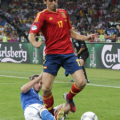
On 29 July 2009 Real Madrid brought him back for around five million pounds on a five-year contract, and Arbeloa settled in at right-back through the club's fiercest years of competition. He stayed seven seasons, making 238 competitive appearances and winning eight trophies: two European Cups, one league title, two Copas del Rey, a Supercopa de España, a UEFA Super Cup and a Club World Cup. He scored six goals, few and well spread: the first at Jerez in February 2010, another weeks later in a 3-2 derby win over Atlético Madrid and one more in the European group stage against Ajax. He was a regular starter in the hundred-point league title of 2011-12, the one that broke Barcelona's grip on the era with 121 goals scored, and lifted the 2011 Copa del Rey at Mestalla, decided by Cristiano Ronaldo's header in extra time. Europe provided the finishing touch, with the long-awaited Décima in 2014 and the Undécima in Milan in 2016, by which point his role was peripheral: he played only nine matches in his final season. He left on 30 June 2016 and joined West Ham United, where he debuted on 21 September against Accrington Stanley and played only four competitive games before announcing his retirement in June 2017, aged thirty-four.
The full-back who held Spain's greatest team together
Arbeloa belongs to the most decorated generation in Spanish football history and was present for all three of its great triumphs. He made his debut on 26 March 2008 against Italy, won fifty-six caps without ever scoring, and featured at Euro 2008, where he played once against Greece; at the 2010 World Cup in South Africa, where he played once against Honduras; and above all at Euro 2012, where he started all six matches for a Spain side that conceded a single goal across the entire tournament. In between came a third place at the 2009 Confederations Cup and a runners-up finish in 2013. His game explains why he fitted that team so well: he was not an overlapping full-back or an insistent crosser but a defender by trade, well positioned and hard in individual duels, who sealed his flank, forced wingers infield and always offered a safe passing option to return the ball to midfield. In a side built on never losing possession, that profile was worth as much as a goal.
From the under-14s to the Bernabéu bench
His coaching career began in September 2020 in Real Madrid's academy with the under-14 side, which he led to a league title; he took the under-16s in 2021-22 and in the summer of 2022 was handed the Juvenil A, where he produced his finest developmental work. In 2022-23 he won the treble, taking the cup in March, the league in April and the Copa de Campeones in May with a 3-1 win over Real Betis at Las Rozas, without losing a single match in domestic competition; the club had not won that Copa de Campeones since 2016-17. He was a youth league champion again in 2024-25 and on 28 May 2025 replaced Raúl González at the head of Castilla, taking charge of nineteen matches. On 12 January 2026, following Xabi Alonso's departure, the club promoted him to the first team. «I have been in this house for twenty years, I know the responsibility I carry», he said. He began with a 3-2 defeat at Albacete in the Copa del Rey round of sixteen and won his first league game on 17 January, the day he turned forty-three, beating Levante 2-0. He took charge of twenty-eight matches, winning eighteen, drawing two and losing eight, reached the quarter-finals of the European Cup, where Bayern Munich knocked Madrid out, and finished second in the league, but the season ended without silverware and on 9 June 2026 club and coach formalised their separation.
Craven Cottage: a first bench outside Spain
Less than a month later he found a new home in England. On 7 July 2026 Fulham announced him as head coach, succeeding Marco Silva, who left for Benfica after years of making the club a reflection of his own style. It is his first job outside Spain, though English football is hardly foreign to him after his seasons in Liverpool and London. His Premier League bow came on 24 August 2026 and could scarcely have been more cinematic: a west London derby at Craven Cottage against the Chelsea of Xabi Alonso, the friend and former team-mate he had succeeded at Real Madrid, settled by a 2-3 defeat. The Blues went ahead after thirty seconds through João Pedro; King equalised, Rogers and Palmer reopened the gap either side of the interval and Gonzalo García provided a late consolation. «We concede goals in the first minute, at the end of the first half and at the beginning of the second. There are no worse moments to concede them», Arbeloa admitted, true to the self-criticism that has always marked his public voice. His task at Craven Cottage is to sustain a Fulham long associated with the profile of his predecessor and to give it an identity of its own.
ADVERTISEMENT
Profile compiled by the VAVEL Editorial Team from historical records and official competition data. · Editorial policy