
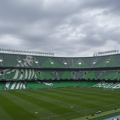
Stadium
Benito Villamarín · Profile

Other languages2
ADVERTISEMENT
The Estadio Benito Villamarín opened on 17 March 1929 with an international match between Spain and Portugal, won 5-0 by Spain with goals from Gaspar Rubio and José Padrón. Built in the Heliópolis district of Seville, beside the Avenida de la Palmera, it began life as the Estadio de la Exposición, tied to the Ibero-American Exposition the city hosted that year. It is the home of Real Betis Balompié, which owns the ground, and it has carried several names over almost a century of use.
The Estadio Benito Villamarín opened on 17 March 1929 with an international match between Spain and Portugal, won 5-0 by Spain with goals from Gaspar Rubio and José Padrón. Built in the Heliópolis district of Seville, beside the Avenida de la Palmera, it began life as the Estadio de la Exposición, tied to the Ibero-American Exposition the city hosted that year. It is the home of Real Betis Balompié, which owns the ground, and it has carried several names over almost a century of use.
A stadium for the Ibero-American Exposition
The project had a long history. Aníbal González drew up a first design in 1912, and Antonio Illanes del Río completed the final version in 1923, with technical work by Manuel María Smith. The ground opened with room for around 18,000 spectators and a 105 by 68 metre pitch. In 1936 Betis signed a ten-year lease with Seville City Council and became the sole tenant. After the Spanish Civil War, the ground reopened on 12 March 1939 as the Estadio Heliópolis, named after the surrounding district.
From Heliópolis to Benito Villamarín
The club took ownership of the stadium in the early 1960s, under the presidency of Benito Villamarín, who ran Betis from 1955 to 1965. The ground took his name in 1961. The first improvements came in the same period: the north and south end stands were extended in 1958, and floodlights were installed in 1959. Between 1971 and 1973 both end stands were demolished and rebuilt. In 1997 the ground was renamed Estadio Manuel Ruiz de Lopera, after the Betis executive, and in 2010, following a members' vote, it went back to the Benito Villamarín name.
The rebuild for the 1982 World Cup
Seville's selection as a host city for the 1982 World Cup brought a major overhaul between 1979 and 1982. The far stand was knocked down and rebuilt, and the new main side stand, with its first tier, opened on 19 October 1980 for a match against Hércules. That year capacity reached 48,500. During the tournament the stadium staged two of Brazil's first-round games: on 18 June 1982 Brazil beat Scotland 4-1 in front of 47,379 spectators, and on 23 June they defeated New Zealand 4-0 before a crowd of about 43,000.
ADVERTISEMENT
The Spain national team at Heliópolis
Up to 2018, Spain played 15 matches at the stadium and won 13 of them. The biggest scoreline came on 21 December 1983, when Spain beat Malta 12-1 in the game that closed qualifying for Euro 1984 and took the place in the tournament ahead of the Netherlands. The national team's last match at the Villamarín was on 15 October 2018, a 3-2 defeat to England in the Nations League. On 25 May 2019 the stadium hosted its first Copa del Rey final, in which Valencia beat FC Barcelona 2-1 in front of 53,398 spectators.
Turn-of-the-century works and the south stand
Another round of construction began in the late 1990s. On 12 September 1998 the lower stands and the first tier behind the north goal and at the far end were opened, and on 1 January 2000 the first half of the new stadium was officially unveiled, with three tiers in those two sections. The south end stand waited more than fifteen years. Its demolition began on 30 June 2016 and the work was completed in June 2017, at a cost of around fifteen million euros. The stand grew from about 5,000 seats to about 14,700, and total capacity rose from 52,000 to 60,721. The same project replaced the seating and installed LED lighting.
The new main stand
In August 2023 the club presented plans for a new main stand, designed by Rafael de La-Hoz and Gensler, with a lightweight roof. In the summer of 2025 the stadium closed for the works, and the first team moved to the Estadio de La Cartuja, where it began playing home games in August that year. On 9 September 2025 demolition started on the main stand built for the 1982 World Cup, together with the cantilevered stairway. In April 2026 the construction firm Acciona began the first phase of the build, covering excavation and foundations.
ADVERTISEMENT
Profile compiled by the VAVEL Editorial Team from historical records and official competition data. · Editorial policy