
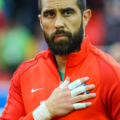
Athlete
Claudio Bravo · Biography

Other languages2
ADVERTISEMENT
Claudio Bravo made his professional debut on 10 April 2003 for Colo-Colo, in a Copa Libertadores match against Independiente Medellín that his side lost 2-0. Born Claudio Andrés Bravo Muñoz on 13 April 1983 in Viluco, in the Buin district of Chile, he kept goal for Colo-Colo, Real Sociedad, FC Barcelona, Manchester City and Real Betis, and captained Chile, for whom he won 150 caps between 2004 and 2024.
Youth career and Colo-Colo
He came through the Colo-Colo academy, which he joined in the mid-1990s. After that continental debut in 2003 he established himself as the first-team goalkeeper and made 123 league appearances for the Santiago club. His first title came in the 2006 Apertura: in the final against Universidad de Chile, settled on penalties, he saved two kicks. It was his last game for Colo-Colo, who had already agreed his transfer to Real Sociedad.
Eight seasons at Real Sociedad
He moved to San Sebastián in the summer of 2006 and made his La Liga debut on 22 October that year in a goalless draw with Mallorca. The club went down in 2007 and Bravo stayed on in the Spanish second division, where he became the regular starter. In 2008-09 he won the second-tier Zamora Trophy, shared with David Cobeño, and in February 2010 he scored a direct free kick against Gimnàstic de Tarragona, the only goal of his club career. Real Sociedad won the second division that season and returned to the top flight. Bravo stayed at Anoeta until 2014, finishing with 229 league appearances.
FC Barcelona
In 2014 he joined FC Barcelona. He opened his first league campaign with 754 minutes without conceding, the best start ever recorded by a goalkeeper in the competition, and ended the 2014-15 season with 19 goals against and the La Liga Zamora Trophy. He was the league starter while Marc-André ter Stegen played the cup and the Champions League. In two seasons he won two league titles (2014-15 and 2015-16), two Copas del Rey (2014-15 and 2015-16), the 2014-15 Champions League, the 2015 UEFA Super Cup and Club World Cup and the 2016 Spanish Super Cup, with 70 league appearances.
Manchester City and Real Betis
In 2016 he moved to Manchester City. Between 2016 and 2020 he made 29 league appearances in England and won the 2017-18 Premier League, two League Cups (2018 and 2020) and two Community Shields (2018 and 2019). In 2020 he returned to Spain to sign for Real Betis. He played 56 league games in Seville up to 2024 and started the 2022 Copa del Rey final, played on 23 April at La Cartuja against Valencia: 1-1 after extra time and a 5-4 shootout win for Betis.
Chile national team
He made his Chile debut on 11 July 2004 against Paraguay at the Copa América in Peru. He inherited the captaincy after Marcelo Salas retired from international football and wore the armband at the 2010 World Cup in South Africa; four years later he played at a second World Cup, in Brazil. As captain he lifted the 2015 Copa América, Chile’s first, and the 2016 Copa América Centenario, and was named best goalkeeper at both tournaments. At the 2017 Confederations Cup in Russia Chile finished runners-up and Bravo received the Golden Glove. That year he handed the captaincy to Gary Medel, regaining it in 2021.
Playing style
He was a goalkeeper comfortable with the ball at his feet and able to start attacks from the back, a quality that weighed in his moves to Barcelona and later Manchester City. He combined that distribution with sharp reflexes and a strong penalty record, and shootouts decided two of his finals: the 2006 Chilean Apertura and the 2022 Copa del Rey.
Final years
He played in seven editions of the Copa América. At the 2024 tournament in the United States he became the oldest player to appear in a match in the competition’s history, at 41. He finished his international career with 150 caps for Chile and, after leaving Betis in 2024, announced his retirement from professional football on 26 August 2024.
ADVERTISEMENT
Profile compiled by the VAVEL Editorial Team from historical records and official competition data. · Editorial policy