
Stadium
Estadio de Gran Canaria · Profile

Other languages2
ADVERTISEMENT
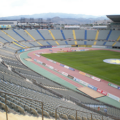
Gran Canaria Stadium (Estadio de Gran Canaria) is in the Siete Palmas district of Las Palmas de Gran Canaria, and UD Las Palmas have played there since 2003. The stadium belongs to the Cabildo of Gran Canaria, the island council, not to the club. It was designed by the architects Pedro Medina and Guillermo Ortego Carretero. The natural grass pitch measures 105 by 68 metres.
Replacing the Estadio Insular
From 1951 to 2003, UD Las Palmas played at the Estadio Insular. In the late 1990s the island council decided to build a new ground to replace it, in the Siete Palmas ravine in the upper part of the city. It was planned as a multi-purpose venue. A running track circled the pitch and kept the stands away from the grass, and the original capacity was more than 30,000.
Opening in 2003
The stadium opened on 8 May 2003 with a friendly between UD Las Palmas and the Belgian club RSC Anderlecht. The home side won 2-1, and Rubén Castro scored the first goal at the new ground. It was also the venue's first sell-out. Since then the club has played its home games there in the Spanish top flight, the Spanish second division and the third-tier Segunda División B.
The running-track years (2003-2014)
The Spain national team played there for the first time on 18 August 2004 and beat Venezuela 3-2 in a friendly. On 21 November 2007 Spain returned for a Euro 2008 qualifier and beat Northern Ireland 1-0 with a goal from Xavi, in front of about 31,000 spectators. On 24 June 2006 UD Las Palmas clinched promotion to the second division at the stadium after their game against CD Linares, with 30,210 fans in the stands. On 10 May 2014 the Canary Islands derby against CD Tenerife drew 31,123 spectators. A freestyle motocross show was held there three times between 2005 and 2007, and the Máster Stadium Race took place in 2008. The stadium also hosted concerts: Shakira in July 2006 and Bruce Springsteen on 15 May 2012, each in front of about 30,000 people.
The 2014-2016 redevelopment
Redevelopment work started on 11 November 2014. The project removed the running track and moved the lower tier of seating about 20 metres closer to the pitch, turning the venue into a football-only ground. The first phase was declared complete in January 2016, with a capacity of 32,392. The East Tower, an annex building and bringing the Naciente stand closer to the pitch were left for later. With the redeveloped ground, UD Las Palmas played in the top flight from 2015 to 2018. In the 2015-16 season their average league attendance was 21,304. On 18 November 2018 Spain played there again and beat Bosnia and Herzegovina 1-0 in a friendly, with a goal from Brais Méndez.
Back in the top flight and new uses (2023-2026)
UD Las Palmas returned to the top flight for the 2023-24 season, with an average league attendance of 25,041. On 27 January 2024 their match against Real Madrid drew a crowd of 32,037. Since 2022 the stadium has hosted the Granca Live Fest music festival every summer. On 24 May 2025 the singer Quevedo played there to 41,000 people on his “Buenas Noches Tour”. In April 2026 the stadium hosted a super special stage of the Rally Islas Canarias, a round of the World Rally Championship, and it was chosen to host the 2026 Copa de la Reina final, scheduled for 16 May. On 11 June 2026 Pope Leo XIV celebrated Mass at the stadium in front of about 30,000 people.
The 2030 World Cup project
In July 2023 the island council, backed by UD Las Palmas, put Gran Canaria forward as a host city for the 2030 World Cup, which Spain, Portugal and Morocco are hosting together. In July 2024 the stadium was confirmed as a host venue. In June 2024 the council approved a second redevelopment, planned to raise capacity above 40,000 over 36 months of work. In March 2026 UD Las Palmas agreed to put in 60 million euros in exchange for co-managing the stadium. On 3 June 2026 the construction contract was put out to tender for 174.7 million euros, but no company bid. On 30 July 2026 the council announced a new tender worth 234 million euros.
ADVERTISEMENT
Profile compiled by the VAVEL Editorial Team from historical records and official competition data. · Editorial policy