
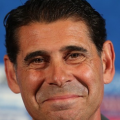
Athlete
Fernando Hierro · Biography

Other languages2
ADVERTISEMENT
The first trophy of Fernando Ruiz Hierro’s career was the 1989-90 Spanish league title, won with Real Madrid in his first season at the club. Born on 23 March 1968 in Vélez-Málaga, he played as a centre-back and, at times, in midfield. He captained both Real Madrid and the Spain national team. After retiring he worked as a sporting director and coach in Spain, Mexico and Saudi Arabia.
Early years in Vélez and a debut with Valladolid
He came through the youth ranks of Vélez, his hometown club, between 1973 and 1978. He spent 1979 in the Málaga academy and then went back to Vélez, where he stayed until 1986. That summer he joined Real Valladolid’s reserve side and played the 1986-87 season with them. On 4 October 1987 he made his La Liga debut against Espanyol. In two seasons with the first team he played 59 league games and scored twice. Real Madrid signed him in 1989, with José Luis Caminero moving the other way as part of the deal.
Fourteen seasons at Real Madrid
At Madrid he formed a centre-back partnership with Manolo Sanchís. His striking of the ball and his heading led several coaches to push him into midfield. In 1991-92 he scored 21 goals in 37 league games, the best return of his career. Between 1989 and 2003 he made 602 official appearances for the club and scored 128 goals, 102 of them in 439 league matches. He added league titles in 1995, 1997, 2001 and 2003 to the one from 1990, along with the 1993 Copa del Rey, the Spanish Super Cups of 1990, 1993, 1997 and 2001 and the 1994 Copa Iberoamericana.
European Cups and the captain’s armband
As Madrid captain he won the Champions League in 1998, 2000 and 2002. The 1998 win was the club’s first in the competition since 1966. He also won the Intercontinental Cup that year, then won it again in 2002, along with the UEFA Super Cup. At the end of the 2002-03 season, just after winning the league, the club let him go, as it did with coach Vicente del Bosque.
Spain captain
He made his senior Spain debut on 20 September 1989 in A Coruña, a 1-0 win over Poland, after five appearances for the under-21 side. In qualifying for the 1994 World Cup he headed the winner against Denmark that took Spain to the United States, and at the tournament he scored against Switzerland in the round of 16. He was selected for the World Cups of 1990, 1994, 1998 and 2002 and for Euro 1996 and Euro 2000. He captained the side from 1998 until he retired from international football in 2002, finishing with 89 caps and 29 goals. From 2 June 2001 to 12 February 2003 he was Spain’s all-time top scorer.
Qatar and England: the end of his playing career
In 2003 he moved to Al-Rayyan in Qatar, where he played 19 league games, scored 3 goals and won the 2004 Emir Cup. That year, on the advice of his former Madrid teammate Steve McManaman, he signed for Bolton Wanderers. He played 29 Premier League games and scored once, in a 3-2 defeat at Norwich in December 2004. Sam Allardyce asked him to stay, but he retired on 10 May 2005.
Sporting director and coach
From 2007 to 2011 he was sporting director of the Royal Spanish Football Federation, a period in which Spain won Euro 2008 and the 2010 World Cup. In 2011-12 he was general manager of Málaga, who qualified for the 2012-13 Champions League. On 10 July 2014 he became Carlo Ancelotti’s assistant at Real Madrid. In 2016-17 he coached Real Oviedo in the Spanish second division for 43 matches, with 17 wins, 10 draws and 16 defeats, and finished eighth. In November 2017 he returned as the federation’s sporting director. On 13 June 2018, two days before the World Cup in Russia began, he was named Spain coach after Julen Lopetegui was sacked. Spain won their group but went out to Russia on penalties in the round of 16 after a 1-1 draw. On 17 October 2022 he became sporting director of Guadalajara, whose reserve side, Tapatío, won the Liga de Expansión MX Clausura 2023. He left the Mexican club in May 2024 and in June 2024 he was appointed sporting director of Al-Nassr in Saudi Arabia.
ADVERTISEMENT
Profile compiled by the VAVEL Editorial Team from historical records and official competition data. · Editorial policy