
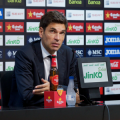
Coach
Mauricio Pellegrino · Biography

Other languages2
ADVERTISEMENT
The first trophy of Mauricio Andrés Pellegrino Luna's career came in the 1993 Clausura with Vélez Sarsfield. Born on 5 October 1971 in Leones, in the province of Córdoba, he played centre-back in Argentina, Spain and England and, after retiring in 2006, coached in four countries. He has managed Lanús since December 2024.
Early years and Vélez Sarsfield
He started out at Club Atlético Sarmiento in his home town, where he played from 1982 to 1987. That year he joined the Vélez Sarsfield academy in Buenos Aires, and in the early 1990s he established himself in the first team. In 1991 he made two appearances for Argentina's under-20 side. With Vélez he won four league titles: the 1993, 1996 and 1998 Clausura and the 1995 Apertura. Abroad, that Vélez side won the 1994 Copa Libertadores and the Intercontinental Cup the same year, followed by the 1996 Supercopa Sudamericana and the 1997 Recopa Sudamericana.
Barcelona and Valencia
In 1998 he joined FC Barcelona on loan. He made his debut against Extremadura on 12 September 1998 and finished the 1998-99 season as a Spanish league champion. In 1999 he signed for Valencia, his longest spell in Europe. He played in two consecutive Champions League finals: Valencia lost 3-0 to Real Madrid in 2000 and went down on penalties to Bayern Munich in 2001 after a 1-1 draw following extra time, with Pellegrino missing the final kick. At Mestalla he won the Spanish league in 2001-02 and 2003-04 and the 2003-04 UEFA Cup.
Liverpool, Alavés and Argentina
In January 2005 he signed a six-month deal with Liverpool. He was part of the run to the 2005 League Cup final, which Liverpool lost, but was ineligible for the Champions League the club won that spring, having already played in it for Valencia. He was released at the end of the season and moved to Deportivo Alavés, where he retired in June 2006. He won three caps for Argentina, all in 1997, making his debut against Ecuador at the Copa América in Bolivia, where Argentina went out in the quarter-finals.
Learning under Rafael Benítez
As soon as he stopped playing he stayed in Valencia to coach in the academy, with a youth team. In 2008 he returned to Liverpool as a first-team coach under Rafael Benítez, and in mid-2010 he followed him to Inter Milan. That Inter side won the 2010 Club World Cup, and in the same December Benítez and his staff were dismissed.
First jobs in Spain, Argentina and England
His first post as a head coach was at Valencia in 2012, replacing Unai Emery. His first match was a 1-1 draw away to Real Madrid on 19 August 2012, and he was sacked on 1 December that year after a 5-2 home defeat by Real Sociedad. In April 2013 he took over at Estudiantes de La Plata, where he stayed until April 2015, and in June 2015 he moved to Independiente, who lost the Pre-Libertadores tie to Racing. In 2016 he returned to Spain with Alavés and took them to the first Copa del Rey final in the club's history, lost 3-1 to Barcelona in 2017. In June 2017 he joined Southampton, who dismissed him in March 2018 with the team in a relegation fight.
Leganés, Vélez, Universidad de Chile and Cádiz
From June 2018 to October 2019 he managed Leganés. In April 2020 he went back to Vélez as head coach, replacing Gabriel Heinze: he reached the semi-finals of the 2020 Copa Sudamericana, where Lanús knocked them out, finished runner-up in the 2021 league and resigned in March 2022. He took charge of Universidad de Chile for the 2023 season, finishing ninth, and in January 2024 he arrived at Cádiz, who were relegated in May that year.
Lanús and continental titles
On 14 December 2024 he was appointed head coach of Lanús. On 22 November 2025, in Asunción, the team won the Copa Sudamericana on penalties against Atlético Mineiro, and Pellegrino was named the tournament's best coach. In February 2026 Lanús won the Recopa Sudamericana against Flamengo, 1-0 in the first leg and 3-2 after extra time at the Maracanã, the club's first Recopa title.
ADVERTISEMENT
Profile compiled by the VAVEL Editorial Team from historical records and official competition data. · Editorial policy