
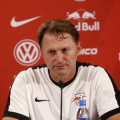
Coach
Ralph Hasenhuttl · Biography

Other languages2
ADVERTISEMENT
In the summer of 2016, Ralph Hasenhüttl left FC Ingolstadt to take charge of RB Leipzig, who were about to play their first season in the Bundesliga. A year later the newly promoted club finished second in the 2016-17 Bundesliga and qualified for the Champions League for the first time. Born on 9 August 1967 in Graz, Austria, Hasenhüttl had spent almost two decades as a centre forward before building a coaching career in the lower tiers of German football that eventually took him to the Premier League and back to the Bundesliga.
A striker in Austria, Belgium and Germany
A tall forward at 1.91 metres, he made his debut in 1985 for his hometown club Grazer AK, scoring 20 goals in 65 league games before 1989. That year he joined Austria Vienna, where he enjoyed the best spell of his playing career: 44 goals in 134 matches, three consecutive league titles (1990-91, 1991-92 and 1992-93) and two Austrian Cups (1992 and 1994). In 1994 he moved to Austria Salzburg, winning another league title in 1994-95 and the 1995 Austrian Supercup.
He went abroad in 1996, spending a season at KV Mechelen and another at Lierse, where he lifted the 1997 Belgian Super Cup. Two years at 1. FC Köln (1998-2000) and two at SpVgg Greuther Fürth (2000-2002) followed, before a final stint with Bayern Munich’s reserve side between 2002 and 2004. He finished with 450 league appearances and 119 goals.
Eight caps for Austria
He won eight caps for Austria and scored three goals between 1988 and 1994. His debut came on 15 May 1988 in a friendly against Hungary: he came off the bench and scored ten minutes later.
Unterhaching, Aalen and Ingolstadt
His coaching career began at SpVgg Unterhaching, where he worked with youth players in 2004-05 before serving as caretaker and then as assistant to Werner Lorant. He took over the first team on 4 October 2007, finishing sixth in 2007-08 and fourth in the 3. Liga in 2008-09, one point short of a play-off place. He was dismissed in February 2010.
In January 2011 he took charge of VfR Aalen and kept them in the 3. Liga in 2010-11. The following season they finished second and won promotion to the 2. Bundesliga in 2012, then placed ninth in the second tier in 2012-13. On 7 October 2013 he was unveiled as FC Ingolstadt head coach, and in 2014-15 he led them to the 2. Bundesliga title and the club’s first promotion to the top flight. Ingolstadt finished eleventh in their debut Bundesliga season in 2015-16.
RB Leipzig
At Leipzig he deployed the high press and fast transitions that earned him the nickname “Alpine Klopp” in the English press. After the runners-up finish of 2016-17, the team played in the Champions League in 2017-18, finishing third in a group behind Beşiktaş and Porto, and then reached the Europa League quarter-finals, where they lost to Olympique de Marseille. In the Bundesliga they came sixth. He left the club in May 2018 after 83 matches, with 40 wins, 19 draws and 24 defeats.
Southampton
Southampton appointed him in December 2018, making him the first Austrian manager in Premier League history. He took over a side in the relegation zone and kept them up in 16th place in 2018-19. An eleventh-place finish in 2019-20 and a fifteenth in 2020-21 followed. He was named Premier League Manager of the Month for July 2020, and on 2 January 2021 his team beat reigning champions Liverpool 1-0.
His spell also included two 9-0 defeats: at home to Leicester City in October 2019 and away to Manchester United at Old Trafford in February 2021. He was sacked on 7 November 2022, having taken charge of 173 matches with 59 wins, 41 draws and 73 losses.
VfL Wolfsburg
In March 2024, during the international break, he replaced Niko Kovač as head coach of VfL Wolfsburg. He steered the side away from danger and finished the 2023-24 season in twelfth place with 37 points. The club dismissed him in May 2025, with two matchdays remaining, after a 4-0 defeat to Borussia Dortmund. He left Wolfsburg after 44 matches in charge: 17 wins, 9 draws and 18 defeats.
ADVERTISEMENT
Profile compiled by the VAVEL Editorial Team from historical records and official competition data. · Editorial policy