
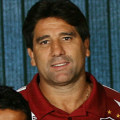
Coach
renato portaluppi · Biography

Other languages2
ADVERTISEMENT
On 11 December 1983, at Tokyo’s National Stadium, Renato Portaluppi scored both goals as Grêmio beat Hamburg 2-1 in the Intercontinental Cup final. He was 21, and the win brought that year’s world club title to Porto Alegre. Born on 9 September 1962 in Guaporé, in the interior of Rio Grande do Sul, and known across Brazil as Renato Gaúcho, he spent two decades as a right winger and forward. Later, as a coach, he won the Copa do Brasil with Fluminense and the Copa Libertadores with Grêmio.
From Bento Gonçalves to Porto Alegre
He came through the youth ranks at Esportivo in Bento Gonçalves between 1978 and 1979 and made his professional debut there in 1979. In 1980 he joined Grêmio. He was part of the squad that won the 1981 Brazilian Championship, the club’s first, and two years later he had become the starter on the right flank. The Copa Libertadores came in 1983, followed at the end of the year by the night in Tokyo against Hamburg. He also won the Campeonato Gaúcho in 1985 and 1986 before moving to Rio de Janeiro.
Flamengo, Roma and the return to Brazil
He signed for Flamengo in 1987 and won that year’s Copa União. He added the Taça Guanabara in 1988 and then crossed the Atlantic to play for Roma in Serie A in 1988-89. The spell lasted a single season: in 1989 he was back at Flamengo, where he won the 1990 Copa do Brasil. Over the following years he moved often. He returned to Grêmio on loan in 1991, played for Botafogo from 1991 to 1992 and for Cruzeiro in 1992, winning the Supercopa Sudamericana and the Minas Gerais state title. He had another stint at Flamengo in 1993 and played for Atlético Mineiro in 1994.
The belly goal and the end of his playing days
In 1995, with Fluminense, he scored the goal Rio remembers him for. In the final match of the Campeonato Carioca’s eight-team round, Flamengo needed only a draw but trailed Fluminense 3-2. Four minutes from time, a shot from Aílton deflected off Renato’s stomach and went in. The goal, known ever since as the “gol de barriga” (belly goal), gave Fluminense the state title. He stayed at the club until 1997, went back to Flamengo for 1997-98 and finished his career at Bangu in 1999.
With the Brazil national team
He played for Brazil from 1983 to 1993, winning 44 caps and scoring 5 goals. In 1986 Telê Santana left him out of the final squad for the World Cup in Mexico. He won the 1989 Copa América, held in Brazil, and a year later he was called up for the World Cup in Italy. There he was a substitute and came on in the round of 16 against Argentina, the match Brazil lost 1-0 to go out.
First steps as a coach
He began coaching at Madureira in 2000. He managed Fluminense in 2002 and 2003 and Vasco da Gama from 2005 to 2007. Back at Fluminense, he won the 2007 Copa do Brasil and the following year took the side to the 2008 Copa Libertadores final, lost on penalties at the Maracanã to LDU Quito. He then coached Bahia in 2010, Grêmio in 2010-11, Atlético Paranaense in 2011, Grêmio again in 2013 and Fluminense in 2014.
The Grêmio era and later spells
He returned to Grêmio in 2016 and won the Copa do Brasil that year. In 2017 he lifted the Copa Libertadores after beating Lanús 1-0 in Porto Alegre and 2-1 in Argentina, becoming the first Brazilian to win the Libertadores as both player and coach. With the club he added the 2018 Recopa Sudamericana and the Gaúcho titles of 2018, 2019 and 2020. In 2021 he coached Flamengo and reached his third Libertadores final, lost to Palmeiras. Back at Grêmio from 2022 to 2024, he won the 2023 and 2024 Gaúcho titles; the club announced his departure on 9 December 2024. In 2025 he coached Fluminense, taking them to the semi-finals of the FIFA Club World Cup, where they lost 2-0 to Chelsea on 8 July, and resigned on 24 September after elimination by Lanús in the Copa Sudamericana. He took over Vasco da Gama in March 2026, was dismissed on 18 June, and on 14 September 2026 Grêmio announced him as head coach for a fifth time.
ADVERTISEMENT
Profile compiled by the VAVEL Editorial Team from historical records and official competition data. · Editorial policy