
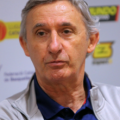
Coach
Svetislav Pesic · Biography

Other languages2
ADVERTISEMENT
Svetislav “Kari” Pešić was born on 28 August 1949 in Pirot, in what was then Yugoslavia, and in 1967 he moved from his hometown club to Partizan Belgrade, where he played as a shooting guard until 1971. That move started a career in basketball spanning almost six decades, first on the court and then on the bench, with club titles in Yugoslavia, Germany and Spain and gold medals with three different national teams.
Player at Pirot, Partizan and Bosna
After coming through the Pirot team between 1964 and 1967, he spent four seasons at Partizan before joining Bosna Sarajevo in 1971. His best years as a player came there: he won the Yugoslav league and cup in 1978 and, a year later, the 1979 European Champions Cup, the forerunner of the EuroLeague. He retired in 1979 and soon returned to the club as a coach.
Early coaching years
In charge of Bosna, he won the 1983 Yugoslav league and the 1984 Yugoslav Cup. At the same time he coached Yugoslavia’s youth teams and collected three golds in a row: the 1985 European Cadet Championship in Bulgaria, the 1986 European Junior Championship in Austria and the 1987 World Junior Championship in Italy, where his side beat the United States twice. Several players from that group went on to shape an era in Europe and the NBA.
Germany national team and Alba Berlin
In 1987 he took over the West Germany national team and stayed on after reunification. His biggest result came at EuroBasket 1993, held in Munich, where Germany won gold. That same year he became head coach of Alba Berlin, winning the Korać Cup in 1995, four consecutive Bundesliga titles from 1997 to 2000 and the German Cup in 1997 and 1999. He was named Bundesliga Coach of the Year in 1996, 1998 and 1999.
Gold with Yugoslavia and a treble with Barcelona
Between 2001 and 2002 he coached the Federal Republic of Yugoslavia, winning EuroBasket 2001 in Turkey and the 2002 World Championship in Indianapolis; he stepped down on 1 December 2002. That summer he had joined FC Barcelona, and in 2003 he led the club to its first treble: EuroLeague, Liga ACB and Spanish Cup. He was voted European Coach of the Year in 2003, and added a second ACB title in 2004 before leaving.
Rome, Girona, Moscow, Belgrade and Valencia
From 2004 to 2006 he coached Virtus Roma, and in 2006-07 Akasvayu Girona, with whom he won the FIBA EuroCup before leaving after disagreements with the board. He signed for Dynamo Moscow in June 2007 and later had two spells at Crvena zvezda, in 2008-09 and 2011-12. In between, on 16 November 2010, he agreed to coach Valencia Basket until the end of that season.
Bayern Munich and a return to Barcelona
In November 2012 he took charge of Bayern Munich and in 2014 delivered the club’s first Bundesliga title. He left on 24 July 2016 at his own request, citing health reasons. On 9 February 2018 he returned to Barcelona and within days won the Spanish Cup, beating Real Madrid 92-90 in the final; he retained the trophy in 2019, again against Madrid, and was named Spanish Coach of the Year. He was dismissed on 1 July 2020, a day after losing the league final to Baskonia. In 2020 he was inducted into the FIBA Hall of Fame.
Serbia and a final spell in Munich
The Serbian federation appointed him head coach on 28 September 2021. With Serbia he finished runner-up at the 2023 World Cup and won bronze at the Paris 2024 Olympics; his tenure ended on 30 September 2025, after the defeat to Finland at that year’s EuroBasket. On 22 December 2025 he returned to the Bayern bench, replacing Gordon Herbert. He took the team to the 2026 Bundesliga finals, which they lost 3-2 to Alba Berlin, the club where his German coaching career had begun. That series, in June 2026, brought his coaching career to a close.
ADVERTISEMENT
Profile compiled by the VAVEL Editorial Team from historical records and official competition data. · Editorial policy