

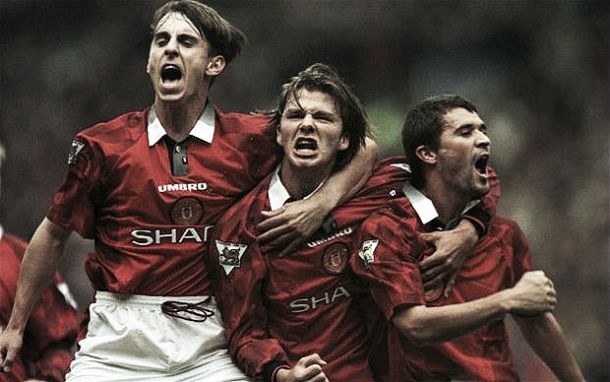

My parents are both journalists so it was always a profession that interested me. I grew up around it as they both worked on Fleet Street; my mother worked on the Sunday Express as a showbusiness interviewer, and my father spent nearly 25 years at the Daily Mirror as their chief foreign correspondent. Today he writes for a range of newspapers and makes documentaries for ITV and the cinema. Once I realised I wasn’t ever going to become a footballer, the thought of writing about the game interested me.
What did you do to pursue you career in journalism?
Growing up I would write match reports about games I had watched on Match of the Day, and do school projects on Manchester United. I went to the University of Sussex and the University of Michigan where I did a degree in American History. I didn’t do media studies, as an arts degree gives you just as good a grounding for journalism. I wrote occasionally for the University newspapers, and afterwards did several work experience placements at the Daily Express sports desk, Hayter’s news agency, Brighton Evening Argus, and the official Manchester United magazine, where I was fortunate enough to be offered my first job back in 1996.
What did it feel like to join Manchester United magazine in 1996?
As a lifelong United fan it was an incredible start in journalism. Within weeks of joining the magazine I was interviewing Ole Gunnar Solskjaer who had just joined the club, and a young player by the name of David Beckham in his living room at home in Manchester. I travelled the world reporting on them from Barcelona to Brazil, and got to interview my heroes both past and present. It was a very successful time with United twice winning the title, and the Treble in 1999. This was a time just before Sky Sports News, MUTV, Twitter, Facebook and even the official website, so the magazine had a far greater prominence. However, eventually after three and a half years I found working for a club magazine restrictive, and wanted to write about other teams and sports.
What does it feel like to write for such prestigious magazines as FourFourTwo and Esquire?
I greatly enjoy writing for these magazines. I never take it for granted. I remember being at the Super Bowl in 2005 in Jacksonville and hearing two veteran journalists moaning about the weather and how they wished it was being staged in Miami or San Diego instead. I could only shake my head and instead appreciate how fortunate I was to be there.
What was your initiative behind writing Manchester United's Best XI?
I was approached by a publisher to choose my best all-time team for Manchester United, and write a book about it. the idea appealed to me because of what I could bring to the book having interviewed and spent time with so many of the players. From the XI I selected I had interviewed nine of them, the only two I hadn’t were Duncan Edwards and Roger Byrne who of course died at Munich in 1958. I hope I was able to offer some good insight in to players like Keane, Stam, Giggs and Schmeichel from my interviews with them.
Who is the most coveted player you have ever interviewed?
Spending time with George Best was very special. I used to ghost write a column with him and would sit with him in a pub off the Kings Road each month listening to his football stories. I also visited him in Belfast. George was a lovely man, and despite being arguably British football’s greatest ever player there was no ego to him at all. He was charming, and just loved talking about football.
Favourite footballer of all time?
Growing up my heroes were Bryan Robson and Norman Whiteside. I loved Whiteside for his natural talent, but also his dominance on the pitch. It is hard to look past Eric Cantona though, he was probably my last genuine football hero.
In your opinion what was your favourite/enjoyable book you wrote?
Alongside Manchester United’s Best XI, I would say The Ashes Match of My Life where 14 Ashes legends recall their greatest ever Test. My great love is cricket, especially the Ashes, and it was a pleasure to work with guys like Glenn McGrath, Mike Hussey and David Gower.
Where do you see yourself in the future?
This feels like the question you get at the end of a job interview. I enjoy what I do at the moment, and by being freelance I have the freedom to work for a wide range of newspapers, magazines and websites, as well as continuing to write books.
