


What does it feel like to be the editor of the official 2014 FIFA World Cup Magazines?
Being editor of the 2014 World Cup magazines is an honour and a privilege. I feel lucky to have this position and I try to enjoy it as much as I can. At the same time it brings with it a lot of responsibility, so you need to be focused and disciplined to make sure you do a good job.
What advice would you give to any football journalists?
This is a complex question and one that I have asked many, many journalists myself. But there are some eternal truths. One is that, eventually, it always comes down to who wants it the most. How much desire you have. Most of those who are at the top work constantly, round the clock. They are obsessives, workaholics, running on a constant treadmill. This desire and dedication – or, the “stamina of motivation,” as Arsène Wenger put it – is the most decisive factor in general, and especially in journalism. I’d say the success rate is based more on effort and persistence than pure intellect.
For more specific advice, I’d say: read and write constantly. And read widely. Not just football news but other magazines, such as TIME and The New Yorker, which have some of the best writers around. Also analyse the style of the UK’s best writers, such as Matt Dickinson and Daniel Taylor. And stay away from bad writing. Treat it like junk food. If you’re at university, spend lots of time at your student newspaper, and get work experience wherever you can.
What inspired you to pursue a career in football journalism?
Like most kids I wanted to become a professional footballer. When I realised that wouldn’t work out, I thought the next best thing would be to write about it. I have always liked writing and languages, but the main motivation was always to be able to work with football.
What is your favourite World Cup moment and why?
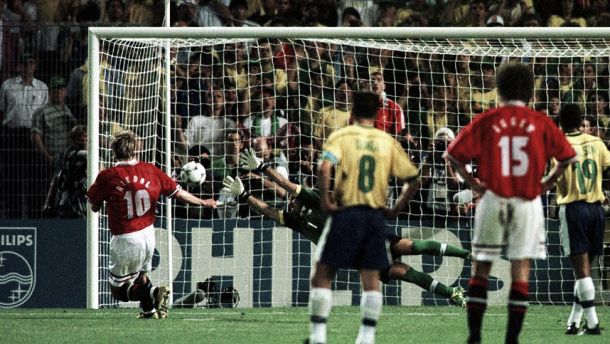
The moment that most intrigues me is Uruguay’s win over Brazil in the decisive match of the 1950 World Cup. I find it fascinating how one game of football can have such a profound effect on a country, and bury itself so deeply into its national psyche. I guess it’s an example of the power football can have. From a more personal point of view, my favourite moment has to be when Norway beat Brazil in 1998 to reach the Round of 16.
What is your favourite World Cup goal and why?
This is linked to the above: Kjetil Rekdal’s last-gasp penalty to sink Brazil. I realise both of my chosen moments involve Brazil on the losing side, so let me add that I’m a big fan of Brazil, Brazilian football and, most of all, Brazilian football fans.
Who do you think will win the World Cup and why?
That’s a difficult question. If I had to pick, I’d say Argentina, because they have a fantastic attacking trio in Lionel Messi, Gonzalo Higuaín and Sergio Agüero; because their road to the final is slightly easier; and because, with Messi being No10, captain and at roughly the same age as Diego Maradona was in 1986, a script might have been written somewhere...
What team do you think will be the dark horse in the tournament?
Chile. Arturo Vidal is now doubtful, and his absence would be a big blow, but their intensity and pressing game is mesmerising and they’ll be strong regardless. I think the continental climate will prove very influential, a factor that strongly favours South American teams, so I’d also give my backing to Uruguay and Colombia.
What does it feel like to have your writing published in such prestigious publications like The Daily Telegraph and The Times?
Such moments are a large part of the reason why you enter football journalism. You pick these papers up as a student and dream of having your name in them. When it finally happens, you get an immense feeling of pride and satisfaction.
