

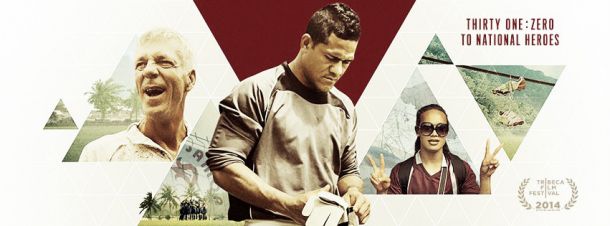

As huge football fans we were all aware of American Samoa's historic 31-0 defeat to Australia in 2001, but it didn’t have any real importance to us until 2011, when we began discussing where the purest form of football could be found. Mike and I had been making football-related commercials for a few years so we knew the game and the industry well. We’d been lucky enough to work with the best clubs and players in the world and filmed from the touchline at the Maracan, Garrincha, Camp Nou and Wembley. But it was our producer Kristian Brodie who reminded us of the American Samoan team and suggested that it is surely the team that plays on, despite losing every single game, that must love the sport more than any other. And so the documentary was born, with the sole purpose of capturing whatever spirit it was that motivated this team to come out for the second half when they were already 16 goals down. Football is a truly international language and we hoped that by finding a positive message within the American Samoan team camp, we would be able to share that message all around the world.
How did you go around approaching them to film the documentary?
As the time difference between London and Pago Pago is twelve hours, contacting them always had to be done very early morning or very late at night. We didn’t just want to send cold emails as we knew they would be less likely to respond, we knew it would be important to speak with them in person to explain our reasons for wanting t come and, hopefully, convince them that our intention wasn’t to poke fun at them as other journalists had. I remember very late night skype calls with terrible delays on the line, the three of us trying to sell to them our idea for the film, it’s quite funny when I think back to it now. Once they’d agreed, they announced that they had a series of games a few weeks later and so suddenly our prep time was cut drastically short. Three weeks later we were in the island!
How do you think Thomas Rongen influenced the side so much?
When Thomas joined the group, we really feared he would stop us filming the sessions entirely. We’ve worked at top clubs and know how hard-line top coaches can be about media access. Thomas was coming from the US National Team set-up so there was every chance he would take a similar stance. Fortunately for us, Thomas actually saw it things differently. Rather than seeing us as a distraction I think he saw us as a kind of motivator for the team. If they could do something historic, we’d be right there capturing every moment!!
Early on in the film, he seems very serious and quite confrontational, but I think in a way that was always part of motivating the team. As you can imagine, many overseas coaches who travel to paradise to coach the soccer team can take things rather too easily, The American Samoans could see Thomas was serious from the outset. He also learned and adapted though, realizing that Samoan culture is all about community and family and so he started to soften as the weeks went on. I think the real turning point was when he gave a little something of himself to them. When he told the team about his own personal tragedy, the gesture of opening up to them really helped strengthen the bond and after that point it felt like he was really connecting with the players in training.
What did it feel like to be given permission to film the documentary after they were so sceptical about people approaching them before?
It really was a privilege to work with them. One of the most beautiful things about American Samoa is how isolated it is from the many layers of media we experience at home in the UK. As a result, the players were less conscious of the cameras around them because they have not been influenced by watching the kind of images we were creating. We were careful never to show them any or our footage as it was important to retain this magic. Understanding that we were fully committed to the cause, having flown 10,000 miles with 300kg of equipment, Tavita Taumua (CEO of the Football federation of Americna Samoa) granted us ‘access-all-areas’ and our daily kick-about with the players after training allowed us to build relationships to the point where they were happy with us following them 24/7.
Did you expect the film to get so much publicity and acknowledgment?
I suppose the result against Tonga gave us some idea what to expect, we were the only foreigners in Samoa at the time and we were embededed with the team. When news of the win travelled around the world we were getting calls at all times, day and night, from foreign press wanting to talk with the team to run their story. Friends who knew I was following them would text from Europe, China and Thailand even, to say they’d seen something in the paper about the win. Now the experience with the film has been quite similar. In all honesty, we made the film for the very special people who feature in it, any publicity feels like a bonus in a way. It is so wonderful to feel that we have been able to share this amazing story across so many international borders. Football really is an international language it seems!
Do you have any advice for any film makers?
I think there’s Thomas says something in the film when talking about the team, but in the time we have been making the film, we’ve always used the advice for ourselves as filmmakers. He says ‘Everbody always says they want to win, but refusing to lose is just another notch up…’
I’ve lost count of the times we thought this would never happen, the film wouldn’t find a distributor or we wouldn’t be able to get it to the public for whatever reason. There have been doubters, lots of them, and times when it really did feel like an uphill struggle. But at the same time we saw how the players in our film were fighting in the face of certain defeat and we were inspired by that. To all other filmmakers setting out on the same path I would definitely pass on Thomas’ words of wisdom. There will be tough times but, to use another quote from the film ‘anything is possible, you just have to find a way to make it happen’!
Was it an emotional experience filming the documentary?
I think there’s something we can all learn from the movie, not just professional athletes. At the end of the day, life is about the people we choose to navigate it with, those in whom we put our faith and those who put their faith in us. Whilst they don’t have professional contracts, brand sponsorships or even the glory of winning in American Samoa, what they do have is much more valuable than any of these things. They have a purity of spirit and a respect for each other that applies both on and off the field and is more important to them than what the score was or who goes home with the bragging rights.
If I had to choose one main lesson that I would wish to spread into the professional levels of our sport, it would be that of Jaiyah Saelua, who made history for American Samoa as the first transgender player ever to start an official FIFA match. In Samoa she is respected as a player on the team, irrespective of gender or sexual orientation, and this respect means she is comfortable to both enjoy and excel at the sport she loves. Professional clubs and associations need to understand and celebrate stories like Jaiyah’s if we are to create an environment where players are no longer discriminated against because of their race, sexuality or gender and all players are comfortable to enjoy and excel at the sport we love.
Did it cause any controversy when Jaiyah Sealua was allowed to play?
None whatsoever, the fact that Jaiyah story has been so interesting to viewers around the world actually says more about our cultures than it does of theirs. If I had to choose one main lesson that I would wish to spread into the professional levels of our sport, it would be hers. In Samoa she is respected as a player on the team, irrespective of gender or sexual orientation, and this respect means she is comfortable to both enjoy and excel at the sport she loves. Professional clubs and associations need to understand and celebrate stories like Jaiyah’s if we are to create an environment where players are no longer discriminated against because of their race, sexuality or gender and all players are comfortable to enjoy and excel at the sport we love.
