


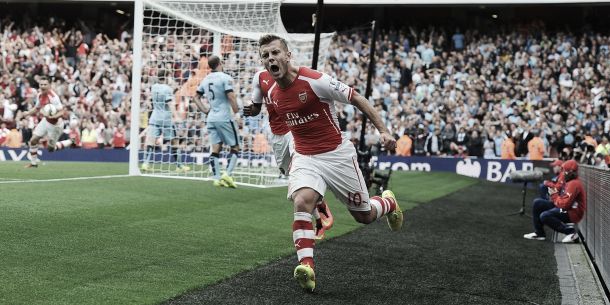

The young, dynamic English midfielder has had his 2014-2015 season blighted by injury, limiting him to only 14 appearances in the Premier League and 21 in total for Arsenal in all competitions.
Indeed, the only campaign where Jack Wilshere has remained uninjured was 2010-2011, four seasons ago. However, that is not to say that he does not remain influential both for club and country.
Roy Hodgson, the manager of the national side, sees him as key to his plans of the future and mainly as the base of a midfield diamond, where Wilshere’s willingness to get on the ball and play risqué passes other England players would not dare, will hopefully create an England side that is not just effective in possession, but also a counter-attacking machine.
Wilshere earned a total of seven caps for England this season, and would have been sure to have earned two more against Lithuania and Italy were he not injured. Man of the Match for England in European Championships qualifier victories against San Marino and Estonia, he was also considered England’s player of the match in the recent 0-0 draw against the Republic of Ireland in his first England game since his injury.
Have no doubt, this season for England, Wilshere has re-enforced his place in the team and his flexibility – Hodgson has used him as the defensive midfielder in both a 4-3-3 and 4-1-2-1-2 as well as the fact that Wilshere has also played as a more traditional centre midfielder in a 4-3-3 and as the number ‘10’ in a 4-2-3-1 for the national team – means that as long as he is fit, he will play.
Is the young midfielder as important for his club as it appears he is for country?
Wilshere started nine games in the Premier League and played a total of 732 minutes, completing 90 minutes only four times in total and scoring two goals whilst recording one assist.
The season started well for Wilshere as he was handed a start in the traditional curtain-raiser of the season; Arsenal’s Community Shield clash with Manchester City. The game ended with an emphatic 3-0 victory for the North London side and Wilshere topped of a fine performance in this pseudo-friendly with an assist. One week later, the Premier League saw its season begin and, once again, Arsene Wenger started Wilshere playing ahead of the defensive midfielder, this time Mikel Arteta, in a 4-1-4-1. In fact, Wilshere played a total of five games in August and none were from the substitutes bench.
Following a scoreless draw in Turkey in the first-leg of Arsenal’s UEFA Champions League qualifier tie with Besiktas, it was time for Besiktas to come to London. The game was tight and scrappy but it was Wilshere who set up the decisive goal, scored by the Chilean Alexis Sanchez, that ensured Arsenal’s progress to the group stages. Wilshere had started the season well and was firmly in manager's plans for the season as a central midfielder with a degree of freedom in a 4-1-4-1, a more fluid variation of the traditional 4-3-3.
Following the international break, Manchester City came to North London and Wilshere would play his best game of the season. A goal, an assist and a Man of the Match award against Pellegrini’s men would end up being the highlight performance of Wilshere’s domestic campaign.
The goal scored on that September day was particularly beautiful. The ball broke in midfield and Wilshere skipped past his man with a precise, outside-of-the-boot pass to Sanchez. The summer signing then passed the ball to Ramsey, who has his back to goal on the edge of the box. He turns and faces up to the two Manchester City men and threads a perfectly weighted pass to the on-running Wilshere, who takes the ball in to his path with the outside of his left boot. Now one-on-one with ex-Arsenal man, Clichy, Wilshere scoops the ball past the defender’s out-stretched leg and deftly dinks the ball with his weaker right foot in to the top corner, over his international team-mate, City goalkeeper Joe Hart.
Gradual decline for Jack Wilshere
The month of September would prove to be a mixed one for Wilshere. Following the fantastic performance against champions Manchester City in a 2-2 draw, Wilshere ended up starting only two more games – in the 2-0 loss against Borussia Dortmund in the group stages of the Champions League as well as the 1-1 draw in the North London Derby. A 13 minute cameo versus Aston Villa in a 3-0 victory followed but it was just that, an irrelevant cameo in an already won game.
In terms of his performances in October, they were similar to those in September minus the Manchester City game – solid if unspectacular. The month began with another 13 minute cameo, but this time against Galatasaray in the group stages of the Champions League. Wilshere was then handed a start versus champions-elect Chelsea but could not impact the game as the Blues ran out 2-0 winners; the game memorable as it was the first time ex-Arsenal captain Cesc Fabregas played against his former side. The 2-2 draw against Hull at the Emirates was another game in October that Wilshere could not play a crucial role in. Yet Wenger persisted with his number 10 and handed him a start versus Belgian champions Anderlecht. Arsenal would end up winning 2-1 and Wilshere was impressive in this encounter, linking up well with diminutive Spaniard Cazorla and his midfield partner in Ramsey as Wenger rolled out his then-favoured 4-1-4-1, with a midfield of Cazorla, Wilshere, Ramsey and Sanchez whilst Flamini provided the defensive cover.
The month of November would prove to be the turning point in Wilshere’s season with Arsenal. After an 11 minute substitute appearance against Swansea in a 2-1 loss, the 23-year-old was handed a start against fellow top four challengers, Manchester United. His game time was limited to just 55 minutes as he was taken off following an ankle injury in an otherwise forgettable game for both Wilshere and Arsenal, as Manchester United took the three points with them back to Old Trafford. Whilst the injury to his ankle was not avoidable, the subsequent six month lay-off was. It was clear to every spectator that Wilshere had suffered a blow to his ankle early in the second half but, instead of taking him off straight away, Wilshere was left on the pitch. So, what could have potentially been an injury that would cause Wilshere to miss a few weeks or a few months, instead caused him to miss half a year worth of game time.
Return from injury
Fast forward six months to May and Wilshere is finally re-introduced to the Arsenal team in a 22 minute substitute appearance versus Hull. Subbed on in a more advanced midfield position, as a wide midfielder on the right with license to drift in-wards and run at defenders, the cameo from Wilshere is one of the reasons why Wenger sees him as an attacking player rather than the more defensive, tempo-setting, Pirlo-esque midfielder Hodgson wants to have for England. It was also further evidence as to why Wilshere gets as many injuries as he does. During his substitute appearance, he picked up the ball in midfield and was constantly running at the Hull City defenders. Desperation setting in, they were diving in hoping to take the ball away and stop these attacks Wilshere was orchestrating. However, on one such occasion, Dawson mistimed his tackle and ended up clattering into Wilshere, who had originally skipped by him. It is Wilshere’s game to commit defenders and, the irony of it is, this ends up limiting his game time.
The month of May would prove to be a good one for Wilshere. Although he would only start two games, against Sunderland in a 0-0 draw that would ensure the North East side their Premier League status for at least another season and West Brom on the last game of the Premier League season in a 4-1 win, Wilshere ended up playing six games in all competitions, including the FA Cup final. Wenger took the wise decision to ease Wilshere back into the side with three substitute appearances in a row before his two starts, and it seemed to work as Wilshere looked to be back to his best.
At his best, Wilshere is an incisive, creative player who takes the opposition on and beats them through a combination of swift, precise one-touch passes and controlled dribbling. At his worst, however, the young midfielder is a tempestuous talent who spends more time running into opposition players, laying on the floor and berating the referee than concentrating on his own game.
The goal on the last day of the season was evidence of the instinctive quality Wilshere possesses. That strike against West Brom, voted goal of the season in a Match Of The Day poll, the second time in a row Wilshere has won such an award following the perfection-incarnate team goal scored versus Norwich last season, was a superb half-volley into the top corner.
Mesut Ozil whipped a corner in that fell to the feet of Alexis Sanchez. The Chilean faced up to Joleon Lescott and tried to dig out a shot that is deflected to the path of January acquisition, Gabriel. The Brazilian centre-back took an awkward touch but with his second managed to flick the ball to Wilshere, who was stationed on the edge of the box. Wilshere caught the ball as it just sat up following a bounce and lashed a left footed strike into the near post of Boaz Myhill’s goal. The strike, controlled in its ferocity, was constantly rising from the boot of the Englishman and flew right into the top corner, leaving Myhill diving in its wake. Had the Emirates’ net not been there, the ball looked set to continue rising all the way out the stadium and into the residential areas. McManaman shook his head in disbelief as Wilshere was mobbed by his team-mates, who celebrated with the goal scorer, who did not seem to believe it himself.
To describe Wilshere’s 2014-2015 campaign, frustrating. What began with such promise was ultimately cut short through injury, a familiar comment on the majority of Jack Wilshere’s seasons so far. Arsenal fans worldwide must be hoping that his overall career does not follow suit. At the age of 23, Wilshere needs a season that remains uninterrupted by injury to prove to his doubters that he can perform at the level that was expected of him when he burst onto the scene against Barcelona. He has time on his hands but also requires some luck to remain free from injury, although an adaptation in his game could be necessary as a preventative measure. Capable of the extraordinary, Wilshere has to keep fit for the majority of next season or at the latest, the season after or else could end up falling into the category of potential-English-world-beaters-who-never-were.
