


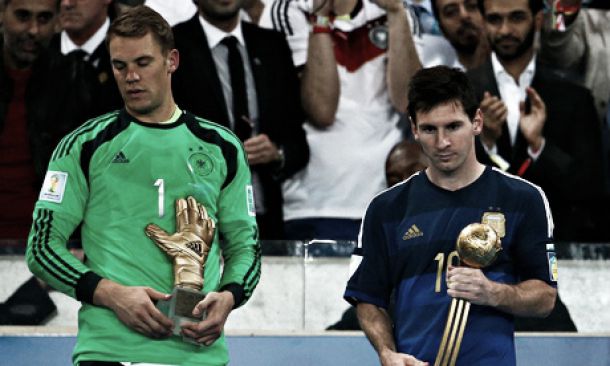
The World Cup was expected to be the stage for Lionel Messi to really prove himself on the international stage, finally gaining plaudits and seeing the population of Argentina compare him to their own World Cup great Diego Maradona. His side were unable to topple Germany, as a 112th minute strike from Mario Götze was enough for Die Mannschaft to bring the World Cup to the nation for the first time since 1990 and the first as Germany (previous three won as West Germany). Despite this, Messi picked up the Golden Ball award, but was the Argentine forward less deserving of the award than others?
There are many statistics that would justify Messi collecting the award. The FC Barcelona striker won four man of the match awards and was explosive in the group stages, scoring in each of the three games, including a brace against Nigeria and a very late winner against Iran. Messi's performances were less exciting in the knockouts, although he did register an assist in the round of 16, setting up Ángel di Maria's 118th minute winner against Switzerland. He also scored Argentina's first penalty in their semi-final penalty shoot-out victory over the Netherlands, but was a hidden figure in the final, some glimpses of quality showing. He missed a fantastic opportunity to put his nation into the lead in the final at the start of the second half also, and managed just 66 touches on the ball throughout the 120 minutes. By contrast, all German outfield players that played at least 90 minutes had more touches on the ball.

One player that shone at the World Cup was Colombia and AS Monaco midfielder James Rodríguez. Rodríguez contributed to eight of Colombia's 12 goals at the World Cup, scoring six (winning the Golden Boot in the process) and assisting another two. Despite playing less games than Messi at the tournament (four starts compared to Messi's seven), he scored and assisted more goals for his team as Colombia eased through the group stages and made it to the quarter-finals, where they were narrowly beaten by Brazil. The moment of his World Cup was undoubtedly his fabulous second goal against Uruguay, chesting the ball down before hitting a half-volley from a full 30 yards. Such form has begun rumours of a mega money move to Spanish giants Real Madrid, who are reportedly willing to pay up to €90million to Monaco to sign the player.

Another player who many fans saw as more deserving was Germany's Thomas Müller. The midfielder, who played a number of games in the centre forward role for Germany, scored five goals in total, setting up another three. His outstanding performance against Portugal in the opening game, marred by what some called 'play-acting' to get Pepe sent off, a hat-trick sealed a 4-0 win and the start of a World Cup winning tournament. He was also one of the star players in the 7-1 annihilation of Brazil in the semi-final, scoring the first and setting up another. Before the introduction of James Rodríguez into the tournament, Müller was fully expected to become the first player to ever win consecutive Golden Boot awards at World Cups, and fell just one goal short of his target.
"Messi? I would give him heaven if possible, but it’s not right when someone wins something that he shouldn’t have won just because of some marketing plan."
Football fans came out in their numbers to criticise the giving of the award to Messi, with his and Argentina's idol Diego Maradona slamming FIFA for what he thought was an undeserving award, seen as a marketing ploy by football's governing body. Other former World Cup stars also voiced their opinions about the direction of the award, Gary Lineker and Rio Ferdinand both agreeing that Messi couldn't replicate his Barcelona form for Argentina, and despite peforming well, he wasn't able to do it consistently like other players.
It may not have totally been the World Cup that Messi and Argentina were hoping for, going home with one award, but not the right one. Despite this being his third World Cup, at 26, Messi still has the 2018 World Cup in Russia to look forward to, and possibly the 2022 World Cup, when he will be approaching 35 years of age. Is it too late for Messi to write himself into a massive part of Argentina history?
(All statistics via whoscored.com, quotes from BBC Sport/Guardian)
