


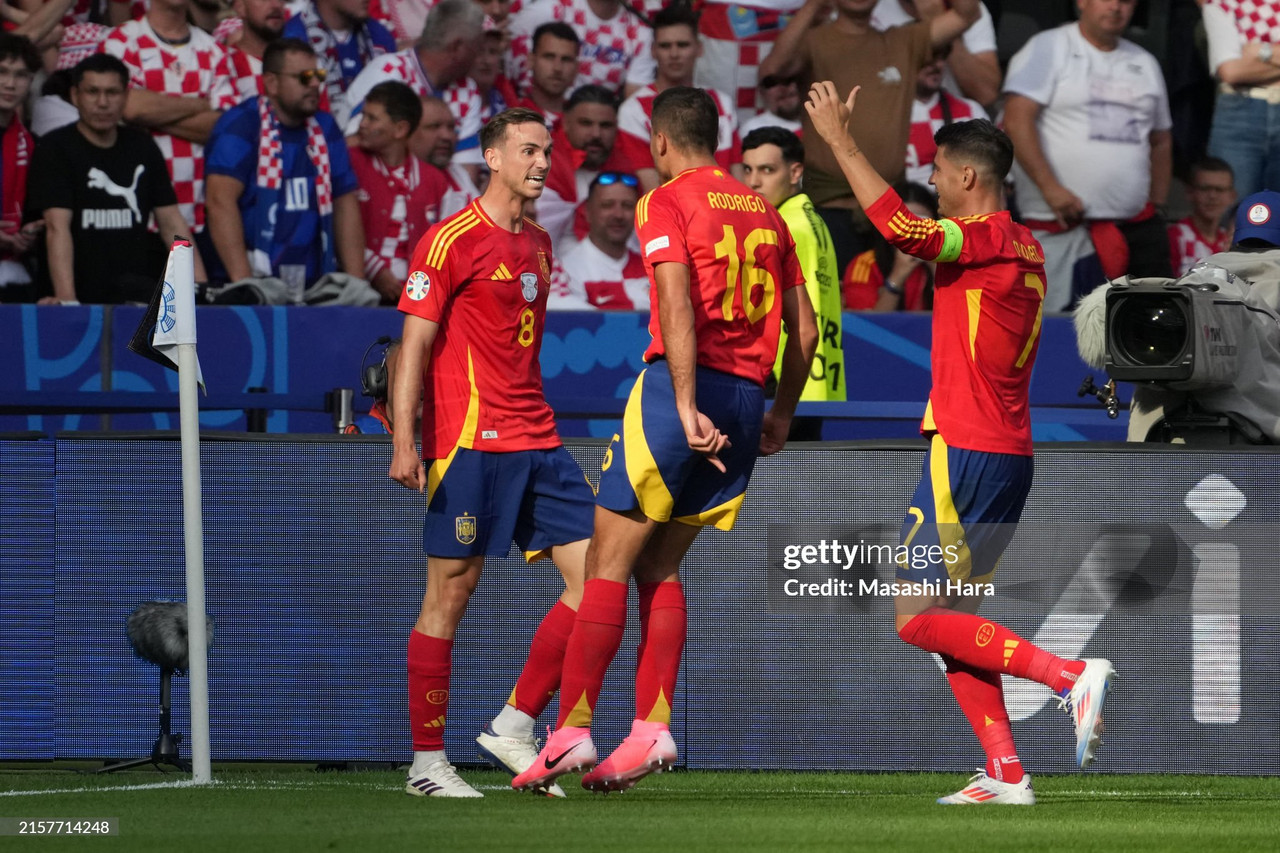

The action in Group B kicked off on Saturday, Luis de la Fuente’s Spain facing Croatia. Whilst Zlatko Dalić’s side have often been complimented for their defensive stability, the Spaniards blew them away in a first half demolition.
Goals from Álvaro Morata, Fabián Ruiz and Dani Carvajal stormed La Roja to a 3-0 halftime lead. Croatia’s aim was evidently damage limitation as they eye up a strong third place finish, successful in that aspect as they kept the Spaniards out in a closely fought second half.
A late penalty offered the chance for a Croatian consolation, but Bruno Petković’s strike was saved well by Unai Simón, the rebound converted but swiftly ruled out for encroachment.
-
Spain are deadly in all areas
De La Fuente’s side were not spoken about as favourites for this tournament prior to the action kicking off, however their performance in this game may well have put their names on the list of potential UEFA Euro 2024 Champions.
The most promising note for the Spanish faithful is that their goals have come from all areas of the pitch. The quality that each and every player possesses results in chances not only being created, but also converted with deadly proficiency.
The skill on show from Ruiz as he slalomed his way beyond three oncoming Croatian defenders before dispatching a precise finish into the bottom corner.
Carvajal wanted in on the act, and as he did in the Champions League final, he scored the result deciding goal.
Add to this the youthful talent of Lamine Yamal, Pedri and Nico Williams JR, and Spain suddenly stands out as a team to be frightened of.
-
Croatia lack threat
Mario Mandžkić, Davor Šuker and Andrej Kramarić. Croatia have often had exemplary talent in the number nine position. Whilst the latter started against Spain, the 32-year-old is merely a shadow of his former self.
It was clear from the moment the game kicked off that Vatreni were going to have a torrid time when it came to converting chances. Ante Budimir may be an effective La Liga striker, scoring 17 goals in the season just gone, but he struggled desperately to hold the ball up and interlink with his teammates.
Despite the promise provided by Wolfsburg’s Lovro Majer, almost every opening went amiss. When they were able to get shots off on goal, the strikes were often tame, or from a distance unlikely to cause Simón any real stress.
Croatia created sixteen shooting chances, only five finding the target. Spain amassed the same number, despite having five shots less than their counterparts. This further demonstrates the lack of a clinical finisher in Dalić’s squad, potentially an issue which could further harm them in their remaining group games.
-
Spain have incredible quality in depth
La Roja’s squad boasts a strong claim for one of the best squads in the tournament. The luxury provided to De La Fuente as he turns to his bench to see an array of experience and talent alike is one every manager craves.
For example, England have been left with little options in defence, especially in the left-back position where Gareth Southgate will likely play someone out of position in the opening game. Spain have two quality options in this area, with Marc Cucurella and Álejandro Grimaldo fighting for a starting position. One of those is the most expensive full-back of all time, and the other is coming off the back of an invincible title win with Bayer Leverkusen.
Dani Olmo, Mikel Merino and his namesake Oyarzabal were just three of the five bodies introduced to impact the game, not to mention the talent of young players such as Fermine López and Alejandro Baena that went unused.
The option of rotation, and quality in that rotation is one which has seen numerous international sides thrive in tournament football. Spain have that option in abundance. They are going to be a frightening opposition for whoever they face throughout the remainder of their campaign.
-
Croatia lack energy
An ageing side, there was an overwhelming question mark over Croatia as fans across the continent plotted their predictions for this Summer’s tournament.
Whilst they started well in this game, moving the ball with pace and accuracy, as play developed Dalić’s side began to fall short to second balls, reacting slowly and failing to contain the Spanish tiki-taka football.
Despite ending the game marginally ahead on the possession statistic, little threat was created, with a lack of positive forward runs resulting in midfielder Mateo Kovačić taking matters into his own hands as he attempted to drive his team up the pitch, to little fruition it must be said.
Croatia didn’t seem to amass incredible chances, yet finished the game with superior expected goals to their opponents, which demonstrates the clinical finishing on show from De La Fuente’s side.
