


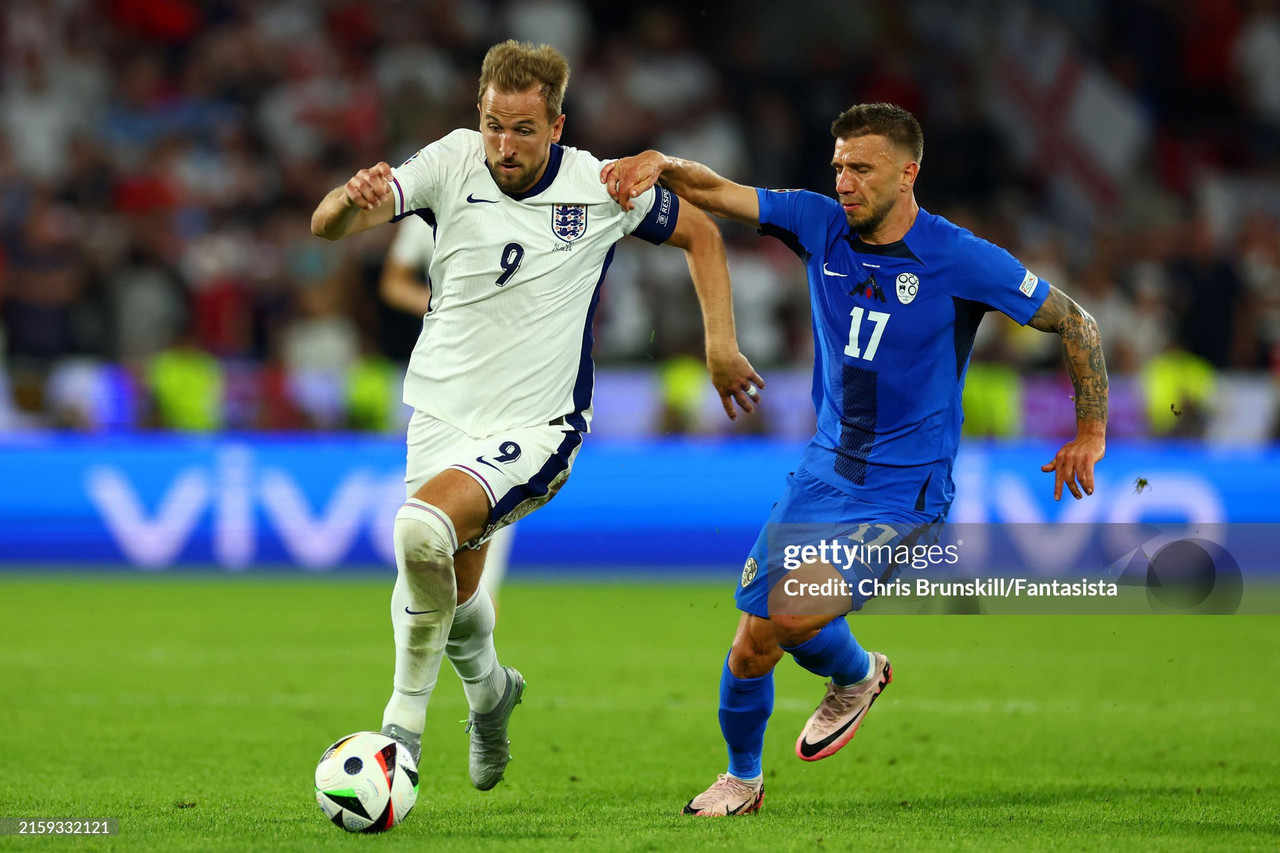

A poor game saw England top the group, with Denmark and Slovenia ultimately qualifying alongside them, but the game left more questions than answers.
The opening minutes flattered to deceive as Southgate’s side looked energetic and took control of possession. However, this proved futile and ultimately sterile as the Three Lions were able to create very few meaningful chances throughout the 90 minutes.
Group C finished up with more of a whimper than a shout, so did we learn anything from the match-up?
-
The media discussion seemed to have a positive effect
It was very noticeable in the opening stages that England – ‘triggered’ by Harry Kane’s determination, pressed more than they had previously in the tournament. The inclusion of Gallagher also suggested a desire for energy and a more assertive approach.
The key pressing metric – passes per defensive action – showed Southgate’s side had offered one of the lowest pressure rates for any team in the tournament in their previous match against Denmark, on this measure at least the match against Slovenia showed a marked improvement. It helped this game was in the evening compared to the late afternoon heat against Denmark.
This game also demonstrated why Kane ‘dropping deep’ is not itself a problem – provided the other attacking players are prepared to run beyond him – maximising the Bayern man’s elite passing and playmaking ability.
At different points in the game, Jude Bellingham and Phil Foden both made such runs and with slightly better timing could have scored.
-
Slovenia will need to offer more to pose a challenge in the last 16
Matjaž Kek set up his team to hold a rigid defence shape - believing a draw would be enough to qualify in third place. He was right and was only a couple of fouls away from finishing second.
Possession statistics don’t always tell the whole story (just ask Spain) but tonight they were a sign of how little Kek’s outfit offered in attack. 24% possession even flatters his side.
An adjustment to allow more counter-attacking options would pose a real threat. Many teams aspire to such a pragmatic approach, but few carry it out with the level of discipline on show tonight.
If they can carve out a few more opportunities to get attacking players running onto the ball they could be a danger to more fancied teams. Add in a world-class goalkeeper in Jan Oblak and an extremely quicksilver attacker in Benjamin Sesko, you have a Diego Simeone-inspired dream in the making.
-
Southgate has diagnosed the problem but not the solution
Whatever you think of Gareth Southgate’s approach, he has identified the key problem with this iteration of the national team. How to find the balance in midfield between progressing the ball and providing sufficient defensive stability?
The willingness to start Conor Gallagher for this game, and effectively dispense with the Trent Alexander–Arnold experiment demonstrated that, however ruthless it may have seemed to the Liverpool fullback.
Yet switching Gallagher with Kobbie Mainoo at half-time showed that Gallagher wasn’t the right answer either.
Mainoo looked promising, in particular, linking play well and offering quicker movement and progression of the ball, surely he will now keep his place for the next game. The question is how many others should?
For the first time, we saw a wider array of the England squad get onto the pitch, bringing energy and dynamism that had been missing for much of the match, if not the tournament. Alexander-Arnold looked more comfortable in his natural position and Cole Palmer was brimming with attacking intent. Sadly, Anthony Gordon did not get more than a few minutes to show what he could bring. Hopefully, he gets further chances.
-
Slovenia's celebrations show the tournament continues to offer hope to the smaller nations
The celebrations at full time were merited, for they marked the first time Slovenia had reached the knockout stage of a major tournament – at the fourth time of asking.
Walking in the footsteps of Wales and Iceland in 2016, and their southern neighbour Croatia; Slovenia have shown it's possible to compete even as a ‘smaller’ nation.
To put things in perspective Slovenia’s population (just over two million) is less than half the size of Scotland and their domestic teams have never progressed beyond the Champions League group stages.
So, while many English fans are bemoaning their pedestrian efforts, cheers to Slovenia for making history.
