


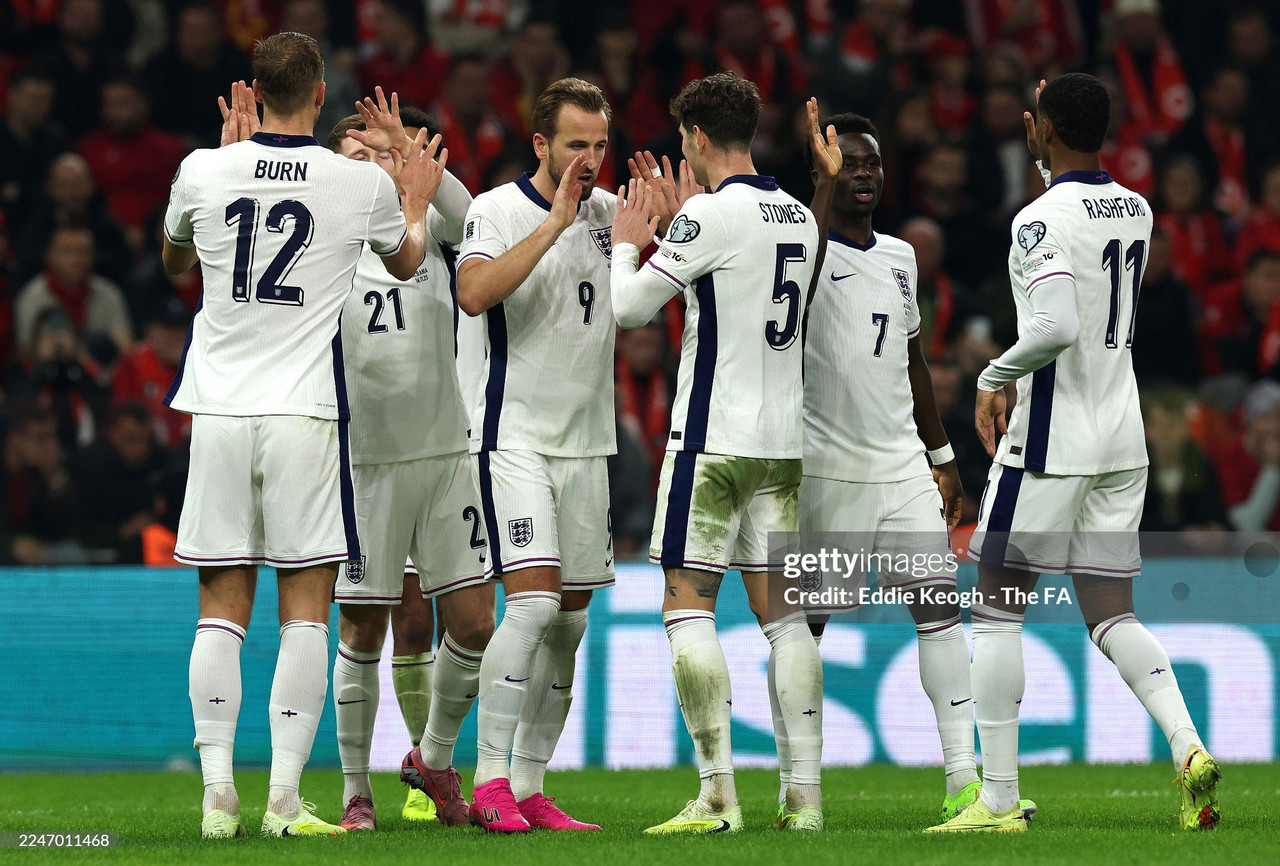

Harry Kane’s second-half double saw England seal a hard-fought 2-0 victory over Albania and complete their qualifying campaign for the 2026 World Cup with a 100% record on Sunday.
An evening of insightful variation and potentially useful difficulty saw Thomas Tuchel make seven changes to the team that started Thursday’s 2-0 Wembley success against Serbia.
The hosts, managed by former Brazil, Arsenal and Manchester City left-back Sylvinho, offered a genuine threat for considerable portions of the contest at the Air Albania Stadium, before Kane’s 74th and 82nd-minute conversions took the game away from them.
As well as winning all eight of their matches in UEFA Group K, Tuchel’s side – whose 5-0 victory over Latvia in Riga last month secured their place at next summer’s tournament in Canada, Mexico and the USA – kept clean sheets in every game.
22 scored and none conceded makes for impressive reading. A regular, and understandable, caveat applied to such statistics in recent weeks and months has been the contrast in level between the Three Lions and their opponents. Albania, Serbia, Latvia and Andorra have, granted, posed them limited problems.
The former, though, who sealed second place in the group and a play-off spot on Thursday, did offer the visitors their sternest test of the campaign on Sunday, and much of the relative serenity of the path to North America can be attributed to the diligence, efficiency and quality with which England have controlled their controllables.
Securing qualification, and doing so in such style, shouldn’t be underappreciated, particularly given the emotional and experiential significance that can come with competing in such tournaments.
With the draw for the World Cup on Friday, 5th December, a little over four months until England’s next matches, in late March, and under seven months until the squad is named and the tournament kicks off, there is plenty to consider off the back of Sunday’s game.
-
England’s quality promisingly decisive
Within the most testing outing of their qualifying campaign, it was pleasing to see England’s unique ability levels come to the fore to break open the contest.
Albania arguably should have gone in front earlier in the second half, when the dangerous Arbër Hoxha sent a presentable opening from 18 yards into the gloves of Dean Henderson, having forced a good diving save out of the Crystal Palace goalkeeper moments previously.
Elseid Hysaj had curled just over from range for the hosts in the 18th minute, too, although Jarrod Bowen, Jarell Quansah, Eberechi Eze, Jude Bellingham, and substitute Bukayo Saka had also come close going the other way.
This was a game that felt more evenly poised than any of the Three Lions’ previous Group K clashes. While there was less riding on this one in terms of broader results-based consequences, the highly charged atmosphere and level of the match-up gave the goals an additional sweetness when they came about.
Tuchel referenced post-match that there are potential benefits to things not going smoothly, and having had to navigate some choppier waters, Kane’s two goals demonstrated the capacity the captain and his teammates have to decide matches in virtually the blink of an eye.
The Bayern Munich striker’s opener wasn’t necessarily the most stylish, but it shone a light on the poaching instincts that are within the 32-year-old’s famously broad skill set. He arrived right on time in the six-yard box to beat home goalkeeper Thomas Strakosha to Saka’s deflected inswinging corner and divert it home right-footed.
His second eight minutes later represented a clearer display of just how eye-catching and impactful that aforementioned quality can be. Marcus Rashford, only seven minutes after joining the action, utilised the room he was afforded on the left flank by delivering the most inviting of crosses.
It dipped and curled right onto the forehead of the skipper, who nodded it back across Strakosha and into the bottom-left corner with familiar efficiency. 78 England goals in 112 caps now. That’s one more than Pelé registered for Brazil. Not bad going.
2026 looks an exciting one for Kane and his colleagues collectively, first and foremost, but it could well prove a year of further individual landmarks for the Three Lions’ leading goalscorer. A strong World Cup and clean bill of health may see him also become England’s leading men’s appearance-maker before 2027 arrives.
Having received some criticism, perhaps harshly, for his showing on Thursday, this felt like a welcome moment for Rashford, too. He, Anthony Gordon and Eze look among the strongest contenders for the left-wing role, at present.
This contribution showcased the explosive ball-striking capacity that arguably acts as a unique selling point for the 28-year-old currently enjoying a productive season at Barcelona, on loan from Manchester United.
That range of options, both in terms of personnel and approach, is another crucial tool for Tuchel when it comes to platforming the substantial qualities within the England set-up and finding routes to success.
-
John Stones exemplifies invaluable flexibility
This was also an evening that further demonstrated the wide variety of approaches that the German head coach could take.
The structure implemented by Tuchel in recent months has been a notable source of positivity, with it providing clarity, continuity, balance and a healthy level of flexibility from game to game. Generally perceived as a 4-2-3-1 or 4-3-3 on paper, it often morphs into a 4-4-2 or 4-2-4 out of possession and something akin to 3-2-5 or 2-3-5 as attacks progress.
Numbers only ever tell part of the story, of course. Sunday, anyway, saw perhaps the most interesting development yet, as John Stones often stepped up from centre-back and into central midfield when England had the ball.
That saw him persistently take up positions alongside, or at times move beyond, full-debutant Adam Wharton, who was stationed at the base of a midfield that also included Declan Rice and Bellingham.
That meant the in-possession structure often looked something like 3-2-5 again, just via a different route. Debutant Quansah, Dan Burn and Nico O’Reilly tucked in to make a back-three behind Stones and Wharton, while Bowen, Bellingham, Rice and Eze supported Kane.
It is a role that Stones has operated in for Pep Guardiola at Manchester City as recently as earlier this season but also, perhaps most famously and effectively, during the latter stages of their treble-winning 2022/23 campaign.
A relatively bitty first-half showing by Tuchel’s side reflected its limited impact in Tirana, with the intention seemingly being to boost midfield numbers and enhance Rice and Bellingham’s licence to advance, but the former did pop up in some threatening zones, while there were hints of the overloads and structural solidity such an approach can provide.
The tactic was shelved for the second half, but it was another sign of the unique capacities of different players within the squad being utilised. This is just the kind of malleability that can keep opponents guessing.
Reece James, Trent Alexander-Arnold, Myles Lewis-Skelly and O’Reilly are all full-backs recently fielded by England who can invert into central midfield, too. That consistent structure, occupied by players who can play various roles, could prove an immensely solid, yet unpredictable, and ultimately fruitful, combination – particularly in tournament football.
Another alteration after the break, which saw Tuchel tweak the structure to accommodate Bellingham and the newly introduced Foden as dual No.10s behind Kane, due to a double-pivot not being required from a defensive standpoint, was similarly intriguing.
-
Jude Bellingham discussion requires balance
Bellingham’s reported displeasure at being substituted in the aftermath of the second goal garnered a fair amount of post-match attention.
He appeared calm on TV coverage as he approached the touchline to make way for Morgan Rogers, although certain photos – seemingly taken a few seconds earlier – do support reports that he initially raised his arms in frustration upon realising he would be making way. There are also images showing teammates Burn, Foden and Kane interacting with the Real Madrid midfielder as he made his way off.
Bellingham was already on a booking, meaning a second yellow would have seen him suspended for England’s first game at the World Cup, and he and Rogers look closely matched in their pursuit of the team’s No.10 role – it was a logical move from Tuchel, in many ways. As the head coach subsequently pointed out, though, it is rare that any player wants to come off.
The head coach was asked about Bellingham’s initial reaction several times in the post-match press conference, as well as whether it contrasted with the culture he is looking to create. Having explained that he didn’t see said reaction, Tuchel stated that he would review it, as well as saying that "I don't want to make it bigger, at the moment, than it is" and emphasising the importance of a strong culture.
Considered scrutiny of the 22-year-old’s attitude and his impact on the culture is understandable and potentially healthy, in many ways. Fixation on such actions and perceived issues, though, is not.
The optics around such behaviour, however brief, don’t tend to be great, but players not wanting to come off is often viewed as a net positive. A more measured response would have been preferable, but, needless to say, emotions won’t always be contained – especially on a football pitch.
This isn’t the first time Bellingham’s body language has drawn criticism, but that expressiveness often manifests itself positively and tends to feel like a reflection of his desire to drive high standards for himself and those around him.
If such actions were reflective of a broader corrosive influence, that would, of course, be problematic – and additionally worthy of focus – but there appears little evidence of that.
Bellingham’s display in Tirana wasn’t necessarily one of his best, despite winning Player of the Match. He was loose in possession, at times, but that was persistently offset by his notable efforts to win it back.
He has been, and is capable of continuing to be, a genuine figurehead for England. That, needless to say, comes with responsibility and mustn’t be to the detriment of those around him, yet it remains important that room for expression, within reason, is granted.
Microanalysis and critique of a high-profile player’s on-field actions isn’t anything new and, to a certain extent, is unavoidable. It genuinely represents a form of compliment, at times. It doesn’t feel unreasonable to suggest, though, that such coverage can, in itself, swiftly become corrosive if it lacks balance and perspective.
In a sense, this is an area where the four-month interlude between England camps could prove helpful.
-
Thomas Tuchel’s welcome problems
The context for the England boss, then, is interesting on several levels as club football enters into that uninterrupted four-month run.
Plenty can change in that time, of course. Form, injuries, various managers’ team selections – they are all likely to play a part in who Tuchel calls up for the March camp. By then, the World Cup will be less than 90 days away.
There looks set to be plenty of difficult decisions to make both at that stage and come the summer. There is seemingly a sense that, at present, Jordan Pickford, Reece James, Stones, Marc Guéhi, Elliot Anderson, Rice, Saka and Kane each have a good hold on starting spots in England’s strongest line-up. Left-back, the No.10 role and left wing appear to be the positions of most debate, meanwhile.
O’Reilly has staked a good claim at left-back in this most recent camp – playing every minute and looking similarly assured to his recent Manchester City showings.
Lewis-Skelly, Djed Spence and Tino Livramento have also impressed for the Three Lions in that role recently, though. The likes of Newcastle United’s Lewis Hall could begin to knock on the door with consistent game time, too, and a Luke Shaw return may not be beyond the realms of possibility, either.
Rogers and Bellingham look best placed to compete for that No.10 position. The former was among the standout performers in the role during the September and October camps when Bellingham was absent firstly due to his ongoing recovery from shoulder surgery and then due to a subsequent lack of rhythm. The latter has, however, often been a driving force and a deliverer of big moments for England in recent years.
There’s a good case for both, while Foden, Cole Palmer, Eze and Morgan Gibbs-White are also strong options in that region.
The competition for the left-wing role, meanwhile, appears to be between Rashford and Gordon. Rashford displayed his quality with that delivery for Kane on Sunday, but Gordon, who pulled out of the November camp through injury, appeared to be Tuchel’s first pick earlier in the autumn. His off-ball qualities, in particular, appear to be highly valued by the German.
Eze, who scored that brilliant second against Serbia, represents an option there, as well, while Bowen briefly occupied the role in the second half on Sunday, and Noni Madueke has impressed in the position under Tuchel, too.
There look to be a genuinely healthy range of options for Tuchel across virtually every area of the pitch. FIFA are yet to confirm whether the maximum squad size for the tournament will be 23 players or, as appears most likely, 26. Either way, there will almost inevitably be some tough conversations, come the summer, but that bodes well for the Three Lions as a collective.
Such depth and breadth of quality is one of the main reasons why England look set to be among the favourites in North America. That brings its own pressures, but, as Kane said while speaking to ITV post-match, that’s something to embrace and, significantly, also a level of expectation that has become increasingly familiar for the Three Lions over recent tournaments.
England, at least to an extent, will know who will be in their group by early next month. The draw for the tournament is set to take place at the Kennedy Centre, Washington, DC, on 5th December. 42 of the 48 competing nations will be known by then, with the remainder to be confirmed in March’s intercontinental and European play-offs.
So, opponents, locations, and dates of games will, at least to an extent, be there on paper for Tuchel and Co within a few weeks. That ought to be one source of clarity within a spell where many of those involved in the international game will likely be doing a fair bit of waiting, watching and weighing up.
