


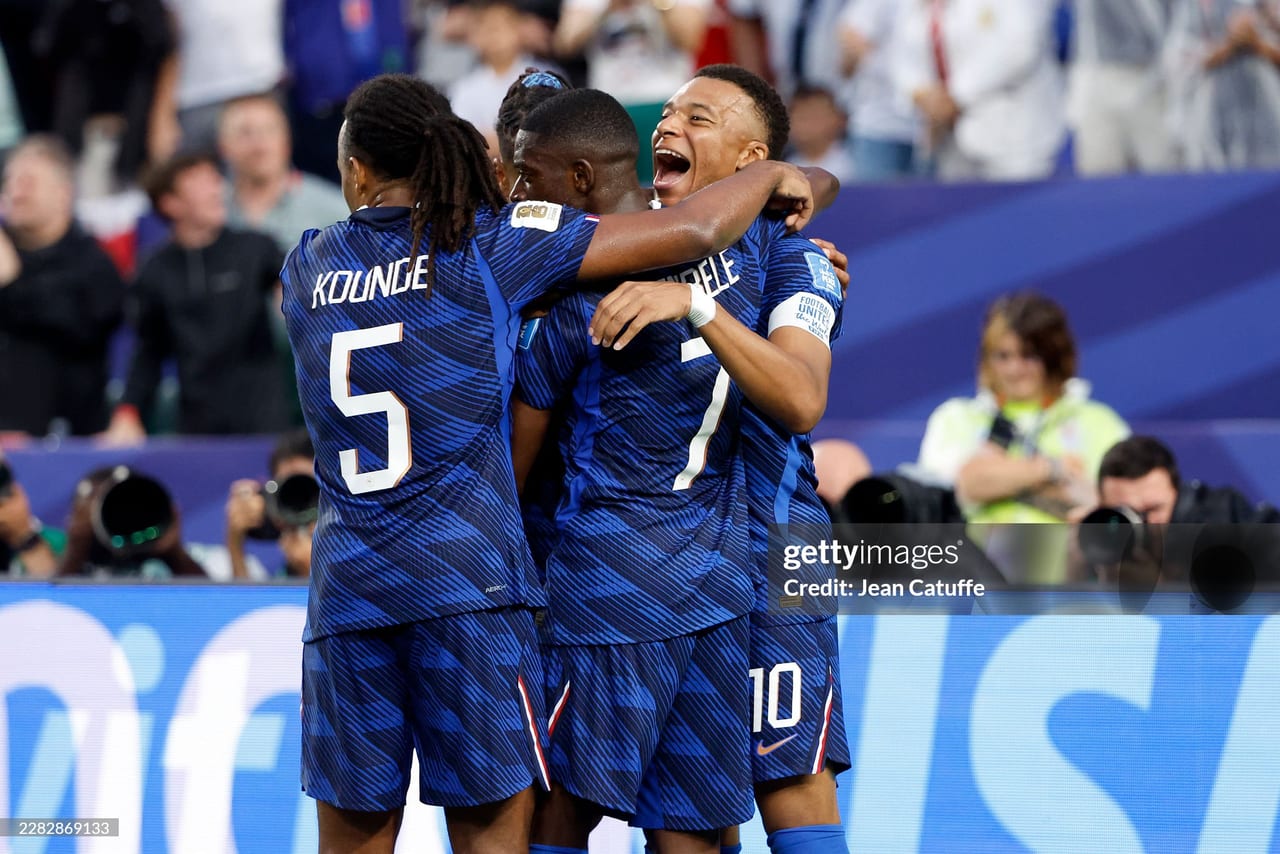

France expectedly brushed aside Iraq at a canter. A defence-against-attack scenario is not always straightforward to negotiate, regardless of the gulf in class.
Through rotation and verticality, France didn’t necessarily need loads of prolonged possession to breach the Iraq defence. This approach paid dividends as Mbappe’s prolific streak in front of goal continued.
France’s blueprint for overcoming low blocks
France may not always be the side to feast on prolonged possession, but this is a fruitful choice to break down sitting defences.
Their plethora of talent facilitates their proficiency in attacking areas, and they can stretch defences with athleticism and a lack of hesitation.
Mbappe’s opening goal came from a driven left-footed shot from outside the area, after initially combining on the right wing with his sights set on finishing swiftly.
You got the sense of his constant threat, and this was a man on a mission to keep pace with the goal tally of Lionel Messi, who broke Miroslav Klose’s goalscoring record at World Cups in Argentina’s win earlier in the day against Austria.
Over two hours of waiting dragged before the second half got underway due to adverse weather conditions, but that didn’t stop Didier Deschamps’ side picking up from where they left off in Philadelphia.
Zaid Tahseen misplaced his pass to goalkeeper Ahmed Basil Fadhil and France were gifted their second.
Ousmane Dembele teed up Mbappe to complete his brace in the 54th minute and tie Klose’s record on his 100th appearance for Les Bleus.
Ballon d’Or winner Dembele did get in on the act to add the gloss when he took Michael Olise’s pass into his stride and found the bottom corner with his right foot. His first goal at an international major tournament.
A common thread in France’s advances beyond the Iraq back line, who were willing to soak up the pressure, was their first thought to look forward.
This avoided recycling the ball in front of Iraq and lacking penetration.
The trade-off for not always keeping the ball is that they embrace risks to conjure opportunities that are more likely to be converted. France registered 56% possession across the match.
In the first half of their opening game against Senegal, much of their combinations were not fluid, and players were not on the same wavelength.
This has now become starkly different in their hopes of a third straight World Cup final and an ominous sight for their rivals looking to lift the trophy.
Comfortable in rotating and defending
Dembele switched out to the wing for this affair as Olise dictated from a central area for the majority of proceedings.
However, there was very little rigidity. Instead, there was freedom to puzzle the opposition by swapping positions and drifting across the front line.
Striker Mbappe often peeled out wide to receive the ball and chose to catalyse the attacks from there, credited to the instructions from those in the dugout as well as how comfortable these players are in so many different areas.
Against Iraq, France’s stars were not getting in each other’s way, which bodes well for their performances going forwards.
In PSG’s Bradley Barcola and Dembele especially, Deschamps has two dependable wingers who are also eager to track back at pace to support their full-back and retrieve the ball.
France’s defensive resolve will be taken away from the limelight, despite reducing Iraq to just four shots, and two capable centre-backs seemed crucial to protect the clean sheet.
If they feel their fortitude has yet to be truly tested, their last group game against Norway will provide the best opportunity to lay down a marker of their strengths in defence.
This will be a shootout for the top spot of Group I on Friday in Boston, where the race for the World Cup’s golden boot will heat up, too. Erling Haaland and Mbappe will face off.
