


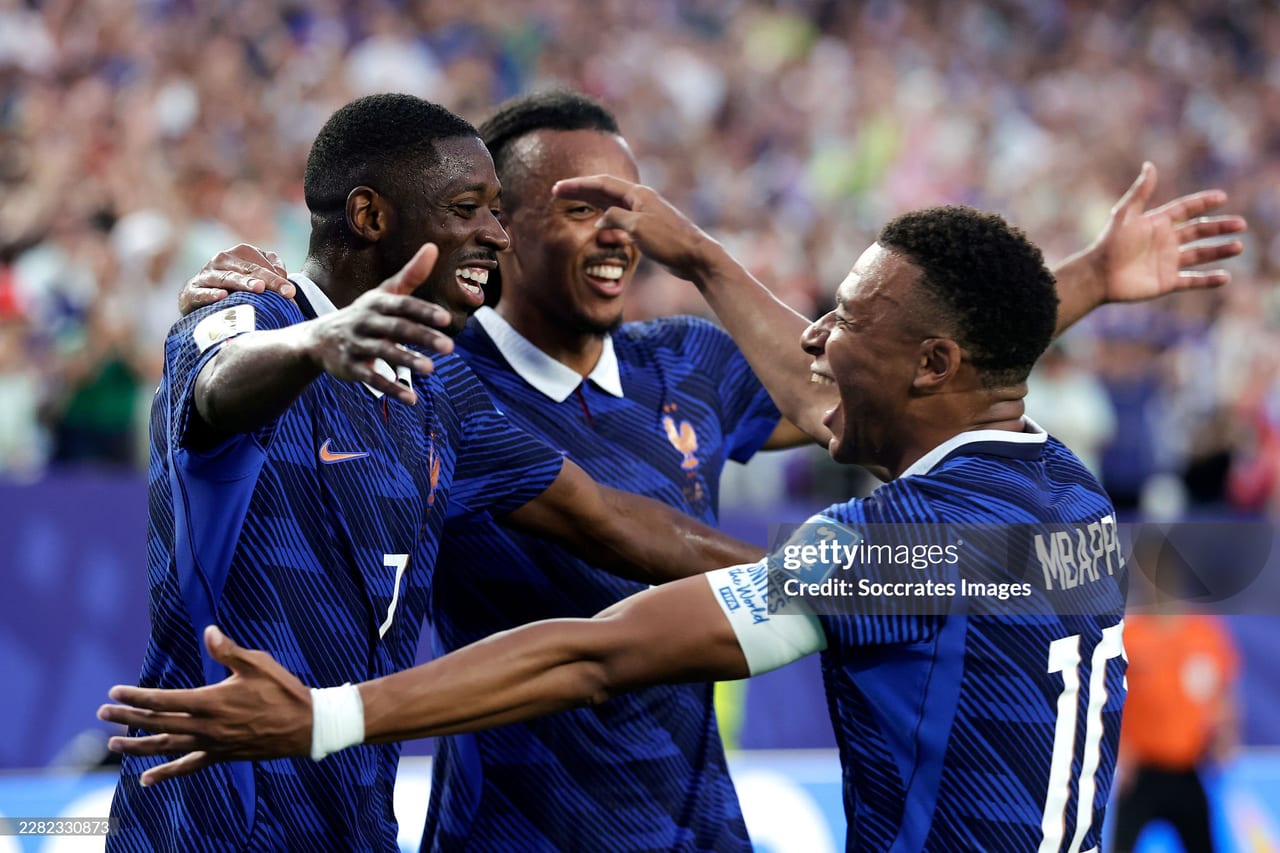

France put on another dominant display as they breezed past Iraq to secure their qualification in the World Cup's round of 32.
It was a disciplined performance from Didier Deschamps' men, who took an early lead courtesy of a thundering strike from Kylian Mbappe, the Frenchman hot on the heels of Lionel Messi as the duo battle it out for the honour of being the competition's all-time top scorer.
The French were relentless in attack and threatened every time they had the ball. The only thing that gave Graham Arnold's men some respite was when a thunderstorm led to the game being suspended for more than two hours.
However, after the restart, the 2018 World Cup winners picked up where they left off, with Mbappe adding a second before Ousmane Dembélé grabbed his first goal in a major tournament to seal all three points.
Dembélé: The glue to France's attack
Despite Mbappe grabbing all the headlines, and rightly so, the last two games have made it apparent that the success and fluidity of France's attack will depend heavily on Dembélé's role.
The Ballon d'Or winner has been used to lead the attack at club level for PSG; however, in the national team, Mbappe is still Deschamps' main man, with Dembele being deployed in a number 10 role.
The PSG forward was ineffective in that role in France's warm-up game against Northern Ireland and in their opener against Senegal, in which he had the fewest touches of any player, aside from Mbappe.
Against Senegal, the French attack struggled in the opening half, barely creating a meaningful chance as Dembélé looked awkward adapting to his position.
Deschamps fixed the issue in that game by moving Michael Olise to the centre of the pitch, with Dembélé forced out to the wing.
After the PSG star drew criticism following his performance, Mbappe was quick to defend his teammate, calling him "the best attacker of the four," and reiterating that he had the confidence of the whole team.
The game against Iraq was another chance for the Ballon d'Or holder to try and adapt to his new role and repay that confidence, and this time around, he passed with flying colours.
Dembélé's movement between the lines stretched the Iraqi defence, making it easier for Mbappe to find space for menacing runs, and his relentless pressing led to France winning the ball multiple times high up the pitch, with the second goal of the game coming as a result of the Parisian's quick reaction to a misplaced pass.
The 29-year-old then went on to score the third goal, which was yet another example of how important his movement is to the French attack. Finding space between the defenders, he received the ball on the half-turn before lashing past Ahmed Basil in goal.
It was the first time in the tournament that he looked completely comfortable in his role, and France looked better as a result. The fluidity between Mbappe, Olise and Dembélé proved too much for the opposition to deal with, and it will only get better with every match.
With Dembélé finally looking at ease, the French attack is firing on all cylinders, and it could spell disaster for the rest of the competition.
